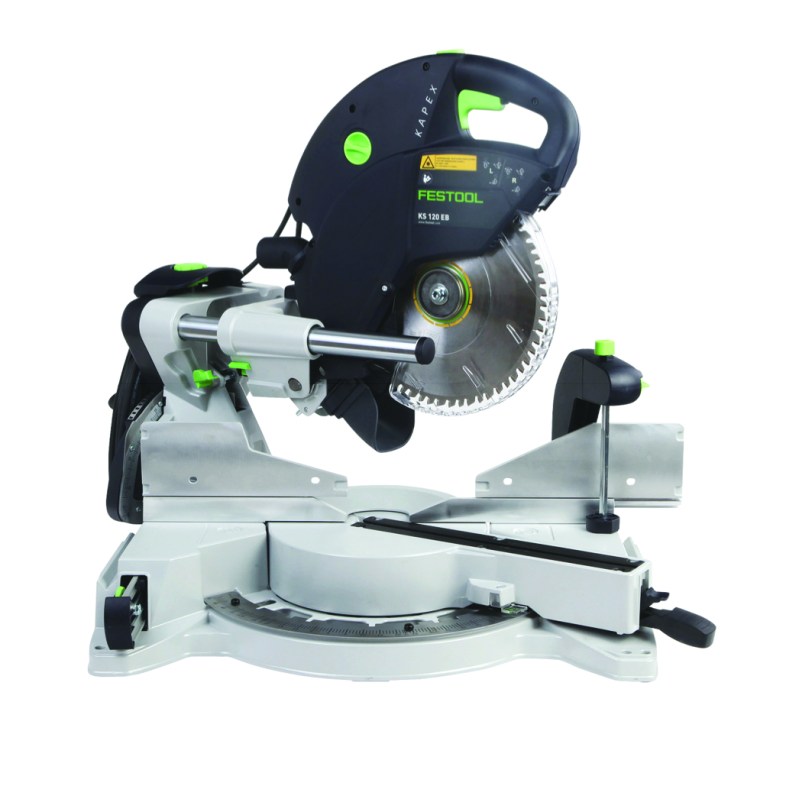
Motor: 13 amp; direct drive; soft start; blade brake; variable speed: 1,400–3,400 rpm
Miter angle: 50° left to 60° right; stops at 15°, 22.5°, 30°, 45°; no detent override
Bevel angle: 47° left to 47° right; no detents; counterbalanced micro-adjustment knob
Horizontal cut width at 3/4 in.: 12 3/16 in. at 90°; 8 3/4 in. at 45°
Horizontal cut depth: 3 5/8 in.
Vertical cut height at ¾ in.: 4 5/8-in. through cut at 90° and at 45° (specs say 4 3/4 in.)
Nested crown capacity: 6 5/8 in.
Dust collection: 3 lb. 0.5 oz.
Weight: 47 lb.
Price: $1,475
Website: festoolusa.com
Comments: At first glance, it is impressive—and after using it for a long while, I can attest that it is built as you’d expect a Festool would be. Everything is precise—from the table, to the fences, to the lasers (it has two lasers, one for each side of the blade; they’re accurate and you can adjust them both independently). The Kapex has a unique arbor nut that is fitted with a carbon material that allows it to act like a brake pad. Should the blade bind, the pad will allow it to spin slowly—significantly minimizing the potential for kickback. It utilizes a special-sized blade (10 1/4 inches) that has a larger-than-common arbor hole (30mm). According to the manufacturer, this large arbor virtually eliminates any blade deflection because it supports more of the blade’s plate. It’s a nice feature, but one you pay a premium for, especially with respect to blades; a 60-tooth 2.5mm kerf blade will set you back $155. Cuts were virtually flawless, the head has no perceived deflection, and there is no blade wobble. It excels at dialing in a bevel angle, and at bevel accuracy. On the other hand, micro-adjusting a miter angle is not easy, and if you are looking for a half-angle near a detent, it’ll take you several tries to get there. Festool gives you an angle finder for fine-tuning the miter using its onboard laser, but it doesn’t give you any way to micro-adjust the miter setting. You can’t lower the head without partially depressing the trigger, and of all the saws tested, I had more issues with small offcuts catching (or, in one instance, jamming) the blade guard. I found the blade guard on this saw extremely annoying—particularly when cutting taller stock. If you’re going to pay three times more money for a miter saw, it should be outstanding in every way. Make it possible to micro-adjust the miter angle (or at least add a detent override), increase the vertical cutting capacity, fix the blade-guard issues, and improve the ramp-up time, and then it would be a worthy investment.