
Handling Trusses
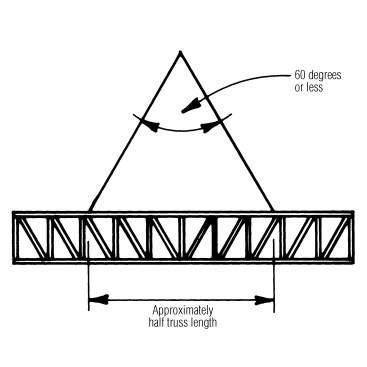
When lifting floor trusses with a crane, always lift from two points and never lift the truss sideways, which can loosen connector plates.
When receiving a truckload of trusses, reject those with excessive splits in chords or braces, those with knots close to metal plates, or those with loose or deformed plates. Also reject any that show evidence of having been damaged and repaired. Beware of warped or wet lumber, which can set up dangerous stresses as it shrinks and dries.
Lifting With a Crane
If you use a crane, always lift from two points (Figure B) and never lift the truss sideways; the excess flexing can loosen the connector plates, causing eventual failure.
Installing Floor Trusses
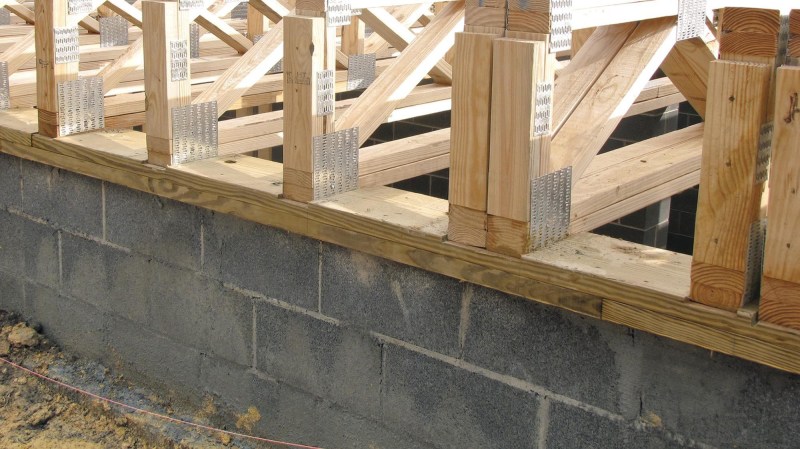
Floor trusses are usually spaced 24 in. o.c., and are typically lifted by hand, rolled into place, fastened, and braced.
Right Side Up
It is crucial to install each truss right side up, according to the label attached to the truss. Each web member is designed to be in compression or tension, but not both.
Bearing at Center Girder
A bottom-chord-bearing truss that crosses a girder or bearing wall may be designed to function as two simple beams. In this case, a tag attached to the truss will indicate that the top chord should be cut after installation (Figure C). Without this cut, a load applied to one end of the truss will lift the other, creating a seesaw action.
Stairwell Openings
Girder trusses are designed to support several standard floor trusses. These are often used around stairwell openings (Figure D).
Bracing Floor Trusses
Bracing prevents trusses from bending, twisting, or otherwise deforming. On bottom-chord-bearing trusses, the ends are tied together with 2×4 ledgers that also serve as a nailing base for the perimeter of the plywood deck (Figure E). Underneath, 2×6 strongbacks laid on edge should run continuously through the webs of all the trusses at 10-ft. intervals (one run for a 20-ft. truss, two runs for longer trusses). The 2×6 serves the same purpose as bridging in a standard floor, distributing concentrated loads over a wider area.
Fire-Blocking for Floor Trusses
Top-chord-bearing trusses short-circuit the fire-blocking ordinarily provided by the top plate. Common solutions are to extend the drywall past the trusses to the top plate, or to insert a separate 2×4 fire block inside each stud bay just below the bottom chord of the truss (Figure F). Check with local codes for requirements in your area.