Pressure-treated lumber hasn’t lost momentum since the industry’s early-2000s phase-out of residential chromated copper arsenate (CCA). Chemistry, quality control, and product options have advanced quickly, giving builders clearer options for combating rot, insects, ignition, and jobsite conditions (above-ground vs. ground-contact, interior vs. exterior).
“There’s always the theory out there that the older preservatives were stronger and better, but now we are treating with newer technology while still carrying that long-term warranty that we’ve always enjoyed,” says Jake Munson, Director of Wood Preservation at ProWood.
Here’s what’s changed and how to choose and use today’s treatments effectively.
From CCA- to copper-based systems
Micronized copper azole (MCA) and related systems are mainstays for fungal decay and termite resistance outdoors. Copper is the primary biocide, while azoles act as co-biocides to broaden efficacy. These formulations are widely available in above-ground, ground-contact, and critical structural retentions.
Pro tip: For exterior framing, decks, sill plates exposed to splash, and structural members near, in, or on-grade, choose a ground-contact retention when members are close to soil, frequently wet, not well drained/ventilated, or not fully sealed on all sides. Reserve above-ground retentions for parts that shed water and dry quickly. Critical structure retentions should be specified for structural retaining walls, foundation systems, or heavy-duty agricultural applications such as pole-framed buildings.
Borate treatments: targeted, interior protection
Borates diffuse into wood and excel against termites and fungal decay without introducing metal or possibly strong corrosion potential. Because borates are water-soluble, they’re intended for dry, interior locations—think sill plates over concrete (with proper capillary breaks), interior framing in termite zones, or protected framing where you want insect resistance without exterior exposure.
Pro tip: Use borates where the wood will remain dry and protected from rain; don’t rely on borate alone for exterior or wet applications.
FRTW: separate chemistry, different rules
Decay-resistant preservatives don’t make wood fire-retardant. Fire-retardant treated wood (FRTW) is a distinct treatment (and label) intended to slow flame spread and smoke development to meet specific code requirements—common on roof decks, interior fire wall assemblies, exterior wall assemblies in proximity-to-line conditions, and certain multi-family assemblies. FRTW is typically used in dry conditions and requires attention to span adjustments, fastener recommendations, and temperature limits per the building code evaluation service report. Confirm that the fire retardant is not a spray-on application, which typically either won’t have a code report or possibly won’t meet code for structural applications. Class “A” rated materials can be anything, from upholstery to window blinds to flooring, so make sure to get fire-retardant materials that meet code by passing an ASTM E84 Extended 30-minute burn.
Pro tip: When a plan or code section calls for FRTW, specify a product that is stamped with accredited third-party conformance ratings for fire such as UL or Intertek, and look to the current ESR and ASTM E84 Extended 30-minute required tests for structural application, following the manufacturer’s installation and fastener guidance. Don’t substitute decay-resistant pressure treated (PT) lumber for FRTW.
Color-infused options: jobsite clarity and long-term appearance
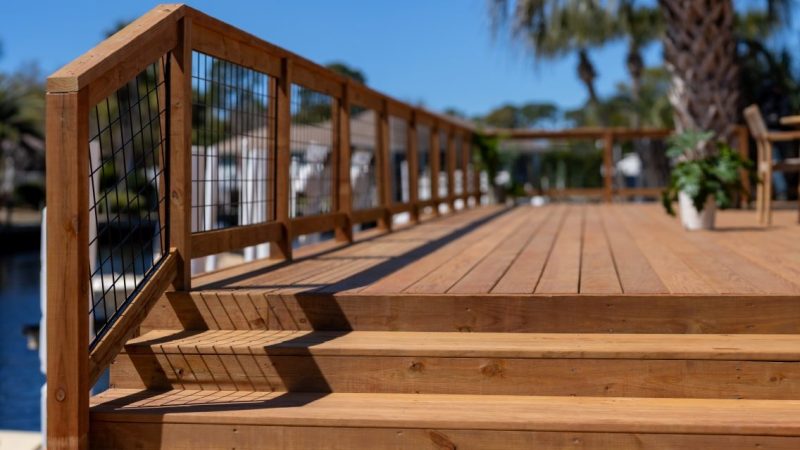
Color-infused or color-matched treated lumber incorporates a pigment during treatment. In the yard and on-site, the color helps distinguish treated members and create colors that look like cedar and redwood, providing options other than normal “green” look treated products. With color-treated wood, builders can offer clients the look of stained wood without waiting for wood to dry, applying stain, or making extra trips to the job site. Some products carry fade warranties and can extend the time before needing to stain visible components like deck framing that may be seen through slats or under stair stringers. These products can also save time on a fence or deck by getting it pre-colored.
“It’s not just a surface-applied coating,” Munson says. “It does last. We have warranties for two years in horizontal applications and five years in vertical applications.”
Pro tip: If the structure will be visible, color-infused stock can save a finishing step and improve client perception. Confirm whether the color carries a fade warranty and whether additional topcoats are recommended. Warranties are typically found on treater websites. Look for warranties backed by the treater directly versus the passthrough from the preservative provider. Good treaters back not only the chemistry but its proper application.
Fasteners, connectors, and contact surfaces
Copper-based preservatives can accelerate corrosion of unsuitable metals—especially anywhere moisture lingers (near grade, coastal, splash zones). Based on the IBC and IRC, use hot-dip galvanized hardware and fasteners that meet those local recognized standards or upgrade to stainless steel (304 inland; 316 near salt or chlorinated water). Avoid mixing metals, isolate aluminum from treated wood, and back-prime cut ends and notches with the manufacturer’s approved end-cut preservative.
Pro tip: This builder checklist.
- Match fastener/connector rating to the treatment and exposure.
- Use corrosion-resistant post bases, hangers, and standoffs to keep wood off concrete and soil.
- Seal field cuts, bores, and notches with the specified end-cut sealer—every time.
Dimensional stability and KDAT
One persistent complaint with PT wood is post-installation movement as the wood equilibrates. Kiln-dried-after-treatment (KDAT) stock helps by driving off excess moisture after the pressure treatment process, improving paint/stain readiness and reducing shrinkage, cupping, and fastener “smiles.” Most importantly, it makes wood more lightweight and easier to work with big framing members, timbers, and beams. Lighter weight means fewer people are required to move the wood around.
Pro tip: Where fit and finish matter (decking, rails, fascia, trim), KDAT is worth the upcharge. For structural members that will be concealed and well-ventilated, standard PT may suffice if you detail for drying and allow acclimation time. For the pro, you may want KDAT to make it easier for one person to move material around.
Bottom line
Ultimately, building right with pressure-treated wood comes down to four decisions: risk, chemistry, retention, and hardware/detailing. Make the right call, and treated lumber will deliver durability without the guesswork. Learn more about specs, product options, and installation guidance.