- Q. I’ve been using wood I-joists for my floor framing. The designs have called for 1×4 crush blocking inserted between the top and the bottom 2×2 flanges and nailed directly to the OSB web. I’ve also heard of using 2x4s nailed to the face of the 2x2s, instead of being inserted between them. Which way is better?
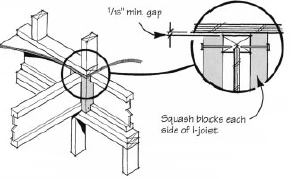
A.Paul Fisette responds: It sounds like you’re confusing squash blocks with web stiffeners. Squash blocks are blocks of wood that are slightly taller than the depth of the joist. The function of squash blocks is to transfer loads created by walls and roofs above to a sill or wall plate below the I-joists. Because these loads in effect bypass the I-joist, the squash blocks also prevent “knifing” of the thin web into the top and bottom flanges.
Web stiffeners are blocks of plywood or OSB that fit between the flanges of an I-joist. These blocks are used at points of support and are fastened with nails right up against the I-joist web. However, web stiffeners are not fit tightly between the top and bottom flange. Typically, a space is left between the top of the stiffener and the underside of the top flange. Web stiffeners reinforce the I-joist and prevent it from buckling. Sometimes they are required as fillers so that there is solid nailing for joist hangers.
Paul Fisette is director of the Building Materials and Wood Technology program at the University of Massachusetts in Amherst.
Q&A: Squash Blocks & Web Stiffeners
Squash Blocks & Web Stiffeners
1 MIN READ