A jigsaw may not be the first, second, or even third cordless tool most tradesmen buy — and yet it’s a handy addition to anyone’s tool kit. These saws are typically sold bare, and most people who buy them are adding them to existing systems.
For this article I tested seven pro-grade models to help you decide if the saw for your system is worth having — or, if you’re in the market for a new system and care about the jigsaw, which systems are worth considering. Included in the test were tools from Bosch, DeWalt, Hitachi, Makita, Metabo, Milwaukee, and Ridgid. Festool doesn’t currently sell cordless jigsaws in this country but plans to introduce a pair of them late this year.
Speed and Power
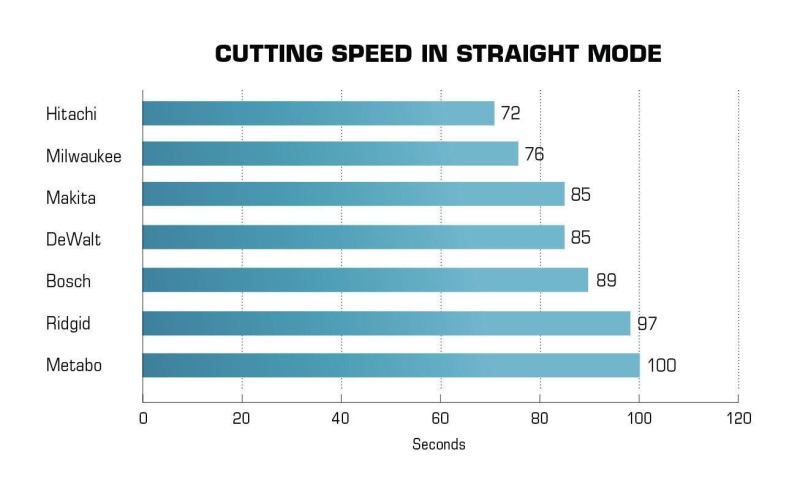
Every tool tested has reasonable speed and power — not as much as the better corded models but sufficient for most of the tasks a carpenter or cabinet installer might use a jigsaw for. I tested speed by timing how long it took to rip 3/4-inch hardwood plywood in straight (nonorbital) and orbital mode. Each saw was equipped with a new 10 TPI blade (Bosch T101B), and I leaned into the cuts because I didn’t want to be there all day.
On average, it took about 90 seconds per 8-foot rip in straight mode and 50 seconds in orbital mode (see tables at right). To put those numbers in perspective, I made the same cuts with a corded saw (Festool Trion) and they took about 50 seconds in straight mode and 35 seconds in orbital.
The manufacturers make varying claims about capacity — one says the saw can cut material up to 51/4 inches thick. Maybe it can, but the fact is that most of the things carpenters cut with jigsaws are 3/4 inch or 1 1/2 inches thick. I made a point of using the tools to cut 1 1/2- and 2 3/4-inch dry Douglas fir. They cut slowly in nonorbital mode and faster in orbital. It’s worth noting that the cuts through thick stock were noticeably out of square if I pushed hard in orbital mode. But the cuts were square if I let the saw dictate the pace.
Runtime
I tested runtime because you have to with cordless tools, though advances in tool design and batteries are making runtime less of an issue than it used to be. This is particularly true of jigsaws, which typically see intermittent use for tasks like notching deck boards and trim, cutting scribes, and making various cutouts. When used in this manner it’s hard to deplete one battery before the spare is charged.
Leaning into the cuts, I cut 3/4-inch hardwood plywood in straight mode and counted the number of cuts each saw could make per charge. To keep it fair, each saw was equipped with a 3.0-Ah battery even though some of the brands tested sell 4.0-Ah packs. I’d have gotten about a third more runtime with 4.0-Ah packs.
The least any saw cut was 50 feet, the most was 80 feet, and the average was about 65 feet. Some tools cut more per charge than others, but I would not let the numbers dissuade me from buying any of these tools, because 50 feet of 3/4-inch plywood is lot to cut with a jigsaw. For long bouts of continuous cutting it’s still best to use a cord.
Blade Clamp
Every tool tested has a keyless blade clamp. The clamp on the Bosch is the best of the bunch. Twisting the ring ejects the blade and “cocks” the mechanism for reloading — which involves inserting the blade and pushing in until the ring snaps back to its former position. You won’t burn your fingers when unloading, because the ring has a plastic cover and you don’t have to touch the blade.
The other tools have levers that engage with a locking ring when pulled so you can insert or remove blades. They work fine, but I’m not wild about the plastic levers on two of the tools. Makita’s is pretty solid, but you have to pull kind of hard on Hitachi’s and I’m not sure how it will hold up over time. Ridgid’s clamp is somewhat finicky; if the blade isn’t pushed all the way home, it will be held skewed — or slightly out of parallel — to the shoe.
Bevel Settings and Base
Changing bevel settings has traditionally required the use of an Allen key to loosen the bolt that secures the base. Most jigsaws still work this way, but a few have a lever between the motor and base that allows you to set bevels without the use of tools. I prefer the tool-free mechanisms because they are faster to operate and there’s no concern about losing the key (which stores in the base or housing).
If you’re one of those carpenters who cope trim with a jigsaw, and you want to try it with a cordless model, then you’ll need one with a traditional base. I had no trouble installing a Collins Coping Foot on tools that use an Allen key to secure the base. I tried with the other models, but gave up because it required too much disassembly and monkeying around. If you decide to use a coping foot on a cordless tool, you’ll need to devise a way to lock the trigger on, because it’s easier to cope that way.
LED Light/Visibility
About half of the models tested have built-in LED lights that shine down from above the blade. The LEDs on the Bosch, Makita, and Metabo illuminate the cut line all the way up to the blade. The Hitachi’s LED is offset to clear an asymmetrical blade clamp, so the cut line is in shadow until a quarter-inch out from the blade. A light makes it easier to see the cut line, but the lack of this feature would not stop me from buying a saw I otherwise liked.
Dust Blower
Every saw tested has a dust blower — which is another way of saying a portion of the exhaust air from the cooling fan is vented out the front. In most cases the blowers cleared chips far enough out for the cut line to be visible 3 to 5 inches ahead of the blade. Makita’s blower was the least capable; during heavy cutting it cleared chips about an inch ahead of the blade. I could still see the cut line, but not as much of it as with other saws.
On the DeWalt and Metabo you can turn the blowers off or dial them down. This feature is not a plus for me; I want the blower going full blast all the time. I might feel differently about this if the saw had dust collection — but none of the models tested did.
The Bottom Line
Every one of these cordless jigsaws is capable, but some are better than others. The Bosch is my overall favorite; though not the fastest cutter, it has an excellent blade clamp and is significantly lighter than all but one other model. The DeWalt and Milwaukee are solid, fast-cutting tools and would be fine additions to a tradesman’s cordless kit. The Makita is equally solid and fast-cutting, but its high price relative to other models complicates the buying decision.
|
|
|
|
|
|
|
|
|
|
|