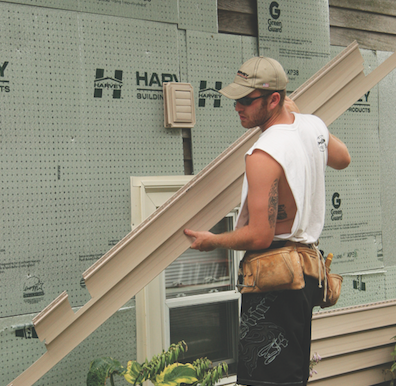
- Q. Before installing vinyl siding over existing wood siding, we first install a layer of fan-fold foam insulation. Is the fan-fold foam an adequate weather-resistive barrier?
A.Corresponding editor Paul Fisette responds: Rigid foam will shed any water that gets past leaky vinyl siding. To be an effective weather-resistive barrier, though, the seams of the fan-fold must be carefully taped, since any seam can provide a pathway for water to reach the structure under the foam. As long as the foam is not foil-faced, the best tape is contractor’s tape from 3M. It’s always a good idea to check with the foam manufacturer to be sure that the tape you use is compatible with its product.
Fan-fold is typically sold in 1/4-inch by 4-foot by 50-foot sections and is installed horizontally across the existing siding to level out irregularities before re-siding with vinyl. This creates a horizontal seam every 4 feet. I have not seen any studies that show how well tape adheres to foam over the long haul. I am mildly concerned that if the tape fails and a horizontal joint is not flush (with the lower panel sticking out beyond the upper panel), a seam could trap water. To avoid this potential problem, you may want to consider installing the fan-fold vertically.
All penetrations, as well as areas around doors and windows, require careful detailing. If the fan-fold and J-channel are simply butted against existing window and door casings, water can get between the J-channel and the casing, and then behind the fan-fold. Proper flashing details at windows and doors may require installation of new flexible flashing, head flashing, and casing.
Q&A: Vinyl Siding Over Fan-Fold Foam
1 MIN READ