
I’ve been successfully hanging drywall for nearly three decades, but when work started slowing down a few years ago I decided to add home-performance contracting to my business. Getting trained and certified felt like a logical step, since drywall work directly involves the building envelope. I also do a lot of insulating (which is common for drywall contractors in my area).
Originally, I just wanted to increase the scope of services I could offer my clients, though I also thought that the added knowledge would give me an edge over my competitors when bidding drywall jobs. My hope was to derive about a quarter of my income from building-performance contracting to help cushion the blow if drywall work fell off again. But after taking the classes, I was pretty excited and open to the possibility of doing even more building performance–related work, figuring I would add certifications as I gained field experience. Unfortunately, it hasn’t worked out that way, for reasons I’ll describe in this article.
BPI Certification
There are a number of paths into home-performance contracting, ranging from utility training programs to private franchising opportunities. I chose to get certified by the Building Performance Institute, a national trade-based certification organization with home offices in Malta, N.Y., just a few minutes from my house. BPI certification — or its equivalent — is not necessary for private work but is often required of contractors working with government agencies, utilities, and other organizations that offer energy-efficiency programs.
Coursework. BPI doesn’t actually provide training; for that I attended classes at Hudson Valley Community College in Troy, offered through New York’s Workforce Development Institute. Independent training organizations in your area can be found on the BPI website.
I started with a course called “Building Analyst Professional.” It met twice a week for about a month; during the afternoon and evening classes, which lasted about five hours each, we covered general building science topics like air leakage, moisture management, and ventilation. By the end of the course we had accumulated 24 hours of classroom time and 12 hours of field class.
After that I took a building-envelope course, which covered the same subject matter but in greater detail, with a little more time spent in the field. As in the previous class, there were 12 to 15 students, most from the building trades and many sent by their employers.
Even with my years of experience, I found the coursework to be rigorous. Those who think they’re just going to breeze through the courses and tests are usually surprised; about half of the students in my building-analyst class failed the written test.
Costs. Each class cost $1,200, with an additional charge of $250 for the written test and $350 for the field test at the end (the cost of a practice field test is $300). At the time I took the courses, I was eligible for an 80 percent refund from New York State Energy Research and Development Authority (NYSERDA), our state workforce development program.
Accreditation. After earning my certifications, I waited a year before becoming an accredited contractor. During that time I performed a few audits and enough improvement jobs to determine that there was real potential. Accreditation requires an annual renewal fee of $500 and a BPI quality assurance fee that varies depending on revenue — $1,000 if annual revenue is under $250,000, for example. This fee helps cover required meetings with Conservation Services Group (CSG), which also checks my field work and occasionally accompanies me on an audit.
Since accredited contractors must meet BPI standards, I figured that accreditation would help sell jobs to otherwise wary homeowners. Another benefit is that accredited contractors are listed on the BPI website, where a lot of people look for information about energy audits.
Equipment. After completing the coursework, I spent $3,500 on equipment, including a blower door, a gas-leak detector, a pressure pan, a foam gun, a CO detector, and an IR thermometer. I bought everything online directly from individual manufacturers; being an accredited contractor qualified me for a 20 percent refund.
Continuing education. Certifications are valid for three years. To renew a certification, I have to earn a certain number of continuing education credits (CEUs), retake a field exam, and in some cases (depending on the actual number of CEUs taken) take online exams for each designation. At least one field exam needs to be retaken every three years at an affiliated test center, at a cost of at least $600.
Insurance. BPI-accredited contractors must carry at least one million dollars in liability coverage, which is not significantly different from the amount I already carry as a drywall contractor.
All these expenses add up: I estimate that the yearly cost to remain accredited is about $2,500. In addition to the expenses mentioned above, this includes about $200 a year to keep my diagnostic tools calibrated and at least 30 hours per year meeting with CSG and taking CEU classes.
Doing Audits
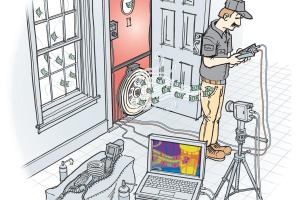
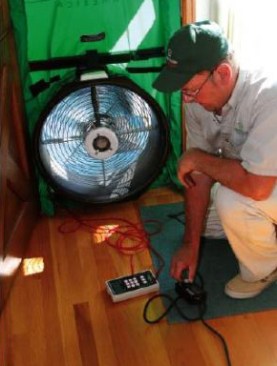
It takes skilled detective work and proper diagnostic equipment to improve the comfort and energy performance of a house without causing damage to it. The process begins with an audit, where I use my blower door and other equipment to assess how much energy the home is currently consuming and determine what measures need to be taken to improve efficiency. The next step is to implement the improvements. Some contractors only perform audits, while others focus on the improvements; I prefer to do both.
In my area, energy audits are offered for free or at a reduced rate. I get referrals from NYSERDA, which pays a flat $250 fee for each audit. A full audit typically takes me at least a half day in the field, and then at least another two hours in the office to enter data and figure up work proposals.
I’ve never performed an audit where I haven’t found a problem. Quite often, there’s an unexpected safety issue, such as a disconnected smoke or CO detector, or a hot-water heater that doesn’t pass the spillage test. Other common problems include the presence of flammable materials near the combustible appliance zone (CAZ), gas ranges that release too much CO into the air, and plugged or damaged dryer vent pipes.
In order to make any money, though, I have to actually sell the proposed improvements, as I don’t really make anything on the audits (compared with my usual drywall work).
Selling Energy Improvements
While some home-performance contractors may think that improving energy efficiency is the main goal, I think energy savings are often the least important part of the job. It’s easy to improve energy efficiency, but it’s not cheap to perform the work, and on most projects the clients aren’t going to see a return on their investment for many years. Instead, I try to focus more on how the work will improve my clients’ comfort, health, and safety.
A recent proposal for a job I didn’t end up getting illustrates that this approach doesn’t always work either. After an audit, my recommendation was to add 10 inches of cellulose over the 10-year-old home’s existing fiberglass insulation and —since I won’t do this type of job otherwise — also properly air-seal the attic. The estimated job cost, including materials, came to $2,250.
I estimated that my clients would save $99 per year after the work, giving them a simple payback of 22.8 years and a savings-investment ratio (SIR) of .99. These numbers actually look pretty good compared with some jobs I’ve estimated (and will only look better as fuel prices increase). It should have been an easy sell.
To address comfort and indoor air quality, I proposed replacing two bathroom fans with units that can be set to run continuously at a low cfm, and providing an inlet port in the CAZ to improve the base pressure near the furnace. I also proposed installing new piping to vent the dryer. The cost for these improvements would have been $1,365. To date, the clients haven’t decided to proceed with the work, though the approach of cooler weather and improved incentives may yet tip the balance in my favor.
Incentives. In my area, low-interest loan programs and financing options are available to help pay for upgrades. The main one I discuss with potential customers is NYSERDA’s incentive, where the customer gets back 10 percent of the cost of eligible measures after work is completed. Initially, this incentive was available only if the SIR was 1 or higher, which meant that a lot of improvement projects didn’t qualify. As a result, we lost a number of customers and were forced to try to lower costs so the numbers would work out. Recently, however, the program was changed to allow some approved work to qualify for the incentive even if it does not meet the SIR cutoff.
In my opinion, understanding how to work with and sell local incentive programs is one of the keys to being a successful home-performance contractor.
Should You Get Certified?
Unfortunately, the market for energy improvement work has never really taken off in my area, mostly because hoped-for energy savings don’t actually add up. The SIR alone just isn’t attractive enough to sell most jobs, and I probably don’t spend enough time selling the loans and incentives that might make the numbers more appealing.
Over the past three years, in fact, I’ve become a little disillusioned. I’ve put on hold my plans to purchase a cellulose-blowing machine and an infrared camera, stopped taking additional classes, and decided not to become a HERS rater. A contractor I know who dropped out of the program said he felt like he was competing against Disney World. “If people have a choice between air-sealing and insulating an attic or basement, or going on a family vacation, they will most likely choose the vacation,” he told me.
Another problem is that most “clients” who get a free audit are tire-kickers who aren’t really planning to spend any money on energy improvements. That means I have to perform a lot of audits to find a serious customer. Many building-performance contractors agree that eliminating free audits would be a good idea, because then we could charge market rates to serious customers.
Finally, the financial goals set by BPI are difficult for small contractors like me to reach. Though I am still a certified contractor, I’m no longer accredited, because I was unable to sell enough jobs. (By the end of the first year of participation, an accredited contractor must report at least 12 completed projects or at least $50,000 of contracted work. At least 24 completed projects or at least $100,000 of contracted work must be reported for each succeeding year of participation). Currently, I’m doing audits and quite a bit of improvement work for a local accredited contractor — who’s also in danger of failing to meet BPI’s financial goals.
Was It a Good Idea?
When my certification expires this fall, I’ll be faced with the tough decision of whether to spend the time and money to maintain it. On the one hand, there’s no question that my drywall and insulation business has improved. Thanks to my BPI coursework, I now offer airtight drywall, dense-packed cellulose, and other improved insulation packages to my customers. I don’t mind the continuing education or recertification requirements, and I think the accountability measures are needed to ensure high standards in the program.
But I wish I could set my own fees for audits, and it would help if BPI relaxed its restrictive financial requirements — I would like to continue to use my home-improvement work as a supplement to my regular business while remaining a BPI-accredited contractor. Over time, I believe I can turn building-performance work into a profitable part of my business, and I feel that the time and money I’ve invested in learning more about building performance was worth it. It just hasn’t worked out quite the way I had hoped.