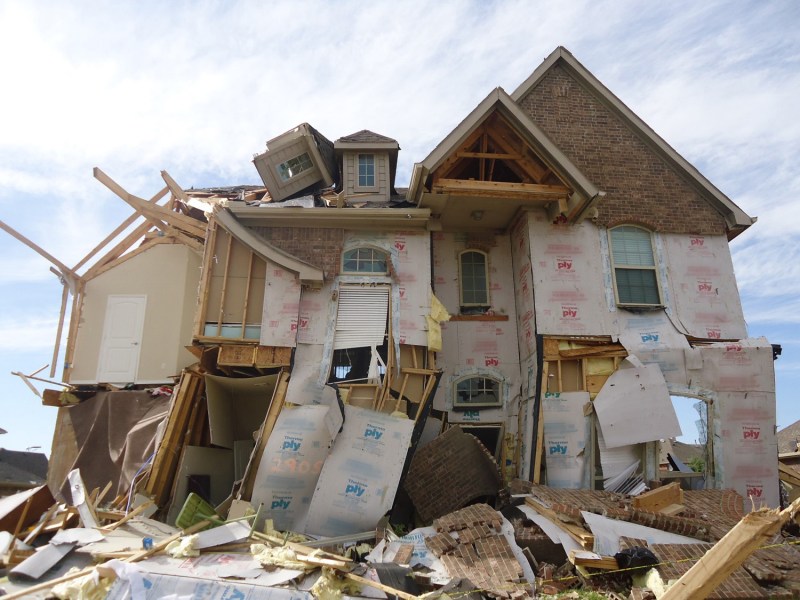
When a strong thunderstorm did major damage to a few homes in Rockwall, Texas, earlier this year, the news was worth noting (see: “From What We Gather, March 27 – 31, 2017”). After all, it’s not common for ordinary “straight-line” winds to bring the kind of destruction more typically associated with tornadoes. Now, a team of engineers from APA – the Engineered Lumber Association has issued a report on the event, zooming in on the significant construction details that may help explain the extent of the structural failure.
Looking at the damaged and destroyed buildings, the investigators identified a laundry list of usual suspects:
- inadequate and improperly installed roof attachments;
- failures of the roof to wall connections;
- a lack of wall rigidity;
- moisture intrusion;
- failures in the facade attachment;
- a lack of enlarged washers
The full report is available as a free download to registered users from the APA website (see: “Texas Straight-Line Wind Damage Assessment Report”).
TESLA INSTALLS FIRST SOLAR-SHINGLE ROOFS
After buying out Solar City last year, Tesla is now rolling the dice on its new solar-roof strategy: upscale roof replacements using solar shingles that mimic the look of slate and tile. Bloomberg had a report this week (see: “Tesla Completes Its First Solar Roof Installs,” by Tom Randall).
“Tesla has completed its first solar roof installations, the company reported Wednesday as part of a second-quarter earnings report,” wrote Bloomberg. “Just like the first Model 3 customers, who took their keys last week, the first solar roof customers are Tesla employees. By selling to them first, Tesla says it hopes to work out any kinks in the sales and installation process before taking it to a wider public audience.”
Tesla’s pursuing a solar-roof strategy similar to the company’s electric vehicle strategy, reported Bloomberg: Start with a boutique product that’s aimed at high-end consumers. The solar roof tiles are designed to resemble an upscale tile roof, rather than present the usual solar-panel appearance of an array of mechanical devices bolted to a conventional roof. To market the product, reported Bloomberg, Tesla plans to abandon Solar City’s model of door-to-door sales, and instead set up showrooms in shopping malls — similar to an Apple Computer mall location, or Tesla’s own automobile showrooms. Tesla says its test marketing indicates that the mall location strategy will produce more sales than Solar City’s previous approach.
In related news. Vermont’s electric utility, Green Mountain Power, is drawing national attention for its pilot programs to offer a combined storage-and-distributed-generation strategy to some homeowners. The New York Times had this report (see: “Utility Helps Wean Vermonters From the Electric Grid,” by Diane Cardwell).

Electrician Scott Millette installs a Tesla Powerwall storage battery in a Vermont home in spring of 2016. (Photo by Tim Healey/JLC)
“The utility, owned by Gaz Métro, a leading natural gas distributor in Quebec, is also working to reduce its carbon dioxide emissions as part of the effort to slow global warming. In 2014, it became a B Corporation. That is a voluntary designation, requiring executives to take into account not just how decisions will affect profit and shareholders, but also how they will affect the public, generally defined as society or the environment,” the Times reported. “As part of that mission, Green Mountain became the first utility to offer customers access to Tesla’s Powerwall home battery system when it was released in 2015. Now it is starting a new program, announced in May, that will offer the battery to as many as 2,000 customers for $15 a month over 10 years, or a one-time payment of $1,500. The package will include software and a Nest thermostat, which conserves electricity by adjusting temperatures to comings and goings as well as established routines.”
JLC went on site in Vermont last year to see technicians install a Tesla battery in a home. (For more, see: “Tesla Powerwall: Not Just for Solar.”)
BRIDGE WORK KNOCKS OUT POWER TO OUTER BANKS
When it’s finished, the new Bonner Bridge will be a lifeline to islands in North Carolina’s Outer Banks. But last month, work on the bridge cut another lifeline for the barrier island communities: crews accidentally severed a high-voltage power cable that supplies the area’s electricity. The Washington Post had a report (see: “The weather is beautiful, but these Outer Banks beaches have been desolate. They might get vacationers back Friday,” by Sarah Kaplan).
“A construction crew working to upgrade the Bonner Bridge, which connects Hatteras with the rest of the Outer Banks to the north, inadvertently dropped a steel casing on three underwater electric cables running to the island,” the paper reported. “The accident severed most of the power to Hatteras and cut off tourism completely. To avoid overtaxing backup generators, some 60,000 visitors were evacuated. Workers have been laboring furiously to restore the broken electric connection.”
Evacuation orders were lifted as of Friday, USA Today reported (see: “Tourists return to Outer Banks islands, as communities measure economic damage,” by Emily Bohatch). Local businesses breathed a sigh of relief (early projections had warned that power could be out for three weeks). But the accident “couldn’t have been at a worse time,” Dare County Manager Bobby Outten told the paper. “For many of the businesses down there, they went from thriving during peak season to closed for a week.”
“Splicing the 115,000-volt power line involves a complicated process of peeling back layers of insulation and protective jackets to expose the conductor cable, which is about the size of a quarter in diameter,” reported the Virginian-Pilot (see: “With power restored to Hatteras, Ocracoke islands, tourists can return at noon Friday,” by Jeff Hampton and Katherine Hafner). “Rejoining the severed ends typically involves inserting them into a connector, tightening it with screws and then meticulously rewrapping it with the insulation and jackets, according to online demonstrations.”
Not surprisingly, the bridge contractor blamed for the power line break, PCL, is facing a lawsuit. The Outer Banks Voice had a report (see: “PCL named in class action suit over Hatteras power outage,” by Russ Lay). “Two plaintiffs were named in the release — Briggs McEwan of Rodanthe and Tami Lynette Gray, of Frisco,” the paper reported. “McEwan owns a pizza restaurant and a home rental business and Gray is a charter boat captain. Both allege they have suffered ‘significant losses’ amounting to thousands of dollars.”