While some decorative drywall finishing methods can help contractors win bids, not all methods will result in a fire-rated assembly. When bidding on commercial and multifamily projects, it’s important to understand how to effectively use decorative products while saving on labor and material costs.
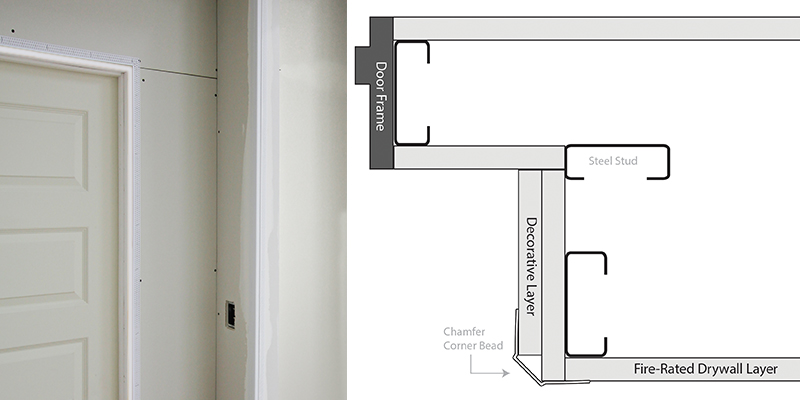
In commercial structures requiring a 1-or 2-hour fire-rating, the drywall must maintain a continuous barrier. Standard 90-degree cornerbead allows two pieces of drywall to overlap forming the barrier. With an increasing variety of decorative drywall cornerbeads comes an increased concern for safety. The installation requirements of some decorative cornerbead breaks the continuous drywall barrier. For example, chamfer bead, requires a set-back that separates the drywall panels, thus breaking the continuous barrier. In a case such as this, when a decorative cornerbead breaks the fire-rated continuous barrier, two layers of drywall must be installed. The first layer will maintain the continuous barrier, and the second layer will be installed with the appropriate offset for the decorative bead. This two-layer approach is critical for maintaining a fire-rated wall. Many architects and contractors see this installation requirement and worry that in-order-to achieve fire-rating, they will have to install an entire two-layer wall system, doubling the cost of the drywall and potentially negating the cost-effectiveness of drywall as a building substrate.
Fortunately, well-considered design choices can create elegant upgrades that simultaneously circumvent the need to install two layers throughout the entire project. For example, a common detail in hotels is a return wall at the entrance of individual rooms (see image above). This detail is an ideal opportunity to add visual interest without adding excessive amounts of labor or material costs. A second sheet only needs to be added on the return wall to maintain the continuous fire-rated barrier and account for the drywall offset needed for the decorative cornerbead. The building requirements for 1 and 2-hour fire ratings can vary by construction detail, always be sure to consult the Gypsum Association’s Fire Resistance Design Manual. Home construction requires at least 1/2 inch drywall. In commercial applications, your standard wall requires 5/8 inch or thicker drywall. The most important thing to remember is, if the thinnest portion of the drywall installation does not meet the fire-rating requirement, the whole wall does not meet the fire-rating.
Drywall is a natural choice for fire-rated walls since it is naturally fire-resistant in its composition. Traditional (plain) drywall corner finishing is compliant with fire codes, while new decorative beads require special consideration to maintain commercial building codes. However, thoughtful design, allows architects and contractors to make bold visual choices with these beads that maintain fire-rating and cost less than custom millwork details. Familiarity with the local code requirements for fire-rated assemblies will allow you to successfully design beautiful, cost-effective, and, above all, safe spaces that your clients will love.
For more information on decorative drywall finishing methods, check here.