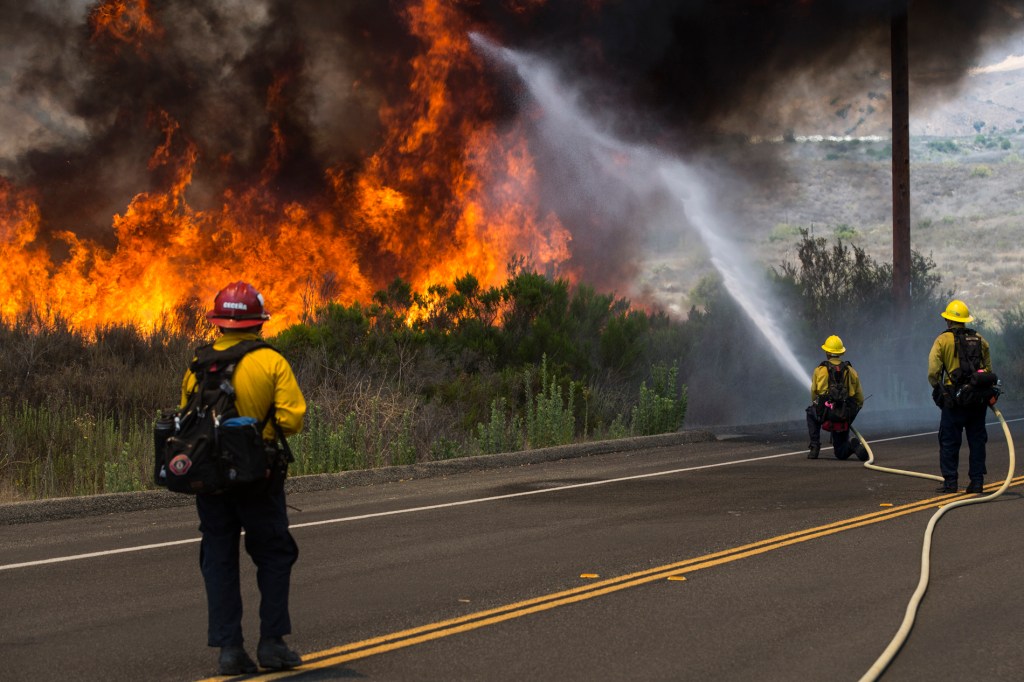
It’s one thing for California to have an early start to wildfire season. It’s another thing when those early-season wildfires are also the biggest burns on record. That’s the situation in California this summer, where by August 9, five days after a Federal disaster was declared for the state, more than 5,000 separate fires had burned 799,000-plus acres. One single fire, the “Mendocino Complex” fire, had burned more than 300,000 acres, ranking as the state’s biggest single wildfire ever. “Of the five largest wildfires in state history, four have occurred since 2012,” noted the Los Angeles Times (see: “California fire coverage: 18 blazes scorch 600,000 acres across the state”).
California’s annual fire season seem to be merging into one long season, according to Cal Fire Assistant Deputy Director Daniel Berlant, appearing on the NPR program “On Point” (listen here: “What These Wildfires Say About Climate Change”). “Here we are in August, and people think of the summer months as being the traditional fire season months. It’s typically actually the fall months. September, October, that is the season when we historically experienced our greatest number of damaging fires. So unfortunately, the worst could potentially be yet to come.”
“To have these type of fires burn with this intensity, this severity, and earlier in the year, it really is just a point of results of our changing climate here in California,” said Berlant. “Our summers are longer, our fire seasons have now become longer, and as a result, fire conditions become more intense and more severe.”
It’s becoming an annual occurrence, said reporter Ryan Lillis of the Sacramento Bee. “In Lake County, near Clear Lake where the Mendocino Complex fire is burning, they are still having fundraisers for fires from three or four years ago,” said Lillis. “That same area in 2015, there was a huge fire called the Valley Fire that burned like 2,000 structures, and killed a few people. There was another fire the year after that. And now here we are again in the summer of 2018, earlier than people plan or anticipated for, and you have entire communities evacuated.”
For his part, climate expert Michael Mann, professor of atmospheric science and director of the Earth System Science Center at Pennsylvania State University, pointed the finger directly at human-caused climate change. “It’s not rocket science,” said Mann. “You make the planet warmer, you dry out the continents, you warm up the winters so there is less snow pack and less water running off from the mountains, those factors come together in a perfect storm. Those are the factors that give you unprecedented wildfires. And look, it’s not coincidence that California has had its two worst wildfires now within the last year.”
Arctic melting is a factor in the California fires, Mann said. “Yes, there is uncertainty in the science, but it is not our friend,” said Mann. “As we have understood better than mechanisms that are involved in climate change over the years, we have found that things can happen even faster than we had predicted just years ago, and we are saying that play out. And here is an example of a surprise: The sea ice in the Arctic is melting faster than we expected. It is on a trajectory where it may be gone at the end of the summer every year in the matter of a couple of decades. And here is the thing: What happens in the Arctic does not stay in the Arctic. It’s not like Las Vegas. What happens when you melt the Arctic sea ice and you warm up the Arctic, you change atmospheric temperatures patterns in a way that alters the jet stream in a way that makes it more likely to have one of these ridges, one of these high-pressure centers over the west coast of the U.S., that generates this unprecedented heat and drought and wildfire. And we did not understand those mechanisms just years ago. And as we learn more, we realize that we face an even tougher problem here.”
California experts are starting to think more about adapting to the heightened fire hazard, said Lenya Quinn-Davidson, an area fire adviser with the University of California’s Cooperative Extension. “Fire is one of the only natural disasters that we fight against,” said Quinn-Davidson. “We think of hurricanes and earthquakes, and other natural disasters, where we just try to adapt and identify vulnerabilities and change our behavior. And for the longest time, we haven’t treated fire like that: We’ve treated it as something we can just put out, and fight. And I think we’re getting to the point, and communities are starting to understand, that it’s time to work with it and learn how to adapt and how to make change that makes us more resilient so that we can learn to live with fire.”
“There clearly is a need for adaptive measures,” Michael Mann agreed. “There is no question that we do have to adapt to this changing environment… There is additional climate change in the pipeline, and we are going to need to adapt to those changes. But if we don’t act on this problem to reduce our emissions dramatically, we will exceed our adaptive capacity.”
One strategy for adapting to wildfire risk is to design homes and developments with “defensible space.” That approach has proven effective in some California communities (see: “Surviving Wildfire,” JLC 4/08). In some wildfire-exposed communities, codes are evolving to require construction details that resist ignition (see: “Living with Wildfire,” JLC 9/17).
Confidence that their homes were defensible led two California men to stay behind and fight the Carr Fire when it broke into the Redding Estates neighborhood in Redding, California, reported the Washington Post (see: “Two California neighbors defend their homes from wildfire,” by Zoeann Murphy and Jon Gerberg). Both the men’s homes, as well as some neighboring properties, were saved.