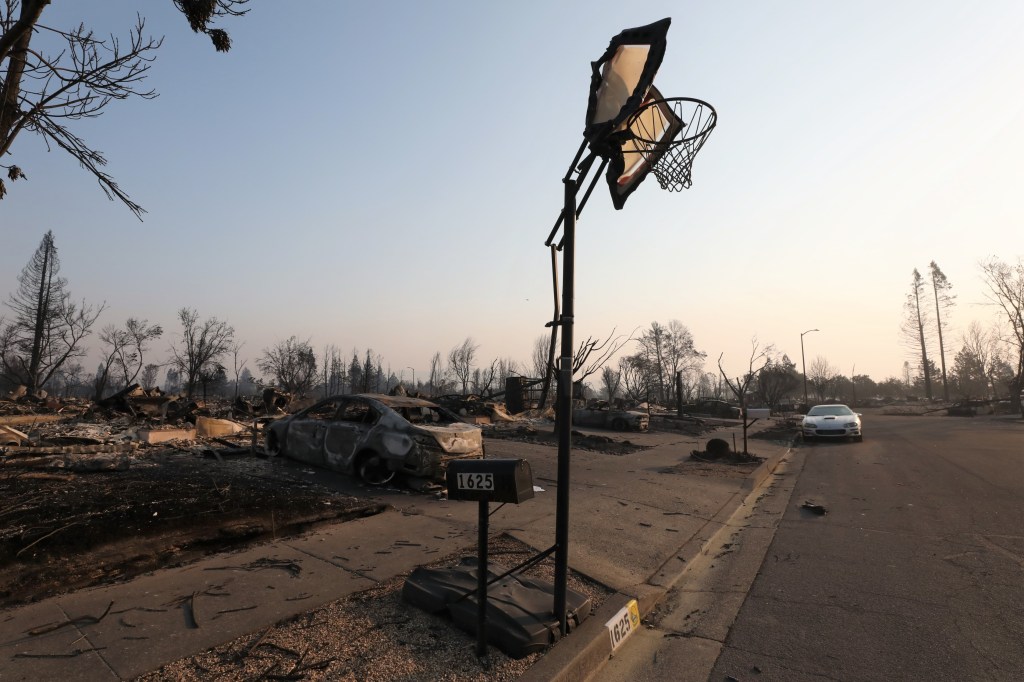
Firefighters gained ground against the deadly wildfires in California this week, with full containment predicted for sometime next week. Authorities looking ahead to the aftermath say toxic residue is a big problem, the Santa Rosa Press Democrat reported (see: “U.S. EPA to oversee toxics cleanup after fires in Sonoma and Napa counties,” by Guy Kovner). “In Sonoma and Napa counties, where more than 100,000 acres have burned, the chore looms so large the U.S. Environmental Protection Agency will manage the first phase, which involves removal of toxic materials from thousands of fire-scorched properties. That includes batteries, paint, solvents, flammable liquids, electronic waste and any materials that contain asbestos.”
The count of destroyed buildings is nearing 7,000, according to press reports. And although fire-destroyed buildings, unlike flood-damaged buildings, tend to be well covered by insurance, finding the workforce to rebuild won’t be easy. The San Francisco Chronicle had this report (see: “Construction labor shortage will slow post-fire rebuilding efforts,” by J. K. Dineen). ““There are not enough workers up here,” Keith Woods, chief executive officer at the North Coast Builders Exchange, an 1,100-member Santa Rosa trade group, told the Chronicle. “Contractors couldn’t find workers to do remodeling or repairs before the fire. It’s a serious problem that will definitely delay the rebuilding effort.”
“Even in the best of times, Sonoma and Napa were not counties known for rapid home construction,” the Sacramento Bee pointed out (see: “Northern California fire victims may want to rebuild. But can they find someone to do it?” by Stuart Leavenworth and Anita Chabria). “Sonoma issued 581 residential building permits in 2016, the most in a decade,” the Bee reported. “In Santa Rosa alone, the wildfire wiped out roughly six times that number of houses, a void that is sure to put upward pressure on housing costs across the North Bay.”
“It was hard to get workers before the fires, because the living costs in Sonoma and Napa are so much higher than elsewhere,” Philip Martin, a labor economist at University of California, Davis, told the Bee. “Most people would say it is going to get even harder to find workers after the fires.”
And the tight labor market isn’t a local, or even a California, phenomenon: it’s national. Jobless claims dropped this month to the lowest level in more than 40 years, the Houston Chronicle reported on Thursday (see: “US unemployment claims fall to 222,000, lowest in 44 years,” by Paul Wiseman, AP Economics Writer).