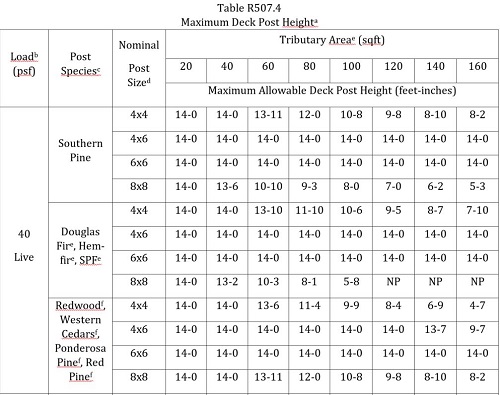
Among the dozens of proposals under consideration for the next (2021) edition of the IRC, of special interest to deck builders is RB184-19, a comprehensive reworking of section R507, the part of the building code that addresses residential decks. If the proposal passes as written, expect to see some big changes, including new guidelines for determining deck post height as illustrated in the chart below.
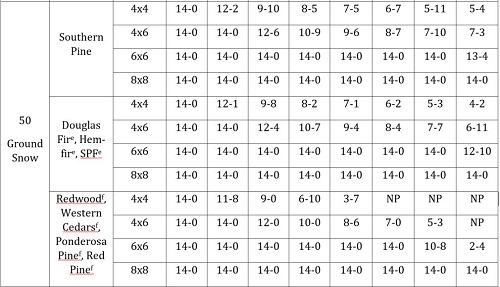
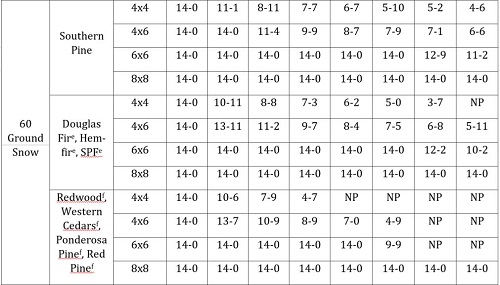
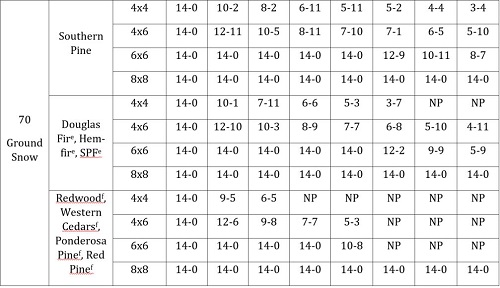
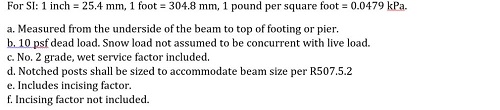
Table Courtesy Deck Code Coalition and the American Wood Council
The Backstory
Up until 2015, building codes pretty much ignored deck posts except to establish a minimum 4×4 wood (or a 3-in. dia. steel) cross section. But in 2015, the IRC introduced Table R507.4, which limited the height of a 4×4 deck support post to eight feet, without any consideration for how much area of deck the post was supporting. The engineering behind post sizing is based on how much weight the post can support without starting to bend out of plane. The longer the post, the less it can support. To illustrate, consider standing a toothpick on end and pressing on it with your finger; it hurts, doesn’t it? But if the same toothpick is two feet instead of two inches long, it will bow to the side and snap long before you flinch. This is the basic principle behind the science of post sizing. As critics of the 2015 sizing table pointed out, the problem with the 8-ft. maximum post height is that it was based on the worst-case loading scenario: a center post carrying a maximum-spanning (2) 2×12 beam from both sides and supporting maximum spanning 2×12 joists with a maximum cantilever. That’s a lot of maximums for a minimum-size post, one that may only be supporting the corner of an intermediate stair landing. The 2015 IRC doesn’t differentiate between the two scenarios; it’s a one-size-fits-all approach.
Fast forward to the next edition, the 2018 IRC, and at first glance it appears things got worse, since the 4×4 maximum height limit dropped to 6-ft. 9-inches. What happened? What happened is that the code provided more flexibility, but only if you carefully read the new footnote ‘c’. Codes have long required that all plies of a built up beam must bear on the post, so naturally a 4×4 (at only 3 1/2-in. wide) can only carry a three inch wide two-ply beam. Thus, the area of deck that can be supported by a 4×4 post is limited to two-ply beam spans. The 2018 height reduction recognizes proprietary post-to-beam connection hardware that will fully support a three-ply beam on a 4×4 post. With larger beams, the limit of deck area that could be supported increased, therefore decreasing the maximum post height. Fortunately, this was all explained in footnote ‘c’, allowing the previous 8-ft. height only when the more common two-ply beam is installed.
While the 2018 IRC version of Table R507.4 did expand on the 2015 version by allowing larger beams on 4×4 posts, it still didn’t solve the one-size-fits-all problem of limiting the height of all posts based on the heaviest loading possible. This is exactly why “the code” – which has been revised every three years since 1927 – will continue with that tradition. There is always a potential to make it more flexible and better reflect changing technology, knowledge, and design trends in a way that maintains it as a minimum standard.
More Flexibility
The more comprehensive post sizing Table R507.4 proposed by NADRA and other members of the Deck Code Coalition was developed with generous engineering contributions from the American Wood Council. If approved, the new table will allow posts to be sized based on the actual tributary area each post supports, and the different snow loads that a region may require. (The tributary area is simply half the joist spans, half the beam spans, and all the cantilevers that a post is within; the area of the geometric shape within those lines is the tributary area.) For small areas, such as a stair landing, the new table allows 4×4 posts to be as tall as 14 feet.
As you can see by looking at the table above, another variable addressed by this new proposal is the wood species of the post. Again, referring back to our toothpick analogy, compare the strength of a hardwood toothpick to one made with balsa wood. Clearly, one would snap before the other, and the new table reflects the fact that different wood species should yield different maximum post heights.
There’s still time for the general public to weigh in on these new proposals to the 2021 IRC (you can see all of them, including RB184-19, at this link).