

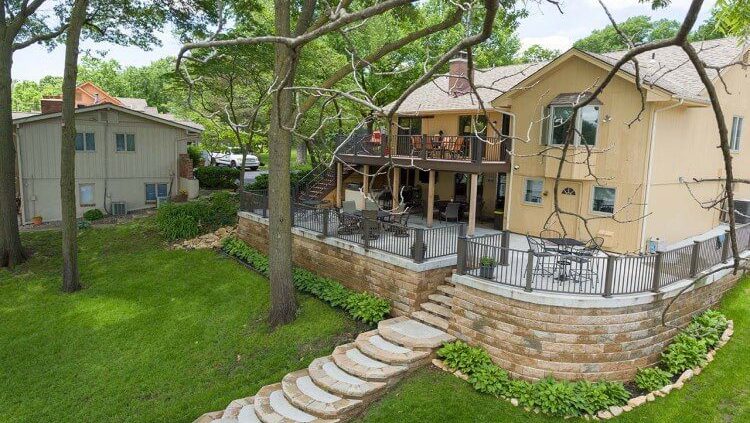
What should a contractor emphasize when evolving a deck-building practice into a full-service outdoor living company? According to Caleb Hunt of Creative Concepts & Design in Kansas City, Mo., design is the killer app. And that includes an effective design process. He credits his success, in part, to his collaborative approach.
When planning a complex project, Hunt gathers his concrete and landscape contractors together onsite with the homeowners. These are the big-picture subs who will configure the various outdoor spaces and make sure that each one complements the others. The team explores alternative layouts with the homeowners and hashes out details—a backyard charette, if you will.
Hunt approaches outdoor living spaces as a series of interconnected “rooms”—zones for cooking, dining, lounging, entertaining, or play—that need to flow together. “We approach this like an architect would,” he says. “[As a group], we ask the homeowners: How will you use each space? How many people will you entertain? Where will the main traffic paths be?” From there, the team works to optimize function and comfort.
The homeowners also get a better understanding of what’s possible at different dollar amounts, and why. All projects include budget tradeoffs, but Hunt finds that the in-person collaboration makes them happier with their decisions—and less likely to request change orders once work begins.
Clear Steps
The process follows a series of proven steps. “The first meeting is just me and the client,” Hunt says. “I’m vetting whether they’re serious, what they’re looking for, and whether we’re a good fit for one another.” Next, he maps out a preliminary deck plan and shares it with landscape designer Glenn Rhees of Rhees Outdoor Concepts and concrete contractor Brent Urbaniak. Then he schedules the on-site working session.
These get-togethers are more than talk. Each contractor brings domain-specific expertise and uses it to flesh out the vision for each zone.
For instance, Urbaniak focuses on the shapes and elevations of concrete patios. “I also help them decide what finish they want—broom-finished, stamped, or stained—and give them ballpark pricing,” he says. “And I make sure the patio will work with Caleb’s deck as well as with Glenn’s landscaping and stonework.”
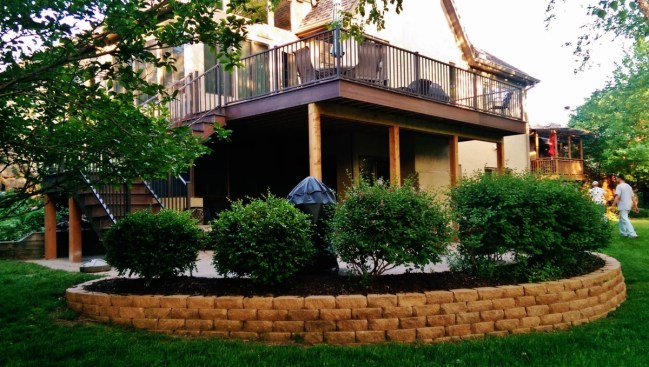
When it comes to stonework—whether it’s a wall defining a seating area, or a walkway connecting the project’s different zones—Rhees listens for stylistic preferences. “Do they want natural stone or stone veneer in certain areas? Or do they prefer something more contemporary like a stacked concrete product?” he says. Then he works with them to figure out how that lines up with their budget and their vision.
The onsite collaboration also solves another major hurdle: helping clients visualize the finished project as a livable environment. “A lot of people have difficulty picturing it,” Urbaniak says. “To help them, we draw it out to scale on site, sometimes with lines, paint, or even sticks and rocks.”
Rhees adds, “We bring product literature, photos from past projects, even sketches. It speeds up decision-making and gives the client clarity.”
Hunt says that clients love this process. “They get to talk directly with the experts,” he says. “Instead of me fielding questions about concrete or landscaping then coming back with second-hand answers, Brent and Glenn do a deep dive with them in-person.”
This approach also makes for easier value engineering. “Say the client wants 1,200 square feet of outdoor space, but decking and pavers are too expensive,” Hunt says. “Working together, we might come up with a plan to break it into different zones, swapping part of the deck for a broom-finished concrete patio, and then using part of the savings to build a pergola. It’s about maximizing impact within budget.”
Building Trust
The process also builds trust. “There are times when I skip a carpentry element because Glenn’s stonework will look better,” Hunt says. “And vice versa. The homeowners see that we’re all about delivering the best result for them.”
There’s a logistical advantage, too: Because Hunt, Rhees, and Urbaniak work together so often, there’s better project coordination and fewer delays. “If I had to bring in a different concrete contractor,” Hunt says, “I might wait weeks to get on their schedule. Our team flows better. We trust each other.”
Ultimately, Hunt’s onsite charettes create more than living spaces—they build confidence. By treating the outdoors as a series of rooms and drawing on the expertise of multiple trades, the team gets homeowners excited about the project. “When we lay everything out in person—with tape measures, paint, and input from the homeowners—it becomes real in their minds,” Hunt says. “They understand what they’re getting, how the spaces will work together, and what it will cost.”
This leads to faster approvals, smoother builds, and spaces that homeowners truly live in—not just look at. It also makes clients eager to refer the team to their friends.