
Q: We have a fence project coming up that will be built in a relatively wet area, right beside a swale. Plans call for the posts to be embedded in concrete, but it seems like when they’re installed this way in our area (Ontario, Canada), they always rot just below grade. While this makes removing the old posts easy—they just snap off at their base—I’d prefer that they last longer. In terms of durability, is there a better method for installing fence posts in cold climates? And is it okay to use regular 4×4 PT posts?
A: Grant Kirker, a research forest products technologist at the USDA Forest Products Laboratory in Madison, Wis., responds: Fence posts rot when decay fungi find wood they can digest. Insects such as subterranean termites can also cause posts to fail, but they aren’t common in cold climates, whereas fungi are widespread. The reason posts often rot at ground level and break off is simply because this is where conditions are most conducive for decay to occur, as well as being where the highest physical stress occurs. Here, fungi find the three basic things they need to grow and survive: moisture (from the soil), oxygen (from the air), and food (the post itself).
While some wood species—such as eastern white cedar and black locust—are naturally resistant to decay fungi, their performance is highly dependent on extractive content in the heartwood, which can be variable. Preservative treatment is a more controlled process that results in more predictable performance, especially in soil contact. Wood preservatives have historically been formulated to be broad spectrum so that they protect from a wide range of organisms. Most of the waterborne preservative systems commonly used today employ a metallic component (usually copper) combined with co-biocides to improve resistance to copper-tolerant fungi, molds, and bacteria. Our studies have found that yellow-pine posts treated with several industrial wood preservatives (including CCA, ACA, pentachlorophenol, and creosote) have remained highly durable even after 50 years of field exposure in a harsh environment.
U.S. Forest Service
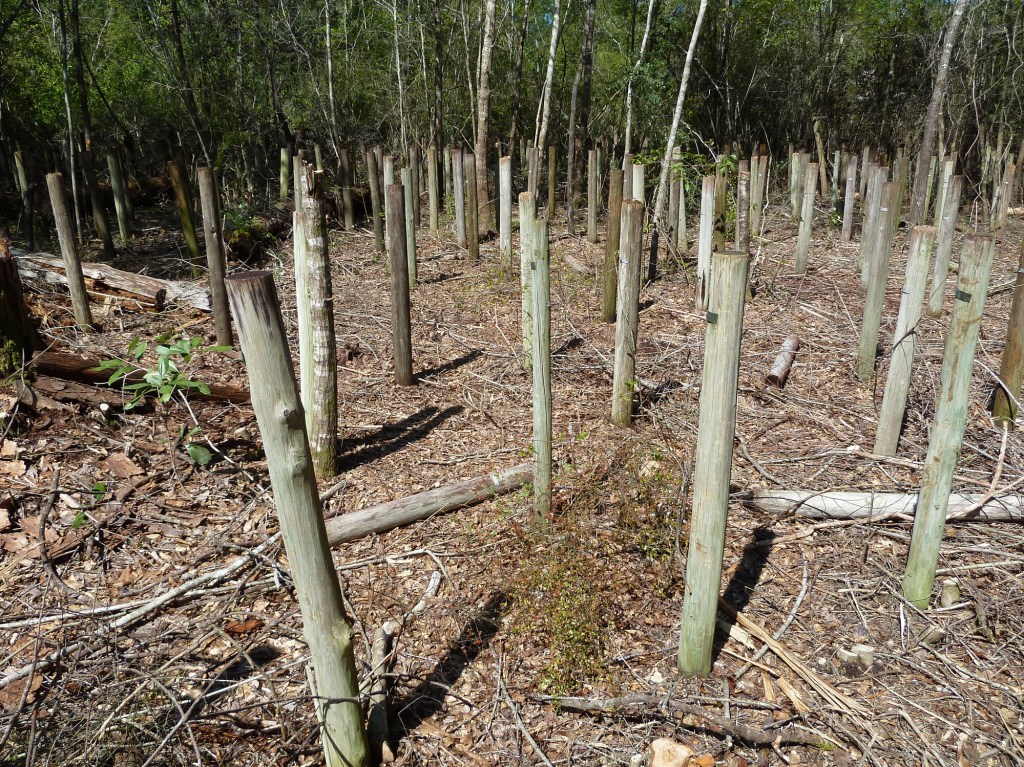
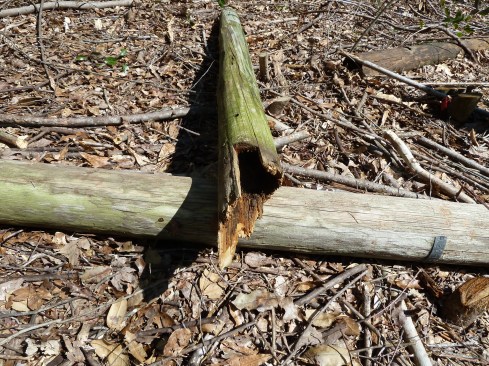
A post is assessed by giving it a lateral pull of 50 pounds. If the post breaks at the ground line, it fails; if it doesn't break, it passes. Tests have been conducted on these posts using this protocol since they were installed in 1964.
In order for the preservative to be effective, the wood must be treated to the proper retention level and penetration. If the wood is treated only on the surface, any cracks or splits in the wood open up the treatment envelope and expose untreated wood, which can be readily eaten by fungi and insects. Some species of wood (southern yellow pine, for example) are easy to treat and take up preservatives readily, while others (such as Douglas fir and lodge-pole pine) are more difficult to treat because of the orientation of their wood cells or presence of heartwood. These species are often referred to as “refractory” and may require additional preparation (incising, steaming, and so on) to open up the wood so that it better accepts treatments.
When choosing wood for fence posts, check the end tag to confirm that the lumber is pressure-treated in accordance with either the Canadian Standards Association, American Wood Protection Association (AWPA), or International Code Commission (ICC). On the label, look for the product’s designated Use Category, or UC. The AWPA’s Use Category system specifies target retention levels for different types of preservatives to meet specific applications; PT lumber intended for below-ground use will have a UC 4A or UC 4B label. UC 4B lumber (with a retention level of 0.60 pcf for CCA, ACZA, and ACQ) is required for harsh below-ground exposure in wet areas or regions with high decay hazard (like the Southeast or Hawaii), but ground-contact-rated 4×4 posts with a UC 4A label should be fine in your application.
It’s not necessary to special-order heavy-duty marine-grade PT lumber. Marine pilings are typically treated to retention levels as high as 2.5 pcf of CCA (chromated copper arsenate, which is generally no longer available for residential use) to ward off marine animals such as limnoria, teredo, and phloads, since some of these pests have been found to be tolerant of copper. But for soil exposure, higher loadings aren’t necessary and just increase the cost of the product you are installing.

U.S. Forest Service
In addition to long-term field testing of industrial wood preservatives, the Forest Product Laboratory conducts research to develop new and improved treatment schedules for a variety of wood species. The FPL's state-of-the-art wood-treating pilot plant, constructed in 2010, offers five different preservative treatment retorts that can accommodate samples up to 12 feet long.
If you have to cut a PT post, be sure to dress any field cuts with a copper-naphthenate preservative containing at least 1% elemental copper. Examples include Copper-Green’s Wood Preservative (coppergreen.com), Tenino copper naphthenate (coppercare.com), and Woodlife Coppercoat (rustoleum.com). Cutting, drilling, or notching PT lumber exposes inner faces of the wood that may not be treated to the same retention as the outer surfaces.
Some fence installers report that wrapping the post base with sheet copper or galvanized steel prolongs the life of their posts. While post wraps and barriers seem to offer some increased longevity, any gaps, holes, or voids behind the barrier or wrap will compromise the barrier and make it less useful. Coating the post base with asphalt roofing cement, driveway sealer, tar, or a bituminous self-adhesive flashing tape are fairly common practices. In concept, these practices would seem to block some moisture transfer into the wood, but there isn’t any research to suggest that it increases longevity.
Finally, setting posts in concrete offers several advantages. First off, it reduces lateral movement of the post once it sets, making the rest of the fence installation much easier. For square posts in foundations, it eliminates some shifting and settling. A recent European study that evaluated concrete vs. gravel vs. dirt fill found that the concrete fill was the best option in regards to longevity and durability, but again, proper pressure treatment is the key to long-term field performance. If setting posts in concrete, be sure to bring the concrete sleeve above grade and slope the top surface away from the post to shed water, as recommended in most local building codes.