By Charlie Wardell
Aluminum deck rails offer more consistent quality and faster installs than wood. We asked two experienced deck contractors, Randy Steyert of South Fork Decking in East Hampton, NY, and Leif Wirtanen of Cascade Fence and Deck in Vancouver, WA, for tips that will help first-time users of these systems.
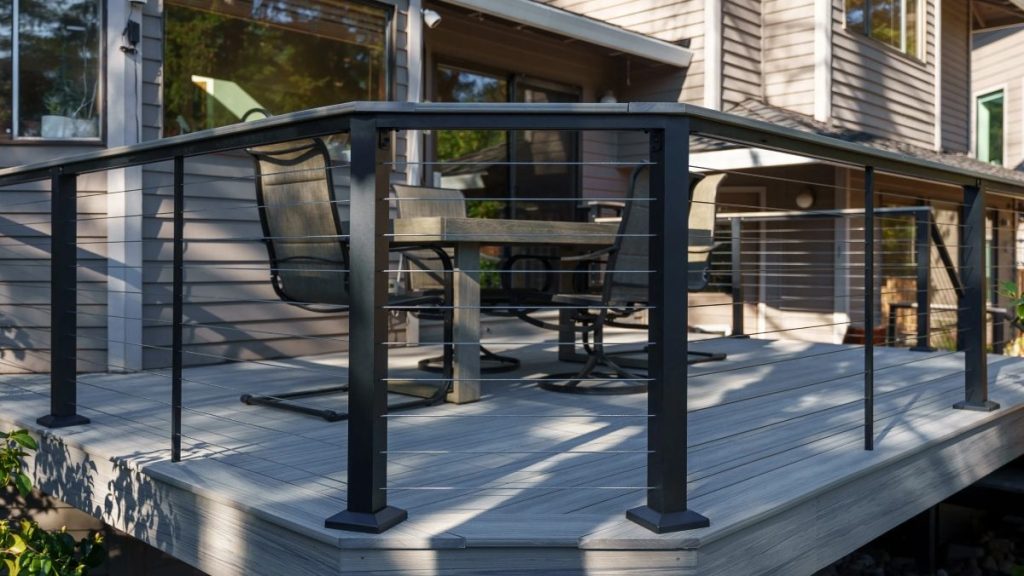
Both use Deckorators products and say that homeowners like the look. “The 2½-inch square posts work with traditional or modern aluminum designs,” says Steyert.
They’re also simple to install, according to Wirtanen, whose crews build roughly 400 decks a year. “It’s way easier to train new installers,” he says. And while aluminum costs more than wood, the time saved more than compensates. “In the end, we come out ahead.”
Making Posts Solid
Of course, screws need to bite into something solid. Wood blocking (6×6 or double 2x8s) is common, but water can cause wood to shrink and crack over time, weakening the connection. “That’s why we use a waterproof membrane,” says Steyert. He prefers to cover the entire frame, but at a minimum puts it over any joint that could trap water.
Another option is a composite product; it holds screws better than wood, and the connection will last a lifetime.
For fastening posts to a concrete deck, Wirtanen recommends Tapcon screws. “Their heads are small enough that the post’s base plate easily fits over them.”
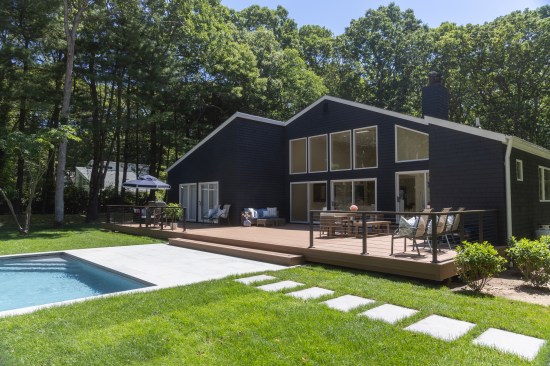
Photo courtesy of South Fork Decking
Tips for Balusters
With preassembled aluminum rail-and-baluster sections, length measurements should be made from the center of each section. “Otherwise, the gap between the post and the baluster at each end won’t be the same,” says Steyert.
Wirtanen’s crews measure and cut all sections at the same time on the ground. “We use a portable band saw. It’s faster than dragging sections to a chop saw.” To simplify cleanup, he recommends cutting over a tarp. “We tap each section after it’s cut to make the shavings fall out.”
If the metal gets scratched, he uses a Q-tip for touch-ups. “You don’t see the repair,’ he says, “whereas if you spray it, you will have a visible spot.”
Wirtanen says that one advantage of the Deckorators aluminum product is that their brackets leave some wiggle room when it comes to cuts. “You have about a 3/16-inch tolerance.”
The manufacturer supplies self-tapping screws for fastening brackets to posts, but Steyert recommends predrilling. “If you have too much torque, the stainless-steel heads can snap off. Predrilling eliminates that.”
He also recommends installing top brackets first, aligning them with a laser, hanging the railings in place, and only then fastening the bottom brackets. This ensures a visually straight top rail.
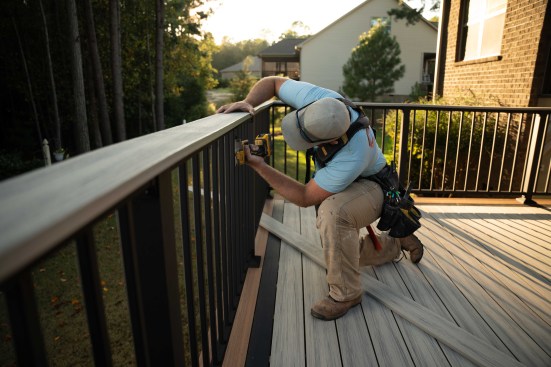
Photo courtesy of Deckorators
Wirtanen installs a lot of cocktail, or drink, railing. “We use a laser to mark post tops, then cut them with a circular saw,” he says. Baluster sections are installed flush with the top of the posts, then everything is capped with continuous deck boards.
The manufacturer supplies brackets for the cocktail rail, but there can be small gaps where light shines through. “We put caulk in between the board and the metal so that everything looks tight,” Wirtanen says.
The point here is that with good blocking, careful measuring, controlled fastening, and smart cutting, it’s not difficult to install aluminum railing that’s straight, tight, and trouble-free. As Steyert and Wirtanen show, some minor technique adjustments can make the transition from wood a lot smoother.
Upgrade your next project with railings from Deckorators and experience faster installs with lasting quality.