

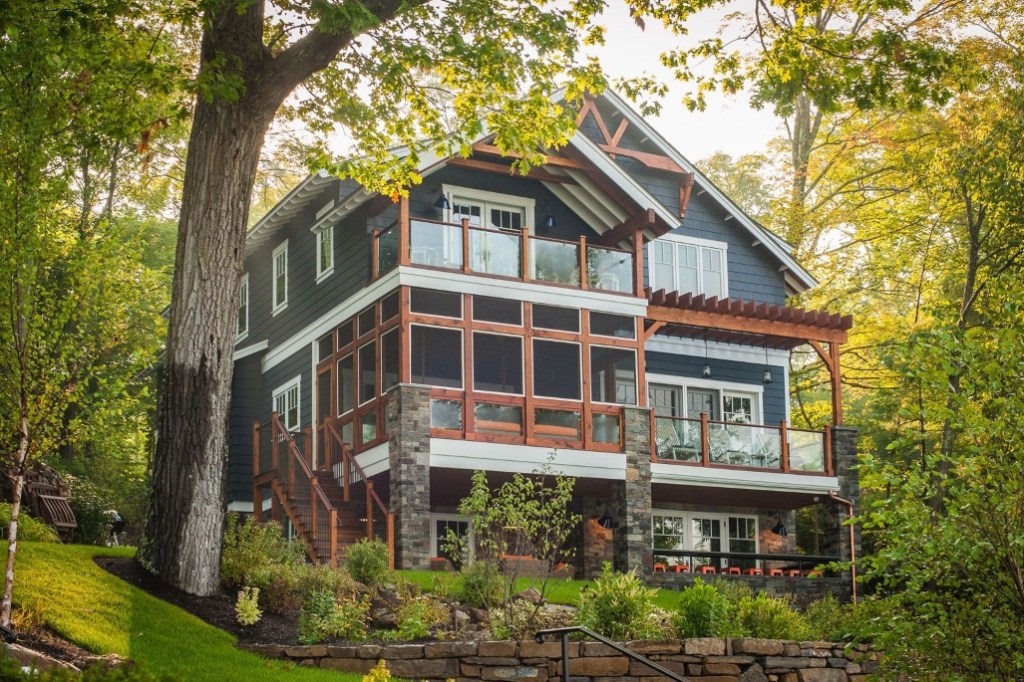
Smart design and material choices can transform an outdoor space into a high-performing extension of the home. The best designs respect the site, anticipate use patterns, coordinate materials, manage utilities, and create seamless transitions that make people forget they’ve stepped outside.
The first piece of advice is to design with the site in mind. A deck that cooks in the afternoon sun won’t get used much. And if the view is away from a water feature, the client will feel cheated.
Issues like these are why architect Edwin C. Anker of Phinney Design Group in Troy, N.Y., insists on a detailed site analysis. “We’ll design around a single tree if it matters to the homeowners,” he says.
His team requests a topographic survey, and they walk the property to understand light, wind, and sightlines. Time spent upfront prevents expensive mistakes later.
Optimize for Lot Coverage
Another issue with outdoor spaces is that zoning rules often specify a maximum lot coverage. This can motivate clients to build the biggest house possible, but doing so can leave them with an undersized deck.
“Maxxing out the house cuts down the available square footage for the outdoor space,” says Stacy Eakman of Alair Homes in Kirkland, Wash. Fortunately, the expansive luxury homes that Eakman builds can get away with a slightly smaller footprint. “Losing three feet in a big dining room won’t affect how the clients live, but the square footage gained can transform the outdoor space.”
Sort Out Client Needs
The best contractors aren’t order takers. They’re translators.
“We encourage people to think hard about how they’ll use their outdoor space,” says Rick Mills, senior project manager at Jackson Andrews Building & Design in Virginia Beach, Va. He says that people who don’t spend enough time on this often find that “how they use it is different than what they planned for.”
Because couples and families often don’t agree, Anker and his team make it a point to get everyone’s wish list. “We shut our mouths and listen,” he says. Only then do they work up a preliminary design concept. “At the end of the day, we want everyone to get something they want.”
Of course, the features that people think they want can differ from what they will actually use. The designer should help them determine which ones are practical. “Everyone starts out wanting pizza ovens,” says Eakman. “But after making three pizzas they realize that it’s easier to call Domino’s.”
The point is that novelties often get ignored, while essentials like prep space, a functional grill zone, and a place to stage food will get used. Prioritize them.
Material choices also matter a lot outside. “Quartz can fade; granite is a better choice,” says Mills. “And dark surfaces can get too hot to use in the sun.” An outdoor kitchen that fails in July is a disappointment.
A Roof Is a Must
Every professional we interviewed agreed that the highest-performing outdoor spaces are at least partially under a roof. Not a pergola. Not an umbrella. A roof.
“I can’t think of a project we’ve done that’s not somewhat under cover,” Mills says. Covered spaces feel like rooms. They can be decorated, lighted, heated and furnished, turning them into three-season rooms.
In many climates, screening is what makes the outdoor room usable for all of those three seasons. And if the budget permits, motorized screens offer a functional wow factor.
This is certainly true in upstate New York where black flies can make an outdoor space unusable in May or June. “We like the motorized screens that drop from the soffit,” Anker says. When retracted, they disappear. When deployed, they turn a porch into a room.
Mills’ clients want the same flexibility. Mills installs motorized Phantom screens on many projects. “It’s a fully open space, but when the bugs appear, you can enclose it with the push of a button,” he says.
Blur Boundaries With Materials
The surest way to make an outdoor space feel like an extension of the home is by choosing the right finishes.
This can even be done with spaces that are totally separate from the inside. A case in point is a covered porch with a fireplace that JR Kramer of Kassel Construction in Glenmont, N.Y., built for Anker. “We used tongue-and-groove mahogany floorboards, not decking,” he says. “It felt like an interior room, but it was screened.”
The lighting and furnishings were chosen to match the rest of the home. Fixed screen panels keep insects out without disrupting views. A door from the outdoor room leads to a curved deck against which a temporary skating rink can be installed in winter.
Not surprisingly, many projects use big sliding or folding doors to join the indoor and outdoor spaces. Material continuity becomes crucial here, and floor levels should be the same height, with no threshold to trip over. In one home, Anker used the same bluestone in the living room, the adjoining outdoor room, and the pool deck. “When the doors are open, you don’t know where inside ends and outside starts,” he says.
Locate the Kitchen Early
Clients may need to be reminded that outdoor kitchens require utilities, which need to be located before work starts.
Eakman pushes clients not to postpone this decision. “Otherwise you end up remodeling what you just built so you can rough in the gas, electric, and water,” he says.
The kitchen should also be placed with airflow in mind. “If you put a grille close to the main house, you might need a vent hood,” says Eakman. But if you put it away from the house, smoke might naturally flow to the outside.
Think Through Structure and Mechanicals
Structural and mechanical decisions can make or break a project. Here are a few to consider.
Build a stiff frame. Outdoor rooms carry more weight than ever: masonry fireplaces, stone counters, and flooring. If you’re building over a framed deck, you need confidence that won’t deflect or settle. “I want it over-engineered with steel so it feels nice and solid,” Eakman says.
Ensure adequate power. “A single outdoor heater might need a 40-amp breaker,” Eakman says. If the homeowners will eventually want two 40-amp heaters, make sure the electrical service can handle them. You don’t want to discover amperage limitations after the finishes are installed.
Don’t economize on doors. The door defines client satisfaction more than any other element. If it’s hard to open, they’ll be cursing you. “I advise people to spend less on windows if necessary, so they can purchase a more expensive sliding or folding door,” Eakman says.
Choose railings to enhance views. What’s important is how the railing looks seated. Eakman uses custom fabricated glass, but manufacturers like Deckorators also make high-quality glass railing products. The point is that when the view is the asset, you don’t want to fence it off.
The lesson is that today’s outdoor rooms have evolved into extensions of the home—and that clients judge them by the same standards. The difference between a deck that the family uses a few times per year and one they use every evening is not the grill, the countertop, or the furniture. It’s the planning.