
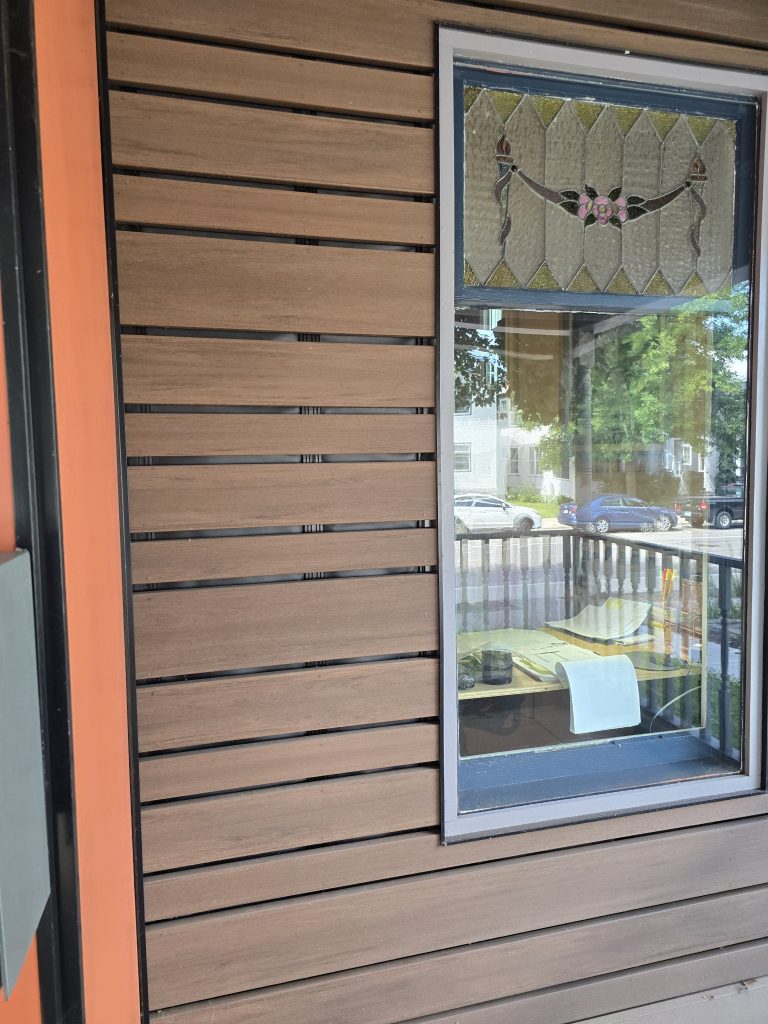
Q. Why do we care about installing insect screening over small gaps in rainscreen siding but not about doing the same with large gaps in open-joint cladding?
A. Michael Anschel, owner of OA Design+Build+Architecture, responds: Large gaps in cladding allow a lot of weather (wind and rain) to enter, which doesn’t make for a great private and protected space for pests. In fact, there is so much airflow behind open-joint cladding, and it is so dry, that the bigger issue is how dusty it gets!
A small gap, especially when paired with a large protected surface (like most claddings that don’t have open joints), makes the perfect protected house for insects or even bats. Wasps like to build their houses in the corners of eaves because they are dry. Spiders like corners (multi-slide doors are spider heaven). Bees like warm, cozy spaces with very tiny holes (stucco installed over lap siding is a favorite bee habitat).
Michael Anschel
The wide gaps in open-joint siding make the space behind the cladding too drafty for insect habitat. And it’s too small a space for spiders to build webs to catch flying prey.
How big should the gap be? When choosing a gap size for open-joint cladding, I’ve found it works to stay within this set of guidelines:
- The gap size can be between ⅞ and 3 inches.
- The adjacent boards can be 3 to 7 ½ inches wide.
- The relationship between the gap and the board need not be linear. For example, a wider board (say, 7 ½ inches) may be bound on either side by a gap of ⅞ inch, and a 3-inch cladding board may carry the same size gap.
- Open-joint cladding (OJC) laid out in a pattern of varying board widths looks better than a series of single-width boards. In the photo, below left, note how the boards vary in width, but the gaps remain consistent.
Keep the conversation going—sign up to our newsletter for exclusive content and updates. Sign up for free