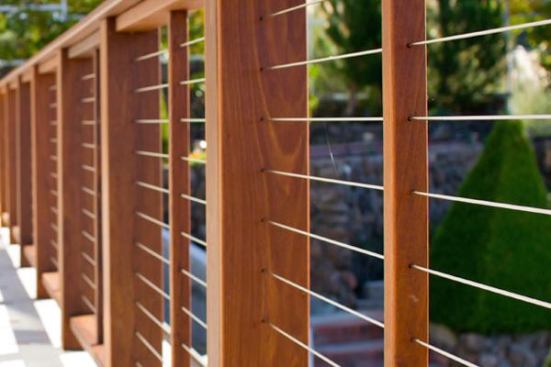
Cables for typical residential installation will have nine to 11…
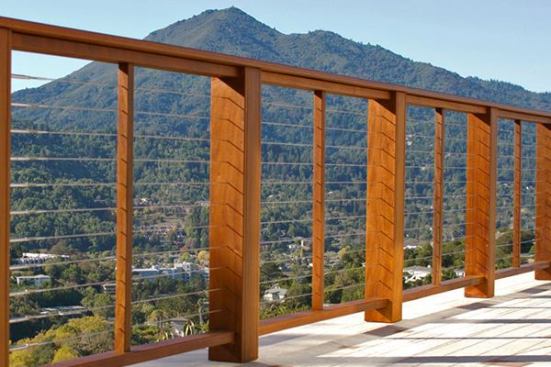
Cables for typical residential installation will have nine to 11 cables, while commercial-grade railing will have 12 to 13 cables because of the higher 42 inch top rail requirement. Cables on long runs can pass through the centers of intermediate posts.
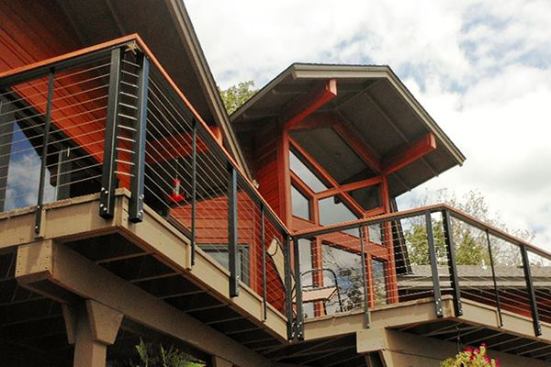
Cable railing can be held in place by site-built wood or metal p…
Cable railing can be held in place by site-built wood or metal posts Metal posts come in both tubular and rectangular profiles, and are often bolted to the outside of the fascia, as shown here. These posts can be topped with either metal or wood rails, depending on the manufacturer's options.
Most cable is 316-grade stainless steel, with common diameters a…
Most cable is 316-grade stainless steel, with common diameters at 1/8, 5/32, 3/16, and ¼ in. The ¼ inch used mostly for commercial work. "The price for [1/4 inch] jumps pretty substantially," says Mark Ellis of Creative Redwood Designs, a deck builder in Los Gatos, Calif. All cable comes with a listed "strand profile," which indicates how many strands of wire there are in how many groups. A 1×19 profile means there is one group of 19 strands, while a 7×7 cable has 7 groups, each with 7 strands. The strand profile affects the cable's strength and flexibility: the 1×19, the more expensive type, is stronger and stiffer, and the best choice for long, straight runs. The 7×7 is more flexible and suited to shorter lengths.
While some installers use runs of cable that are 100 ft. or long…
While some installers use runs of cable that are 100 ft. or longer, manufacturers recommend not going over 50 or 60 feet, as a longer run can make it difficult to get the 240 to 280 foot-pounds of tension that needs to be put on each cable in order for it to meet code.
A 36-inch high guardrail with 11 cables can have a total tension…
A 36-inch high guardrail with 11 cables can have a total tension of 2,640 lbs. on each end post, each of which has to be able to support that load with little or no deflection. If the deck has wood posts, a small amount of wood movement can cause the cable too sag.
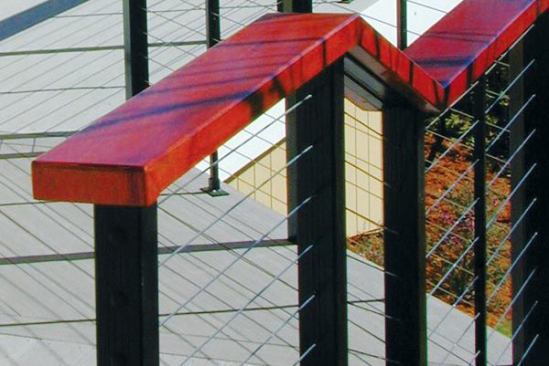
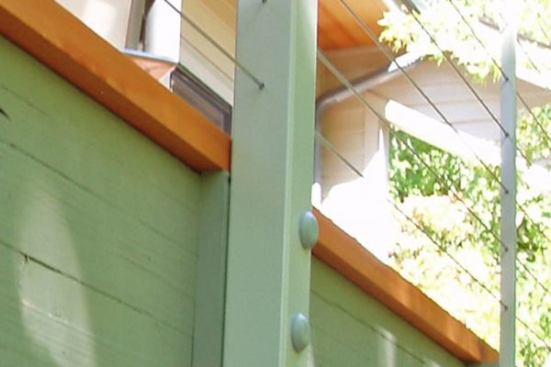
Cables can be made to turn corners without tensioning devices, e…
Cables can be made to turn corners without tensioning devices, either by fastening eyes bolt made for this purpose to the inside faces of the post, or by installing double posts at corners (pictured) and threading the cables through holes drilled through the posts. Be aware that corners make tensioning more difficult, so manufacturers recommend no more than one or two un-tensioned corners per run of cable.
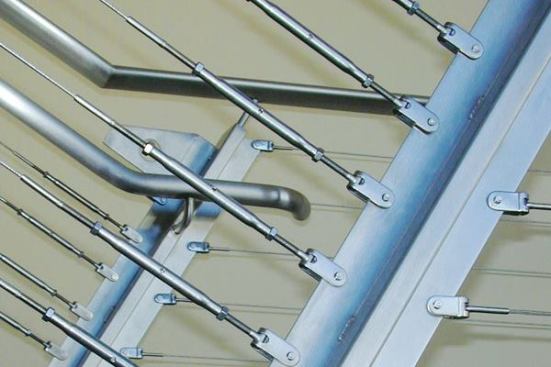
Hardware terminations are used to attach the ends of each cable …
Hardware terminations are used to attach the ends of each cable to a post or to the side of the house. Cables can be bought with pre-attached terminations, or the terminations can be installed on the jobsite. Termination fittings are much of the price of cable rail system. "They're where the expense is," says Kim Katwijk, a deck builder in Olympia Wash. "You can expect to pay more for the fittings than for the wire."
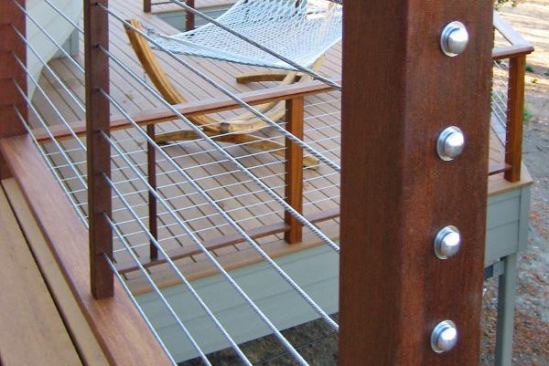
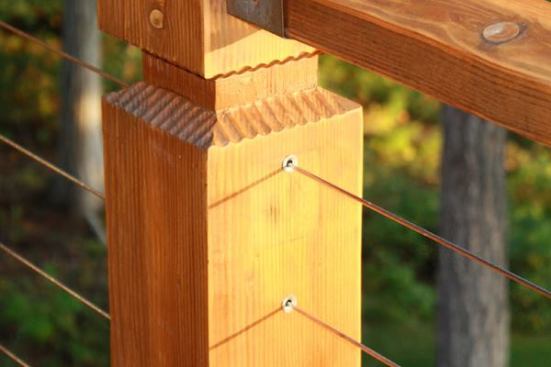
On long runs, cables can pass through intermediate posts without…
On long runs, cables can pass through intermediate posts without terminations. In the case of wood posts, metal sleeves should be used (pictured) to line the holes drilled through the posts. Otherwise the cables may wear away the wood and increase the amount of sag in the cable.
Cables can be ordered with terminations pre-attached to one or b…
Cables can be ordered with terminations pre-attached to one or both ends. If both ends of the cable have pre-attached terminations, one end will need to be attached to a tensioning device, so this needs to be taken into account. If the fittings are pre-attached to both ends, the installer has to provide the manufacturer with super accurate measurements.
Cable railing is all about aesthetics. On decks that overlook attractive landscapes, customers are often looking for guardrail systems that won’t block the view.
There are a range of cable railing systems available, with each manufacturer offering unique choices in posts, rails, and hardware. The slide show at left provides a quick introduction to some of the choices. If you’ve installed cable rail on any recent projects, tell us about your experience in the comments section below.
To learn more about cable railing and deck construction in general, check out The JLC Field Guide. The Field Guide is free to anyone, but you will be asked to register first.
Clay DeKorne is the Chief Editor of the JLC Group, which includes The Journal of Light Construction, Remodeling, Tools of the Trade and Professional Deck Builder.
He was the founding editor of Tools of the Trade (1993) and Coastal Contractor (2004), and the founding educational director for JLC Live (1995). Before venturing into writing and education for the building industry, he was a renovation contractor and carpenter in Burlington, Vt.

![Most cable is 316-grade stainless steel, with common diameters at 1/8, 5/32, 3/16, and ¼ in. The ¼ inch used mostly for commercial work. "The price for [1/4 inch] jumps pretty substantially," says Mark Ellis of Creative Redwood Designs, a deck builder in Los Gatos, Calif. All cable comes with a listed "strand profile," which indicates how many strands of wire there are in how many groups. A 1x19 profile means there is one group of 19 strands, while a 7x7 cable has 7 groups, each with 7 strands. The strand profile affects the cable's strength and flexibility: the 1x19, the more expensive type, is stronger and stiffer, and the best choice for long, straight runs. The 7x7 is more flexible and suited to shorter lengths.](https://jlconline.stg.zonda.onl/wp-content/uploads/sites/4/2025/06/773123899-cable-railings-03-tcm96-2118186.jpg?w=551)