

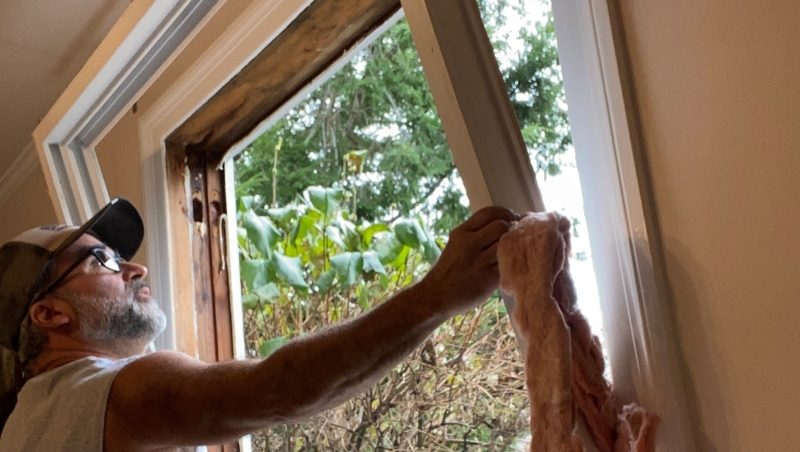
When homeowners ask for new windows, what they really want is your help deciding on an insert/retrofit or full-frame replacement. Each option determines everything that follows: scope, detailing, cost, and how the assembly will perform in years to come.
We spoke with seasoned experts on how they steer that decision and manage expectations when costs rise or timelines shift.
Make the Call Before You Order
Long Island–based builder and JLC Live educator Mike Sloggatt puts it bluntly: “I think once you’ve ordered the window your committed. You need to make the decision before.” The right choice up front prevents change-orders and keeps trust intact.
Start by evaluating the outside. Peeling paint, soft sills, open joints at the head, and suspect casing miters suggest water has been getting in for a while. Inside, stains at jambs or sills—and out-of-square openings—hint that the frame is working against you. In this case, direct clients toward a full-frame replacement.
“You don’t want to put lipstick on a pig,” Sloggatt says.

A replacement should be a long-term fix. That’s why Manny Silva is careful to install correctly, creating a continuous water/air path back to the WRB with pan and head flashing to complete the sequence.
When Retrofit Makes Sense
Retrofit, or insert, windows preserve existing frames and interior trim. They’re faster, cleaner, and typically less expensive. They also minimize disruption in homes where millwork is the point. Sloggatt points to houses from the 1920s and ’30s with elaborate casings: full-frame replacement there can be a “royal mess.” If the frame is sound and square—and the owner can accept a modest reduction in glass area—a well-fitted insert can deliver the comfort and efficiency gains clients expect without tearing up finishes they love.
North of Boston, Manny Silva of Silva Lightning Builders takes the same approach when historic interior details are intact. But he’s direct with clients about limits: Replacing the sash and glass won’t fix a leaky frame or a cold wall. “When you get a replacement window, you are only insulating the window itself. Everything around is still going to be drafty,” he tells homeowners. In other words, inserts are about upgrading the unit; they are not a magic cure for a broken envelope.
When Full-Frame Is the Honest Choice
If there’s rot, failed flashing, or a cladding/WRB condition you cannot properly integrate to, inserting a new unit into an old problem just buys time. Sloggatt recalls consulting on a coastal project where the plan was to set flanged prime windows inside the opening and call it an insert. He shut that down. “This will not work. This will leak,” he told the team. The assembly needed a pan at the sill, positive-lapped flashing, and a clean tie-in to the WRB—work that only happens when you go back to the rough opening.
He’s opened windows rotted “down to the sill plate,” and rebuilt walls after years of unnoticed leakage. Those are not glazing failures; they’re water-management failures. Full-frame replacement is the chance to reset that system correctly and give the window a fighting chance.
Details Decide Durability
Good windows installed poorly become bad windows in a hurry. Silva’s process starts with measuring the opening, not guessing through the glass. He schedules a separate visit, pulls interior stops where needed, measures at multiple points, and orders exact sizes. That discipline has paid off. “I’ve done about 2,000 replacement windows … [with] maybe two” mis-measures, he says. On install day, he and his crew take the time to set, shim, and square so the sash operates smoothly before any foam or sealant goes in. “Replacements are easy to do, but so many people just slam them in place,” he says. “They don’t adjust them … and a year or two later, they’re not working properly.”
On consulting jobs, Sloggatt likes to mock up the pan, demonstrate the flashing sequence (pan, jambs, then head), and make sure the tie-in to the air barrier is real, not aspirational. Increasingly, he’s brought in by manufacturers to supervise that first opening. “Having us out there on a job can save them thousands of dollars,” he says, simply by getting the sequence right before crews repeat a mistake 20 times.

A continuous bead of sealant at the perimeter readies the opening for the new unit.
Budget, Scope, and No-Surprise Communication
Price the decision, not the wish. Sloggatt builds value into the conversation by making the invisible visible: the sub-sill pan, the roll of flashing tape, the air-sealing that will keep trims warm and dry. “If I’m spending $35 on flashing tape on sub pan, I’m letting them know the value they’re getting,” he says. He also draws a hard line when a client insists on the wrong path. “If they want replacement window and it doesn’t look like it would be a fit, I’m walking away from the job,” he says.
Silva takes a similar approach. His estimates spell out the sequence—remove stops, remove pockets/weights, air-seal cavities, set and shim, foam and caulk—so bids can be compared apples-to-apples. When hidden rot appears, he pauses, prices the change, and gets sign-off immediately. The worst time to discover scope creep is at the end.
Avoid the Mid-Stream Pivot
Every contractor has lived the nightmare: Inserts are ordered, demo reveals a rotten frame, and now you’re improvising jamb kits to rescue a plan that should have been a full-frame from the start. Sloggatt’s advice—to decide before you buy—isn’t about being cautious; it’s about being honest. Likewise, Silva has made the mid-stream pivot when he had to, but he’s blunt about the trade-off: “So it kind of sucks because now I’m doing things harder. I’m not getting the full effect of a new-construction window.”
The Close: Sell the Outcome, Not the Unit
Both pros come back to the same principle. Windows are only as successful as the walls they’re placed in. Inserts are the right choice when the frame is sound and the finishes are worth saving. Full-frame is the right choice when you need to fix water and air paths and start fresh. “It’s all about the installation,” Silva says. Sloggatt agrees—and he’s willing to lose a job over it. “We always try to get them to make the right decisions even if it means losing a job.”
Tell the truth about the trade-offs, and detail the winning path. Do that, and window replacements are no longer a gamble but a winning upgrade.