Third-generation wood treater Hal Bumby of Maine Wood Treaters l…
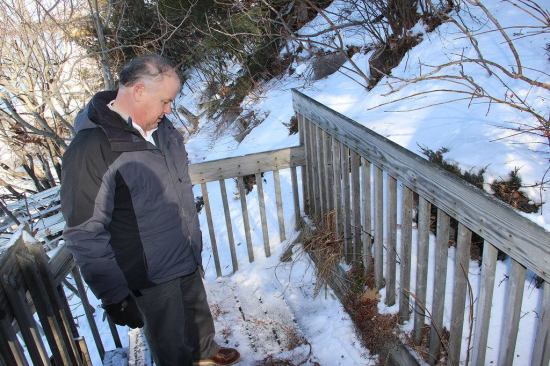
Third-generation wood treater Hal Bumby of Maine Wood Treaters looks at a decades-old treated wood structure on the shore of Sebago Lake in Maine. This deck and staircase, built with CCA (chromated copper arsenate) lumber, is still sound after many years of exposure to weather and ground contact. But newer types of decking and framing lumber would not be warrantied in the same application — not because of a less effective formula, but because of a lower required dose of the treating chemicals. Bumby advocates returning to a policy of ground-contact treatment for all treated lumber: “One product, suitable for all applications.”
Wood treater Hal Bumby walks on a walkway installed on grade usi…
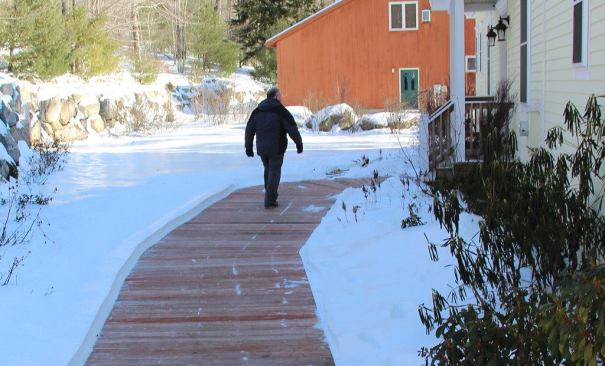
Wood treater Hal Bumby walks on a walkway installed on grade using lumber treated with micronized copper azole (MCA) and infused with an integral iron oxide color treatment. The wood is holding up well after several years in place. But the 5/4 boards, like all decking in the market today, are not treated to ground-contact levels and would not be warrantied. Bumby treated the wood at his own Maine facility, and he comments: “I’m a wood treater. And even I am using material that’s not recommended for this application. How can we expect contractors to know the difference?”
A closer look at the colorized deck boards installed as a walkwa…
A closer look at the colorized deck boards installed as a walkway on grade near Sebago Lake in Maine. This wood contains a copper-based preservative as well as an iron-oxide colorant, both applied deep into the wood using pressure treatment. So far the wood looks fine and is sound, despite the off-label use. But in the event of early decay, the lumber would not be guaranteed because it is not labeled or code-approved for ground contact. In the past, all treated lumber, including deck boards, was typically treated with concentrations of chemical allowing the wood to survive contact with the ground.
This treated wood staircase near a motel in North Dartmouth, Mas…
This treated wood staircase near a motel in North Dartmouth, Mass., dates back to the 1990s, and was constructed with CCA lumber before the arsenic and chromium formula was phased out. The 2×10 stair stringers are partially buried in the earth. Today, 2×10 lumber treated with MCQ, MCA, or CA preservative formulas would not be approved for this use because the wood contains a lower concentration of the treating formula in order to reduce the treatment cost.
A closeup of the label still attached to the old CCA staircase b…
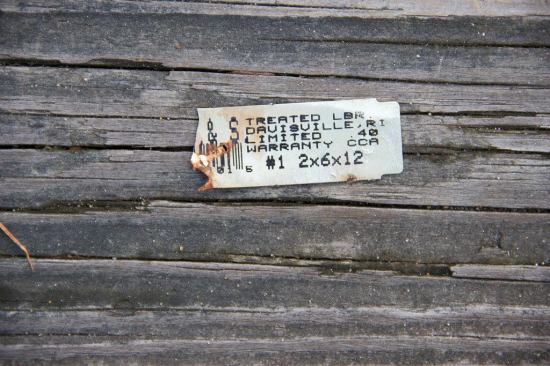
A closeup of the label still attached to the old CCA staircase built on ground in North Dartmouth, Mass., in the 1990s. The number “40” in the label refers to the treatment formula concentration, or “retention” — 40 pounds of retained copper per cubic foot, the level specified for fence posts, landscape ties, and poles in ground or fresh water. This label was taken from a 2×6 board on the walkway, indicating how all treated wood was customarily treated for ground contact in the late 20th century.
A close-up of the label on a piece of CCA-treated wood on a guar…
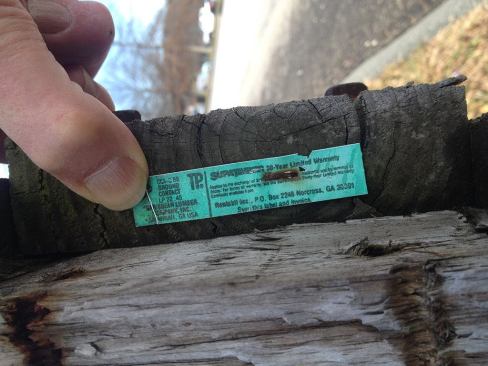
A close-up of the label on a piece of CCA-treated wood on a guardrail by a road in North Dartmouth, Mass., near New Bedford south of Boston. The label specifies a chemical loading or “retention” of 40 pcf, suitable for ground contact, although the wood is installed above the ground. The wood has weathered, but is sound and free from rot, despite being subjected to years of damage from road salt, snowplowing, vehicle contact, and weed-whacking.
A view of the end of a fresh 2×6 treated-wood post on a job site…
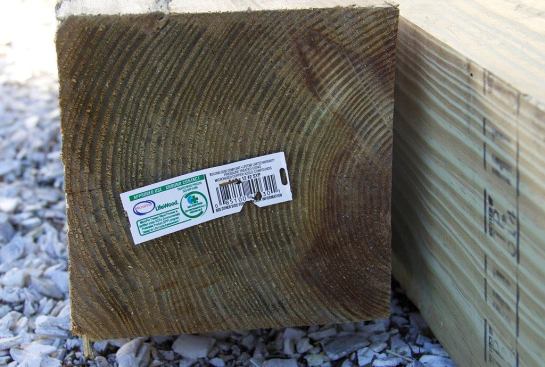
A view of the end of a fresh 2×6 treated-wood post on a job site in Massachusetts, showing the code-required wood-treatment label. This wood is approved for ground contact, like all treated 4×4 and 6×6 lumber in today’s market. (However, cut ends must be field-treated with a copper naphthenate solution in order to maintain warranty coverage, because the treating chemicals penetrate the wood from the inside out, and chemical concentrations are usually lower near the center of the piece.)
A close-up of the code-required label stapled to the end of a pr…
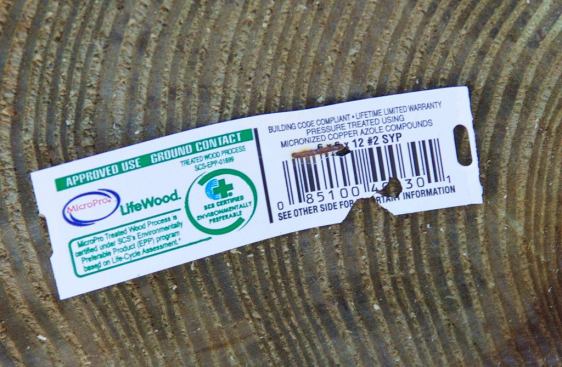
A close-up of the code-required label stapled to the end of a preservative-wood 6×6 Southern Yellow Pine post. The label shows the approved use (“ground contact”), and identifies the treatment chemical (“copper azole”).
Another treated-wood 6×6 post end from the same Massachusetts jo…
Another treated-wood 6×6 post end from the same Massachusetts job site, with a close-up of the required label (inset). The “µCA-C” designation indicates that this wood is also treated with micronized copper and an “azole” pesticide, but using formula supplied by a different chemical company. The label also specifies that the 6×6 is approved for ground contact. As with the other post, every cut must be field-treated using copper naphthenate or the warranty will not be honored. It’s common to see treated lumber from different wood treating facilities, treated with different formulas, on the same job site or on racks at the same lumberyard. It’s up to the end user to make sure that the lumber is appropriate for the application.
The ends of two preservative-treated Southern Yellow Pine 2×10 b…
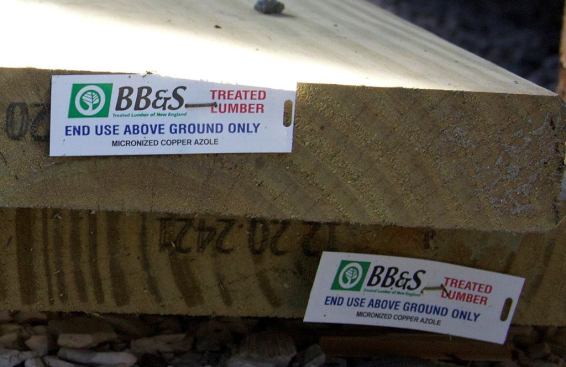
The ends of two preservative-treated Southern Yellow Pine 2×10 boards on a Massachusetts job site. The labels on these boards indicate that the wood is not approved for contact with the ground. That’s rarely a problem in a deck framing situation; however, if the boards are used as stair stringers and with the lower ends touching the ground, the use is not approved or guaranteed. Premature rot of treated-wood stair stringers has been reported in that situation — particularly in coastal exposures and in hot humid climates.
A view of a landscaping detail in Maine: a planting box outside …
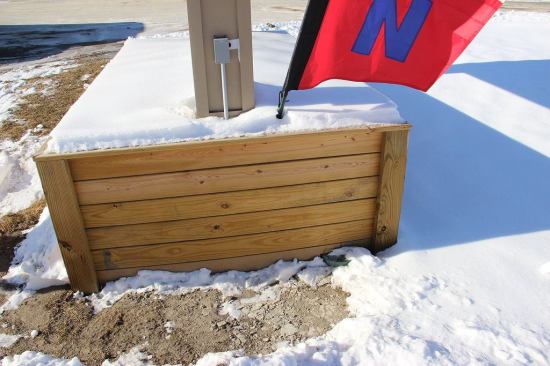
A view of a landscaping detail in Maine: a planting box outside a small office building near a road, filled with soil. This application subjects the wood to conditions that are unusually conducive to decay. But the material, 5/4 treated decking, is not treated to levels appropriate for ground contact, and is not warrantied for this application. Building codes do not regulate planting boxes.
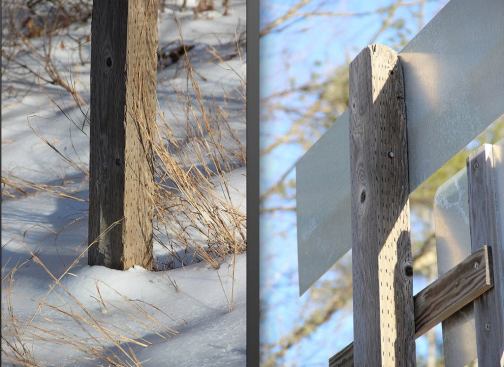
Two views of a road-side signpost in rural Maine, sawn from east…
Two views of a road-side signpost in rural Maine, sawn from eastern Hemlock wood that has been incised, kiln-dried, and then pressure-treated with dissolved (not micronized) copper azole. Maine wood treater Hal Bumby has been treating signposts like this on a state contract since the 1980s, first using CCA, and then using dissolved copper azole after CCA was phased out. Bumby uses dissolved copper azole instead of finely-ground micronized copper for this purpose because Hemlock is what is called a “refractory” wood species — meaning that it does not readily soak up the treating chemicals. Bumby says that whether treated with CCA or with copper azole, the Hemlock wood is good for decades of service buried in the ground — as long as the proper concentration of the treating formula is applied.
Deck builder Jim Finlay wants his arsenic back.
Finlay, whose company Archadeck of Suburban Boston builds custom decks, patios, and sunrooms in the Boston, Mass., area, says, “I’m still a little miffed about the way they discontinued CCA.” CCA, the old familiar green-tinted chromium- and arsenic-treated lumber, which was phased out of the residential market in a 2002 deal between the EPA and the treated-wood industry, was undeniably effective against bugs and rot — and, like many people, Finlay thinks the hazards of the material were exaggerated.
But Harold Bumby, the founder and owner of Maine Wood Treaters in Mechanic Falls, Maine, has a different point of view (see slideshow above). Bumby agrees that the old CCA got a bad rap, and he agrees that it worked beautifully in its day. But realistically, he says, CCA is gone and it’s not coming back. After all, while there is little if any solid evidence that CCA-treated lumber used in home construction is dangerous to homeowners or carpenters, the concentrated arsenic and chromium formula used to treat the wood could be extremely dangerous to workers at the treating plants — and spills at the facilities have been known to cause serious environmental cleanup problems. There are almost 60 wood-treating plants on the EPA’s list of Superfund sites. The government is not going to back off.
Anyway, says Bumby, the new, safer, arsenic-free formulas in today’s market can be as effective as CCA was. But there’s a caveat. “With CCA,” he says, “I never heard about a problem. None. Never. It always worked.” With the new treated wood, he says, “There are some failures. Not a lot. Only a few. But with CCA, there were none.” Bumby prefers none.
Jim Finlay has seen it. In one case, he says, he was under contract to replace just the decking on a deck built with the newer treated wood. When he looked at the stairs up to the deck, however, he found that the 2×10 stair stringers were rotten where they contacted the ground. “I told the owner we had to replace the stair framing, not just the treads,” he says.
That problem is familiar to Bumby, and to managers who have to handle complaints and warranty claims at the companies marketing the major brands of treated wood. The problem, says Bumby, is that these days, treated 2x framing lumber isn’t made for ground contact. Bigger members, like 4×4 and 6×6 posts, get a higher dose of chemical (called “retention”) at the treating plant, and they can handle being buried (although installers should treat cut ends in the field with copper naphthenate). But 2x4s, 2x6s, 2x8s, 2x10s, and 2x12s are treated, rated, labeled, and guaranteed only for “above ground” exposures. You can leave them out in the rain. But you can’t lay them in the dirt.
Deck builder Finlay occasionally needs to build a three-banger 2×10 girder and set it into the ground for a wood deck built at grade. “But I can’t get a 2×10 or 2×12 rated for ground contact,” he says. “Nobody stocks it.” Executives at the major chemical companies agree — if you want a 2×10 stick treated for ground contact, it’s a special order, and you’ll have to wait a few weeks and pay a premium. “That’s just not practical for builders,” says one exec.
On a drive around his neighborhood in Maine, Bumby showed me a walkway built with 5/4 material treated at his own plant, installed at a house he used to own. The boards, laid directly on the ground, weren’t warrantied for that use. They still look good after five or six years, and Bumby is crossing his fingers. But Bumby says, “Look, I’m a wood treater myself. If it’s too complicated for me to get this wood in ground contact retentions, how can we expect contractors to do it?” One industry executive says, “Some of the people in the industry are saying, ‘we need to educate the end users.’ But I don’t think we can educate our way out of this.”
Back in the day, says Hal Bumby, things were different. Bumby grew up in the treated wood industry. His father and his grandfather were wood treaters. In Minnesota, where he grew up, Bumby could look at any utility pole and see his family’s company mark. “In those days,” he says, “there was only one product on the market. It was a general use product — which means, you could use it for ground contact, or above ground applications. People didn’t want to stock two products at the lumberyard — they didn’t have the space for that. And if you wanted to stock just one product that was for every use, it had to be ground contact.” That was the World War II generation, says Bumby: “They knew how to get things done. They kept things simple.”
Bumby wants to go back to the way things used to be. At a September 2014 meeting of the American Wood Preservers Association Technical Committee in Portland, Maine, Bumby made his case to his fellow wood treaters — and, surprisingly, many if not most of them agreed.
“I wanted to go back to treating everything to ground contact,” says Bumby. “Two by fours, 2x6s, 2x8s, even 5/4 decking.” The other wood treaters and chemical industry execs at the Portland meeting wouldn’t go that far. But they did accept the idea of changing the industry’s treating standard to require ground-contact treatment for all 2×8 and wider stock. The reasoning, according to one industry executive, was that if a deck board starts to decay, it’s easy to replace and it doesn’t create a major risk, while if a deck framing member fails, there’s a structural hazard that requires a costly repair.
The cost increase for end users will be relatively minor, says Bumby. But he’s in a cut-throat industry, and he says, “I could never do it on my own. If I’m the first one to treat all my lumber for ground contact, I’ll lose all my customers. It has to be everyone at once.” An AWPA committee is studying the proposal, and the industry association plans to bring the idea to a full vote this coming spring. If the measure passes, there will be a grace period for suppliers and lumberyards to work their way through their existing inventory of above-ground-treated material. After that, all the wide 2x stock on the home center and lumberyard shelves will be treated to be buried in the dirt. It’s not a done deal yet. But there’s a decent chance that by 2016, Jim Finlay will be able to get his 2x10s rated for ground contact at any lumberyard — and with no waiting.