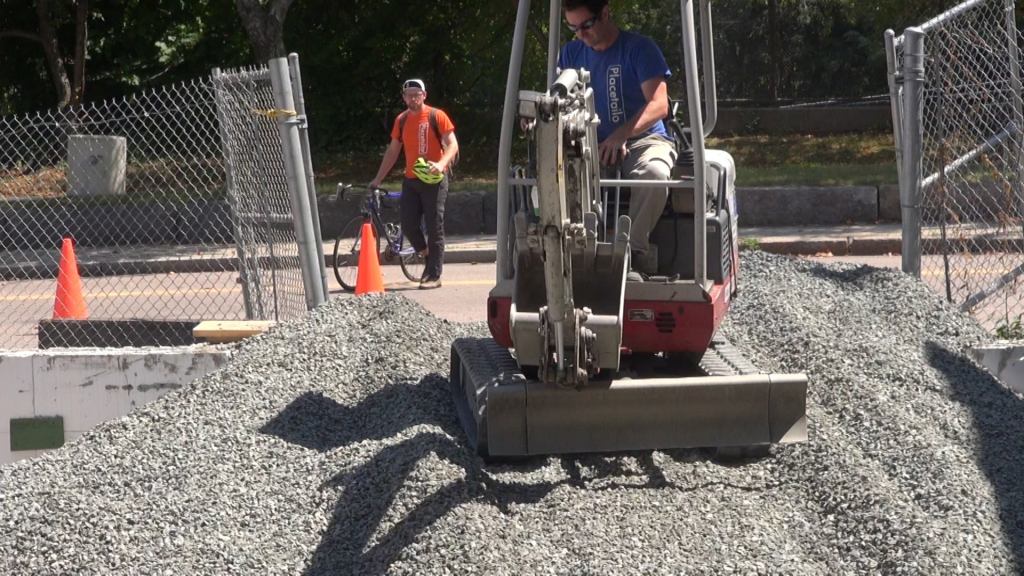
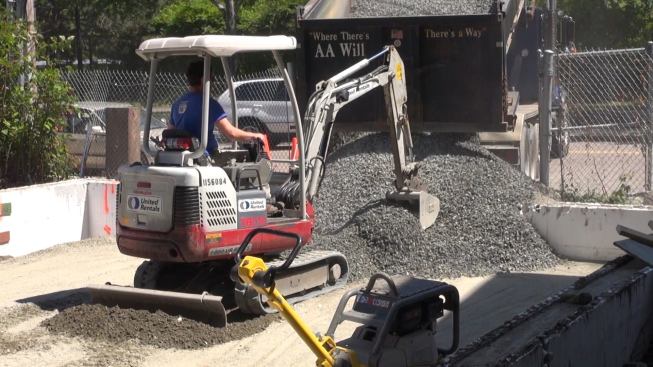
Placetailor director of development, Declan Keefe, arrives at the job site by bicycle, as company operations manager, Evan Smith, moves a fresh load of gravel onto the foundation slab pad using a skid-steer mini-excavator. Educated as architects but experienced in construction, Keefe and Smith are co-owners of the company, and the only members remaining from Placetailor's original group of founders.
Project manager, Steve Daly, and carpenter Greg Hunt carry a bun…
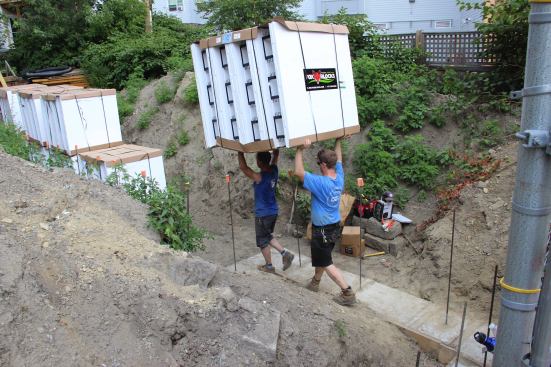
Project manager, Steve Daly, and carpenter Greg Hunt carry a bundle of foam forms into the foundation hole on site. The lightweight foam forms eased the labor of construction for the project while improving the foundation’s energy performance.
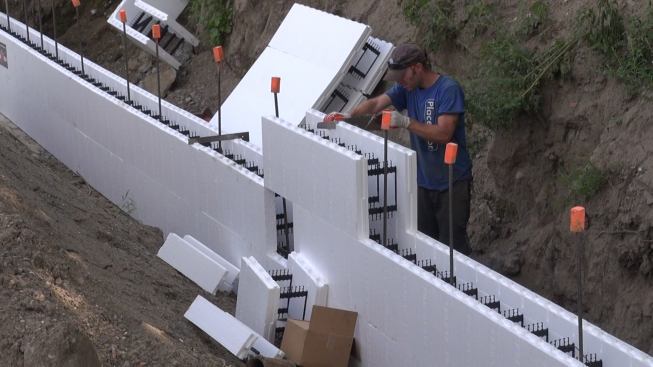
Steve Daly sets a corner form section for the ICF foundation sys…
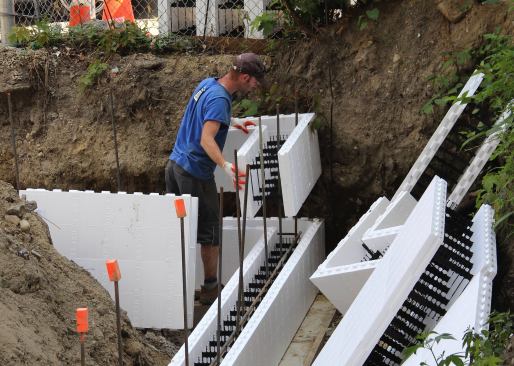
Steve Daly sets a corner form section for the ICF foundation system. The recommended process is to start setting foam form blocks in the corners and work toward a point in the center of the wall.
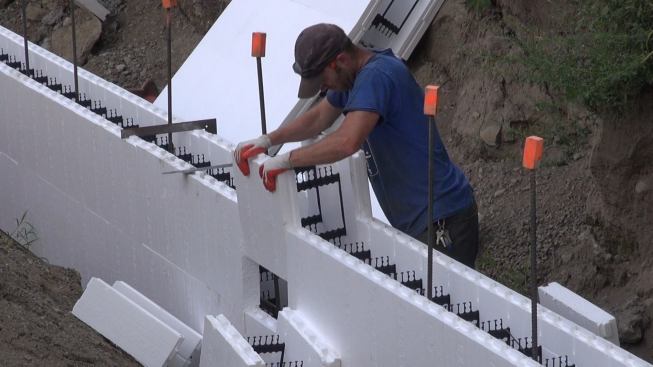
Steve Daly sets a wall form block, working from the corner towar…
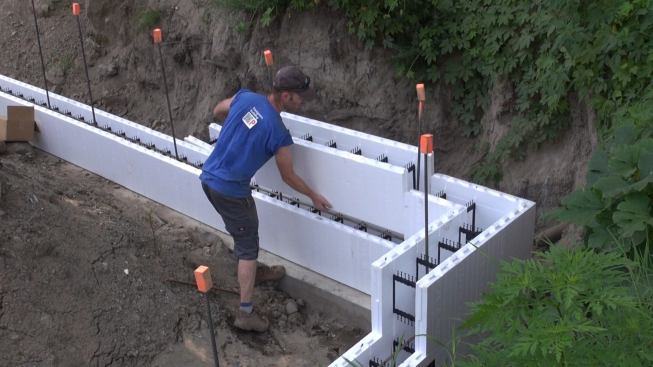
Steve Daly sets a wall form block, working from the corner toward the center of the wall.
At the center of the wall, sections have to be trimmed with a ha…
At the center of the wall, sections have to be trimmed with a handsaw to fit into the remaining gap.
Steve Daly slides a cut-down segment of foam form into the remai…
Steve Daly slides a cut-down segment of foam form into the remaining gap in the wall line.
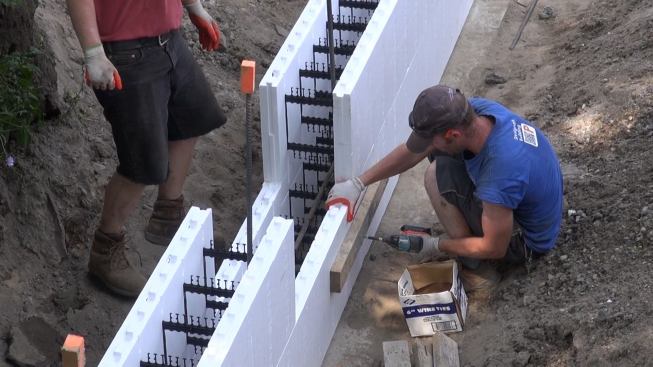
Steve Daly screws a 2×4 scab into the plastic ribs of the foam f…
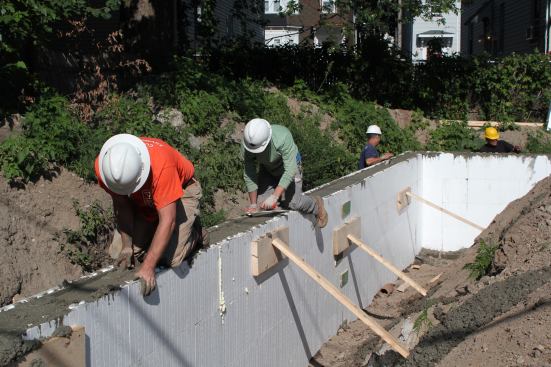
Steve Daly screws a 2×4 scab into the plastic ribs of the foam forms, to create a reinforcing scab at the point where the last segment of foam form has been cut and pieced into place. The ICF system supplier recommends making all the joints in the wall at a single point, which can then conveniently be reinforced with scabs and braces before concrete is poured.
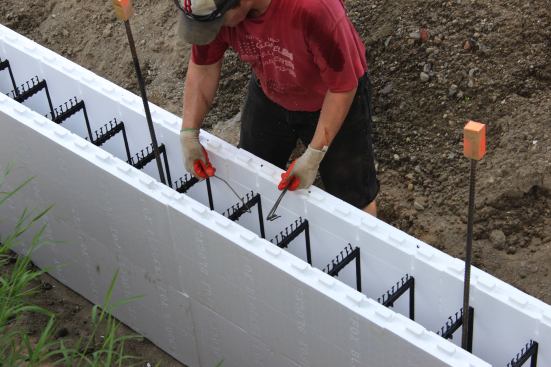
The ICF system includes wire spring-ties, used to connect form s…
The ICF system includes wire spring-ties, used to connect form segments and courses.
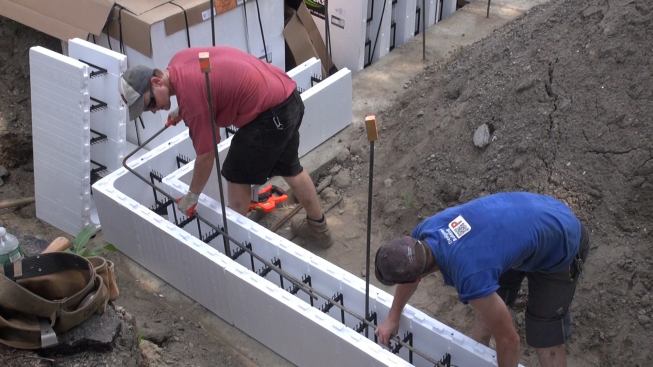
Steve Daly and Greg Hunt set a piece of rebar into the corner of…
Steve Daly and Greg Hunt set a piece of rebar into the corner of the ICF formwork. The plastic ribs that connect and brace the ICF form blocks are designed to hold the steel reinforcing bars in place, eliminating the labor of tying rebar.
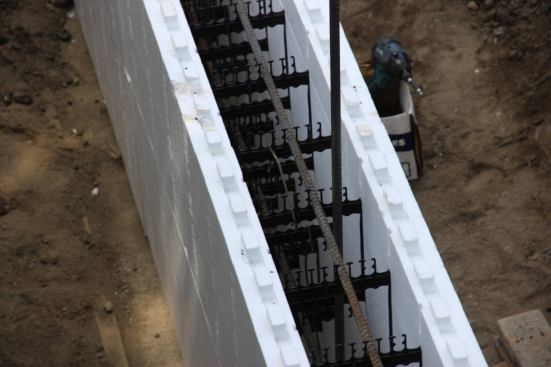
A closer look at the rebar in place in the form, held in place b…
A closer look at the rebar in place in the form, held in place by the plastic ribs of the foam forms.
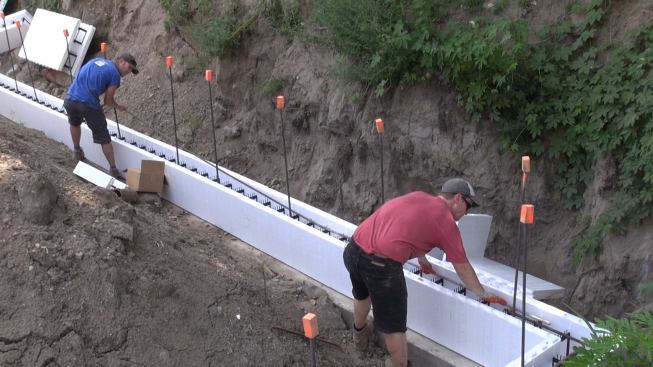
Steve Daly and Greg Hunt place another piece of rebar into the f…
Steve Daly and Greg Hunt place another piece of rebar into the form.
Declan Keefe
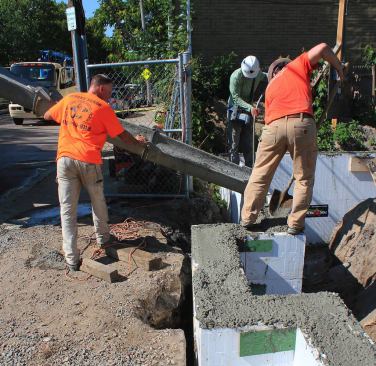
Placing concrete into the form system.
Declan Keefe
Workers strike the concrete level and trowel it flat on the day …
Workers strike the concrete level and trowel it flat on the day of the wall pour.
After leveling and compacting the existing soil within the stemw…
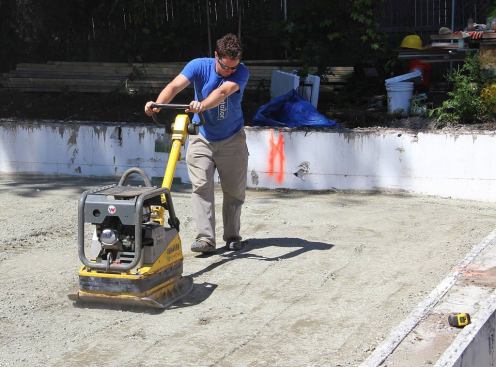
After leveling and compacting the existing soil within the stemwall perimeter, Placetailor’s Evan Smith compacts a layer of engineered fill material containing stone dust along with graded crushed stone, in preparation for adding more gravel to the slab sub-base. Smith explains that without the engineered material, regular gravel would sink into the soft existing soil and be hard to compact, leaving the slab with insufficient support.
Evan Smith pulls a load of gravel into the foundation. The small…
Evan Smith pulls a load of gravel into the foundation. The small skid-steer Smith is driving was the only piece of equipment that was practical for the small site, given the limited access from the street.
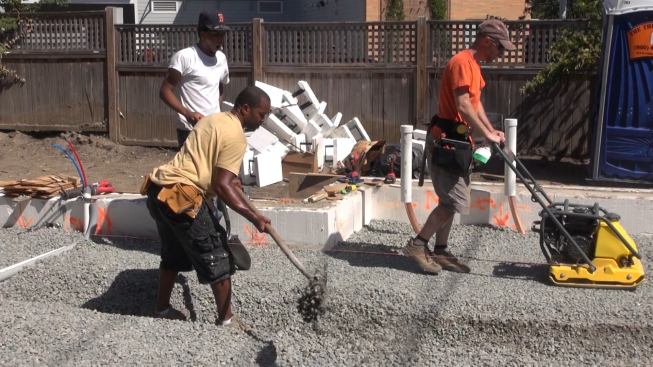
Project manager, Steve Daly, compacts gravel inside the foundati…
Project manager, Steve Daly, compacts gravel inside the foundation perimeter while coworker Scotland Willis excavates with a shovel for a small section of thickened slab intended as the footing for an interior wall by the stairs of the building.
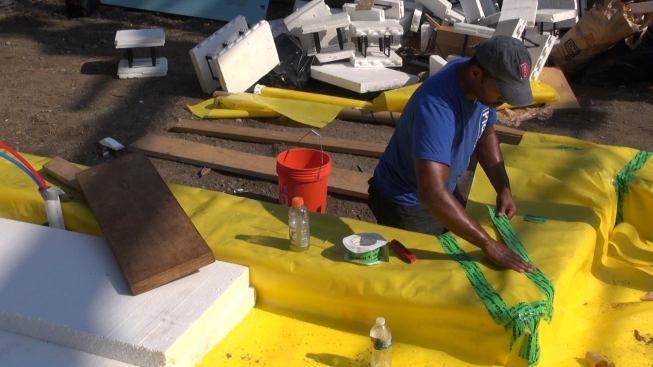
After gravel is placed and compacted, foam insulation and a poly…
After gravel is placed and compacted, foam insulation and a poly vapor barrier are placed on the sub-base in preparation for placing the interior concrete slab floor. Here, Scotland Willis tapes a seam in the vapor barrier plastic.
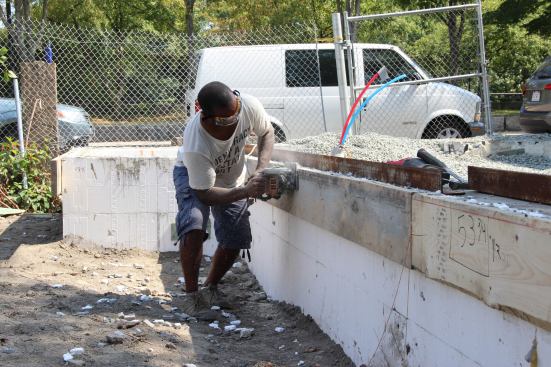
Scotland Willis installs guide boards for a concrete screed. The…
Scotland Willis installs guide boards for a concrete screed. The 2×10 boards are screwed to the plastic ribs in the ICF forms, then a level line is snapped on the boards and the boards are trimmed to create a level guide surface.
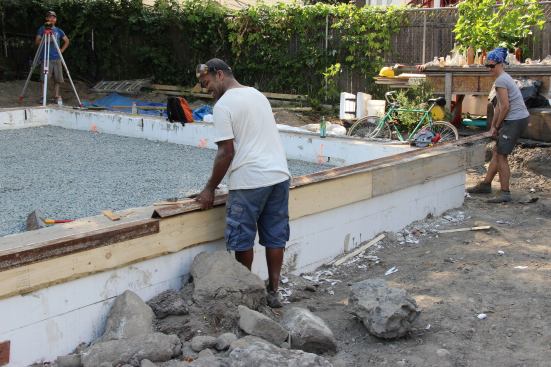
Scotland Willis and Placetailor project manager Laura Doyle set …
Scotland Willis and Placetailor project manager Laura Doyle set pieces of angle iron down onto the boards screwed to the ICFs, to serve as a hard straight-edge guide for the concrete screed that will be used to strike a level surface on the building’s first-floor concrete slab.
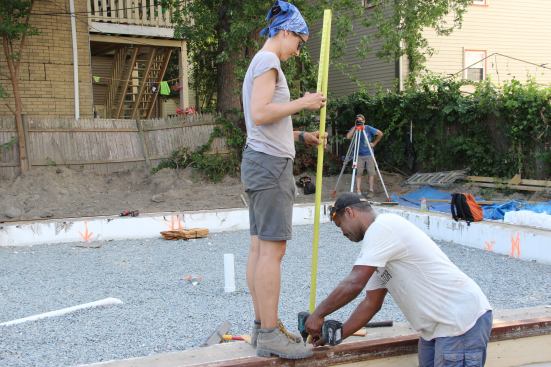
Laura Doyle holds the tape and Scotland Willis screws the angle-…
Laura Doyle holds the tape and Scotland Willis screws the angle-iron down to the wood for the screed guide, while Steve Daly sights with the transit to verify that the edge of the angle iron is level. The arrangement is intended to ensure that the slab to be placed will be level to within ? inch.
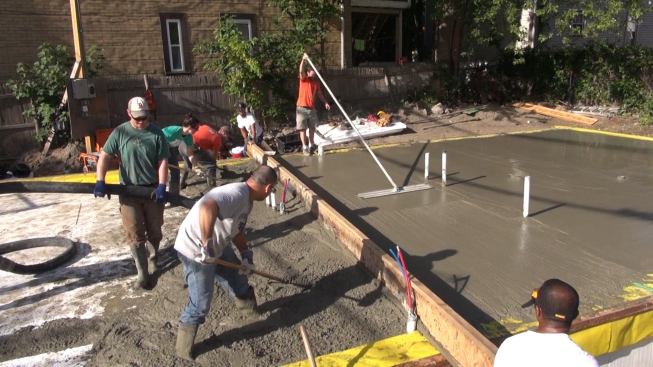
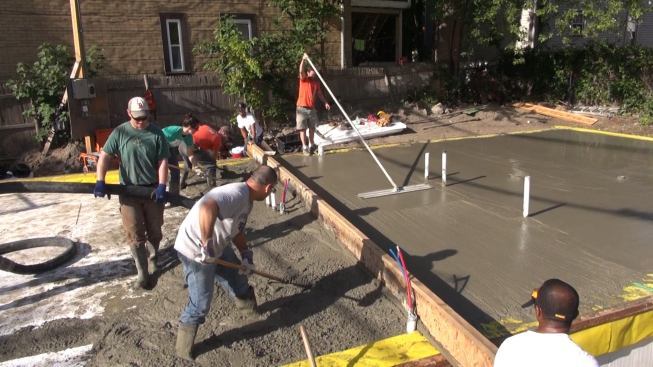
On the morning of the slab pour, three workers shovel and rake c…
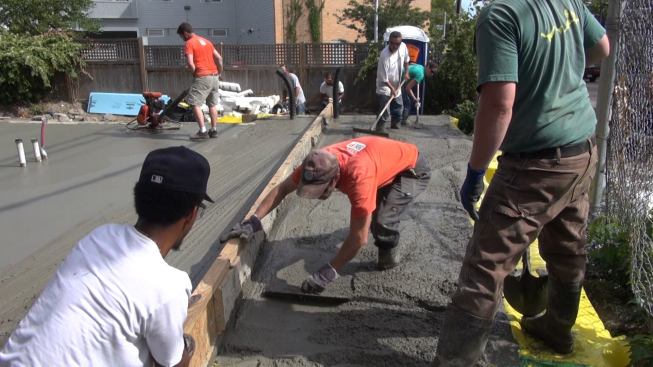
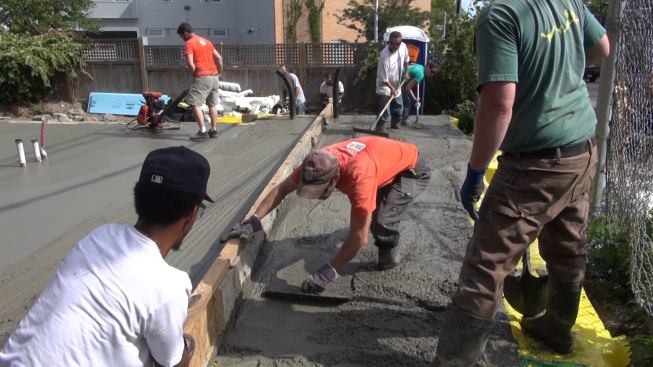
On the morning of the slab pour, three workers shovel and rake concrete while two operate the long screed to strike the concrete level, one handles the hose from the pump truck, and one bull-floats the concrete.
On the morning of the slab pour, three workers shovel and rake c…
On the morning of the slab pour, three workers shovel and rake concrete while two operate the long screed to strike the concrete level, one handles the hose from the pump truck, and one bull-floats the concrete.
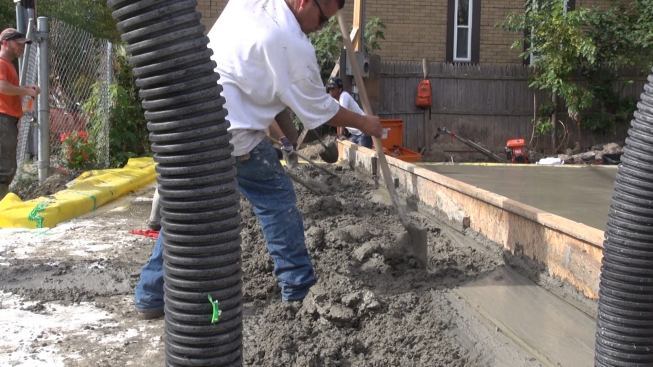
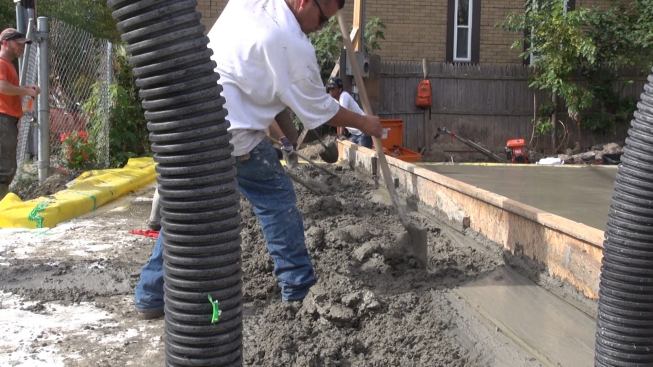
During an unexpected delay in the arrival of the third concrete …
During an unexpected delay in the arrival of the third concrete truck, which got stuck in traffic, the concrete from the second truck began to harden. Here, workers roughen and work the concrete in hopes of preventing a cold joint.
During an unexpected delay in the arrival of the third concrete …
During an unexpected delay in the arrival of the third concrete truck, which got stuck in traffic, the concrete from the second truck began to harden. Here, workers roughen and work the concrete in hopes of preventing a cold joint.
A few small parts of the slab couldn’t be reached by the long …
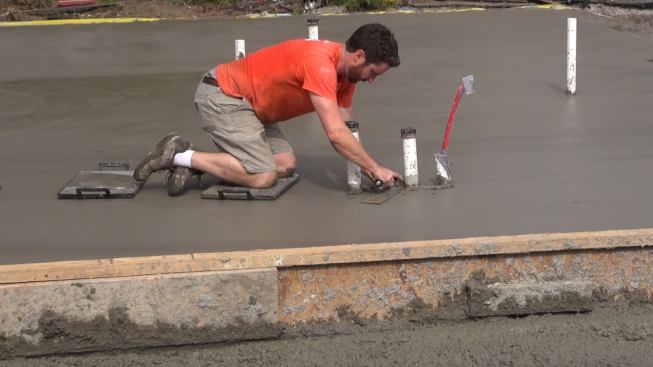
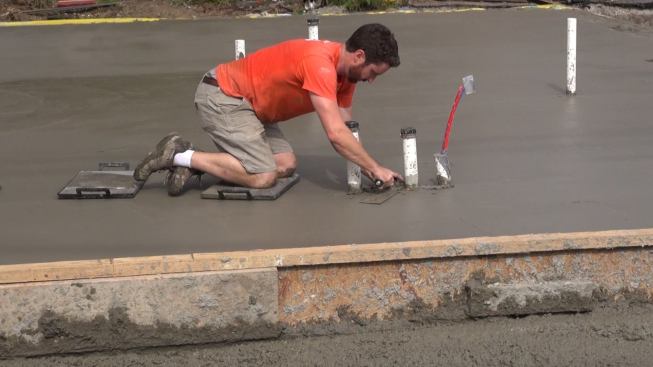
A few small parts of the slab couldn’t be reached by the long screed made of wood I-joists. Here, Evan Smith trowels a small area between two plumbing pipes.
A few small parts of the slab couldn’t be reached by the long …
A few small parts of the slab couldn’t be reached by the long screed made of wood I-joists. Here, Evan Smith trowels a small area between two plumbing pipes.
Towards the end of the pour, too much concrete piled up in front…
Towards the end of the pour, too much concrete piled up in front of the screed, and the screeding was tough going for the men on either end of the tool. Here, Steve Daly removes excess concrete from in front of the screed.
Towards the end of the pour, too much concrete piled up in front…
Towards the end of the pour, too much concrete piled up in front of the screed, and the screeding was tough going for the men on either end of the tool. Here, Steve Daly removes excess concrete from in front of the screed.
The holdup in the arrival of the last concrete truck meant that …
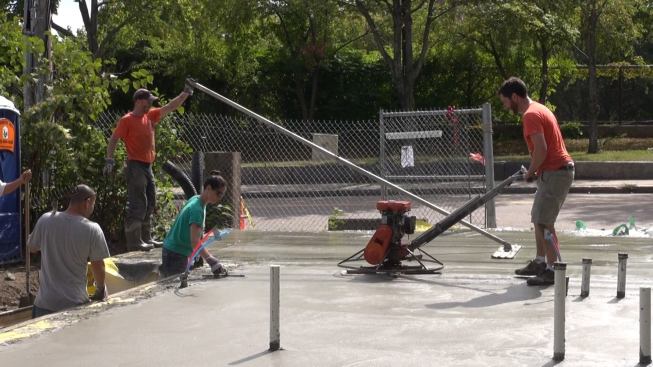
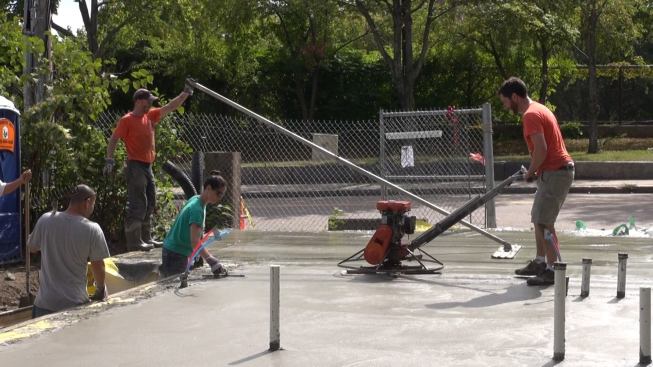
The holdup in the arrival of the last concrete truck meant that finishing of the early deliveries and placement of the final delivery had to happen simultaneously. Here, Evan Smith is almost done power-troweling the second segment of the slab while Steve Daly is still bull-floating the third segment.
The holdup in the arrival of the last concrete truck meant that …
The holdup in the arrival of the last concrete truck meant that finishing of the early deliveries and placement of the final delivery had to happen simultaneously. Here, Evan Smith is almost done power-troweling the second segment of the slab while Steve Daly is still bull-floating the third segment.
The Boston design-build firm Placetailor is unusual in a number of ways. For one thing, the architects who run the company don’t spend all day at the drawing board—they also run the jobs and get their hands dirty on site doing the physical work of construction. Placetailor has spent the last five years developing small infill sites in the Boston neighborhoods of Roxbury and Jamaica Plain. Each small site poses its own challenge in terms of location, context, and site conditions, and as the company’s name implies, the designers and builders tailor their solutions to the site.
JLC spent several days on site in the past few weeks with Placetailor, following the action as the company constructed an insulated stemwall and slab foundation for a three-family apartment building on a busy Jamaica Plain street (see slideshow).
The plan, created by another architect, calls for all the building’s loads to be carried on the exterior walls. The existing surface soils on the site, which consisted mostly of soft soil and fill, wouldn’t readily support a load-bearing insulated slab; and in any case, the wall system includes some point loads that would be complicated to support with a slab. So the design calls for footings placed well below existing grade in good bearing soil. A foundation stemwall rests on that footing to support the bearing walls of the frame, and a non-load-bearing insulated slab sits within the stemwall (and will also be polished to serve as the finished floor for the first-floor dwelling unit).
The original plans called for a conventionally-formed concrete stemwall, with rigid foam insulation to be installed on the outside after forms were stripped and before the wall was backfilled. But concrete contractors are scarce in the busy Boston economy (especially inside the city), and prices for small jobs can be steep. After reviewing a few bids, Placetailor decided to revise the plan, and to form and pour the stemwalls using insulated concrete forms (ICFs). While the insulated forms added cost, the decision meant that Placetailor could form and pour the foundation with their own labor and on their own schedule. And the ICF system also raised the R value of the foundation system. This meant that the designers could reduce the required insulation underneath the interior slab, while still preserving the same energy performance, thus recouping a significant portion of the up-charge for materials incurred by the use of the ICF system.
When Placetailor started to work on the stemwalls, one advantage to their chosen strategy became evident: It’s far easier to carry lightweight foam forms down into a hole in the ground on a tight site and set them up than it is to accomplish the same task using heavy plywood forms. And as project manager, Steve Daly, pointed out, “The really nice thing is we don’t have to haul them back out again or clean them or store them.”
During the slab pour, Placetailor demonstrated another interesting method: The crew constructed a 26-foot-long concrete screed out of wood I-joists, and used it to strike and level the entire floor slab dead flat. Pieces of angle iron, screwed to wood members that were fastened to the plastic ribs in the ICF forms, served as guides for the long screed. It wasn’t easy—the crew members tasked with running the long screed were sweating on an 85-degree morning—but it was fast, accurate, and simple.
Delays in the arrival of the second and third loads of concrete required for the floor slab meant that bull-floating and power-troweling of the first section of slab had started while the third section of slab was still not placed. While most of the crew stood idle for a short time while waiting for the next truck, it turned out to be a good thing that there was plenty of labor on hand during the periods when multiple stages of placement and finish had to be carried out at once.