
Technically, the risk associated with radon in residences is labeled “uncertain.” The Environmental Protection Agency recommends that every existing home be tested for radon and that action be taken if the test shows radon concentrations greater than 4.0 picocuries/liter of air.
Before acting, the best place to start is by looking at the EPA Map of Radon Zones. This is detailed down to the county level so you can determine with a relatively high degree of accuracy if the home in question is located over a geological zone where radon activity is high. If it is, don’t hesitate to take pre-construction mitigation steps. (If it isn’t, well, the “uncertain” language still applies.)
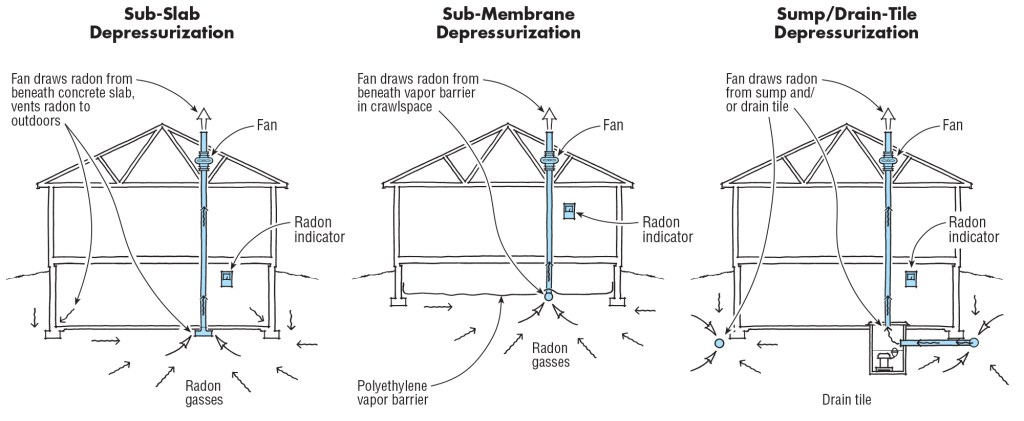
The EPA recommends the following system to prevent radon from entering basements and crawlspaces, and to exhaust radon from below slabs to the outdoors:
- Subslab: Place gas-permeable layer (4-in. layer of clean gravel).
- In basements: Plastic sheeting should be placed on top of gravel sub-base and under slab.
- In crawlspaces: The sheeting is placed over the crawlspace floor.
- Seal and caulk all cracks, joints, or penetrations.
- Use 3- or 4-in. PVC vent stack from sub-slab to above roof. Mark this clearly so plumbers won’t mistake it for a drain vent.
- In attics: Supply a junction box for power in case homeowners choose to install a powered vent fan.
For more on radon solutions in housing, visit the JLC Field Guide.