
Adding Timber Rafter Tails To a Stick-Framed Roof – Continued
A Really Big Beam
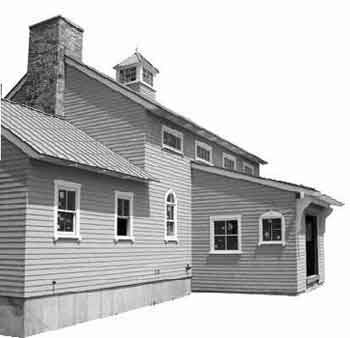
The rafter-tail assemblies at the garage and entry were larger and more complicated. For one thing, they included a concealed gutter. They also required large carrying beams (42 feet long, in the case of the garage overhang) resting on massive knee brackets. These giant assemblies were fabricated and put together in the shop, then shipped to the site for installation.
I inquired about ordering a single-piece 42-foot-long beam, but it would have taken three months and was too expensive. Instead, I joined two shorter lengths together, end-to-end, using a traditional pegged scarf joint made permanent with two-part epoxy.
Without epoxy, this method can also be used to make a strong joint that can be taken apart. The joint requires only one router pattern to make both interlocking ends, and the pattern ensures an exact fit the first time, every time.
A pair of wedges driven against each other in a pocket provided at the joint’s center force the interlocks tightly together.
Knee Brackets
To make the blanks for the knee brackets, we used stepped lengths cut from a single beam and reversed every other piece end-for-end for epoxy glue-up. This reverses the direction of the growth rings and helps ensure that if one piece wants to twist in one direction as it dries, the piece next to it will likely be twisting in the opposite direction, so they cancel each other out. The final blanks measured about 30 by 60 inches and weighed about 150 pounds each, too heavy to manhandle through a band saw. Instead, I made a single-sided MDF router template to contour the brackets and worked the stock from both sides to complete the shaping.
Installation. To help position the knees in the proper attitude on the wall, I made a set of guide blocks that would be tacked to the wall to define the necessary vertical and horizontal offsets. We used a man-lift to help raise and hold the brackets in place while we drilled and blind-bolted them from inside the wall, using 5/8-inch by 12-inch lag bolts passed through the wall framing. Once the brackets were installed, we lowered the main assembly in place with the lift and bolted it down.
The whole process — for both the entry and garage overhangs — took two men a couple of hours to complete. The framing crew followed up with the soffit planking, making it ready for the metal roofer.
Mike Randowns Narragansett Housewrights in Narragansett, R.I.