
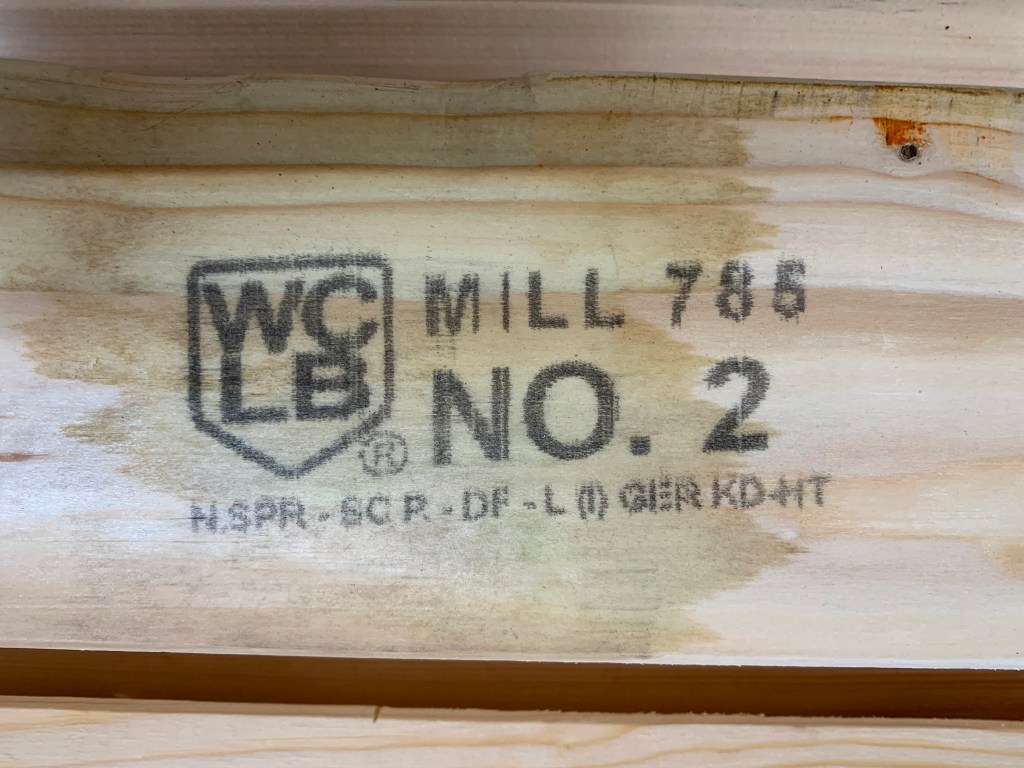
Don Pridgen of Elk Creek, Va. comments on “Special Report: Import Lumber Grades,” by Ted Cushman (May/21):
David Frane
.
Back in “the good old days,” every sawmill produced lumber and, in attempting to cater to its buyers’ needs, sorted it into some form of top, middle, and lower grades. This worked well enough as long as each person knew what the other was talking about. But how could a faraway designer know that the client’s sawmill would produce lumber of the strength his plans called for? The sawmill near him might be selling a much stronger grade of framing lumber than the mill his client was talking to. That was the beginning of the call for uniform lumber grading standards. In 1924, the American Lumber Standard was first published, and now Canada and the U.S. operate jointly under the oversight and grading rules of the National Lumber Grades Authority and the American Lumber Standard Committee.
Base design values—the eight strength, stiffness, and density properties engineers use—are tied to strength-limiting defects and species. Pieces of #2 lumber of two different species may have the same limiting defects, but because of the differing strength properties unique to each species, they will be assigned different design values. This is why the various span tables have different allowable spans for the same grade of different species of lumber. For instance, a 2×12 floor joist in #2 Doug fir-larch can span 18 feet 1 inch while the same 2×12 in #2 SYP is limited to a 16-foot-6-inch span.
The grading rules allow grouping some species of similar range and strength together, but limit the design values based on the weakest species in that group. Some species or species combinations carry different design values based on where they are grown. For example, northern “SPF” (spruce-pine-fir) carries higher design values than “SPF(s)”—the same species group from the south.
When European lumber began to be imported, country of origin led to much more variation in design values for each of the imported species. For instance, #2 Norway spruce in current tables of design values has six different sets of design values based on country of origin when stamped as a stand-alone species. When it’s grouped into various species combinations, that adds 28 possible sets of design values for one grade. You read that right: A stamp containing some form of “#2 NSpr” has 34 possible sets of design strength values. The variability is considerable: Fb 575 E1.1 in combinations to Fb 875 E1.3 in single species, based on species combination and country of origin. I have picked just one example species, but there are several.
The well-understood and widely distributed species combination “SPF” of Canadian origin now may also be easily confused with a grade stamp “SPF/SPF(s)” containing lumber that originated in Canada, U.S., Europe, or South America. The basic design properties range from Fb 875 E1.4 to Fb 575 E1.1. If the designer is working from an optimistic viewpoint and the supplier delivers from the lower end of the spectrum, there is potentially a serious strength or serviceability problem. Using the 2×12 floor joist example from above and the design values just mentioned, the maximum allowable spans would be 17 feet 10 inches versus 14 feet 4 inches, respectively. Misinterpreting those easily confused grade stamps could be a real problem.
Remember where all this began. There was a need for the designer of a building to know that the builder would use wood of the same, or better, strength as what was called for in the design. I can think of a couple of examples where I wandered around looking at the stamps. One house contained lumber from nine different countries; another contained lumber from five. The suppliers do not know which countries their lumber is going to come from; thus, the builder does not know what strength lumber is going to arrive on the job. In other words, we’ve lost sight of the original goal and are back where all this began. This is not working.
There are a couple of ways of addressing the problem. The first is to design very conservatively and use the lowest possible design properties that are listed. If European wood might be used on a job, scan the tables and use the lowest design values. You’ll never be wrong, but you will be limiting spans and driving up costs.
Another solution: The designer can specify the minimum design values required rather than a species or species combination, grade, and country of origin.
Lumber would need to be stamped with a species and grade but also with the design values, similar to the stamp on LVL lumber. Then the builder would order those design values from the supplier. The supplier would simply send out stock that is stamped with those design values or better.
If the builder doesn’t care for the working characteristics of a particular species and the supplier has what is needed in several different species, the builder can request the order be filled with the species of preference. Either meets the strength requirement, but each has unique characteristics as well. This is the reason to retain the species stamp.