
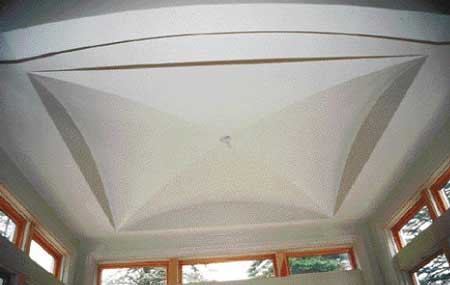
Framing a Cross-Vault Ceiling, continued
Building Barrels
With the recess defined, I concentrated on forming the barrel arches. Each of the four barrel ends spanned 8 feet, point to point. The diagonal of an 8-foot square measures 11 feet 3 3/4 inches. The barrel spans and the diagonal hip spans shared a common height — 12 inches — so I calculated the two radiuses needed, made a trammel stick, and drew the respective arches on 3/4-inch plywood.
For the record, the two radiuses were 6 feet 8 inches and 7 feet 4 inches. I carefully cut the arches with a circular saw — I’ve found that you can effectively cut curves as tight as a 4-foot radius using that tool. The diagonal arches exceeded the capacity of a 4×8 plywood sheet, so I cut them in four separate pieces that met in the center of the ceiling. We had previously nailed 1×3 furring to all the ceilings in the house, a standard framing procedure in this region. The furring provided good general backing to attach the arch components. We added a piece of 3/4-inch plywood to back up the center arch junction and provide support for a chandelier. With the diagonals installed, we nailed the barrel cutouts directly to the plywood facing on the four soffits. Those two plywood patterns established all the necessary framing lines to complete the converging barrel shapes. I used flat 2×4 blocking to define the contours of the barrels, starting at the top of each vault. Each of these longest blocks fit at the center groin with a double 45-degree square end cut. (The opposite ends were all square, 90-degree cuts.) But as the blocking carried along down the hip to the spring line, the hip cuts became progressively compound.
Quick calculation for compound cuts. I took a practical route to calculating these bevels. First, I found the bevel angle for the short triangular piece of blocking at the bottom end using a bevel gauge and a sliding compound miter saw.
Next, I stepped off six equal blocking intervals on a thin flexible strip of wood, bent along the underside of one of the single hips. Then all I had to do was progressively step the bevels down by a sixth of the total bevel angle, one block at a time, from 26 1/2 degrees to 0 degrees. The 45-degree hip angle cuts remained constant. For efficiency, I cut eight of every piece in mirrored pairs, as each vaulted quadrant was identically proportioned. With me cutting and a helper nailing the pieces up, installing the barrels only took us a couple of hours. The resulting geometric framing pattern looked almost too good to cover up.
Arched Header
To further distinguish the nook, I added an arched box header under the front soffit. I laid it out and cut it on sawhorses, using 2x4s and a 1/2-inch plywood skin, then nailed it up in two pieces. I had to keep the dropped shoulders, and hence the arch itself, shallow — only about 4 inches below the soffit level — because the header had to clear a transom window above a door in the angled wall. The arch spanned 8 feet, centered on the vault, and provided a subtle introduction to the curving ceiling lines.
The plastering contractor, Michel Tanguay, used 3/8-inch drywall board and skim-coat plaster to finish the barrels, and did a beautiful job.
He used metal plaster corners, the type with expanded mesh flanges, which flexed smoothly along the easy curves and gave the groin joints sharp definition. The diagonal arcs finish crisply at the recess corners and meet in the center at the chandelier’s electrical box. Maybe someone will come along, take a few snapshots, and the process will begin all over again somewhere else. But you’ll be ready for it.
Jeff Davisis a framing contractor in Harwich, Mass.