
Expanding Outward
Where the addition starts, we had to remove the exterior wall, which carried a gable truss above. To restore the support, we installed a 31/8-inch-by-12-inch glulam beam across the opening, supporting it on new posts that we framed in the flanking walls. We had to trim about 3 feet off the vertical members of the gable truss so that we could place the glulam high enough for the barrel vault to pass underneath.
The new roof was simple to frame; we used trusses over most of the addition and filled in with stick framing where we needed to.
Framing the Barrel
With the structural work out of the way, we could tackle the fun part of the job — framing the barrel. Our first task was to create the opening in the ceiling, which we did by drawing the perimeter of the barrel on the floor, plumbing the location onto the framing above, and then cutting through the bottom chords of the trusses. To complete the opening we nailed a 2×4 around its inner edge.
Curved ribs. The barrel itself consisted of 2×4 purlins nailed between 6-inch-wide curved ribs cut from 3/4-inch plywood with a router and trammel. To avoid damaging the subfloor, we cut partway through with a 3/4-inch straight bit, then finished on the bench with a flush trimming bit that ran against the edge of the partially completed cut.
The ribs were too long to get from 8-foot sheets of plywood, so we laminated them from two layers, staggering the joints and fastening the pieces with glue and staples. There were four ribs in all, one at each end of the vault and two near the middle. To ease the installation of the ductwork for a commercial range hood, we spaced the center ribs one truss bay apart.
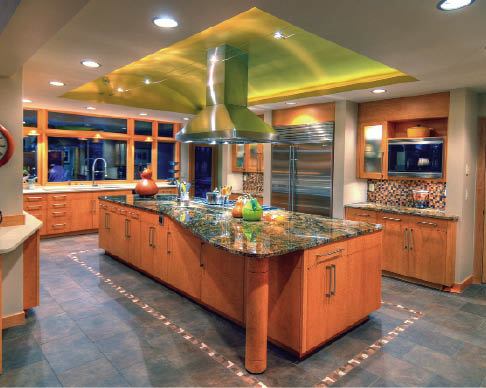
Since the barrel was too large to assemble on the ground and lift into place, we nailed the ribs to trusses and installed the purlins afterward. We spaced the purlins 4 inches on-center to ensure that the drywall bent in an even curve. The final bit of framing was to build a shallow plywood trough around the edge of the barrel to house the LED uplighting.
When the job was complete, the owners had what they were looking for: a modern kitchen suitable for entertaining a large number of guests — with a stunning conversation piece overhead.
David Hanson is a principal at Hanson Carlen Construction in Spokane, Wash.