
Holding Power of Nails
In framing, nails should never be loaded in withdrawal (where the load acts parallel to the nail shank and tries to pull it out). Instead, framing nails should be loaded laterally (where the load acts perpendicular to the shank). Also, nails have more holding power when driven into the side grain rather than into the end grain. In fact, nailing into the end grain will reduce a nail’s lateral load capacity by approximately one-third.
Box vs. Common Nails
Lateral strength is largely a function of a nail’s diameter and the density of the type of wood into which the nail is driven. For example, 10d and 12d nails have the same diameter and the same lateral strength in each type of wood. Common nails are stronger than box nails because of their greater diameter (below).
When substituting box for common nails, calculate the nail size needed using the conversion ratios shown below.
Figure: Conversion Ratio for Common to Box Nails
| Penny Wt. | 8d | 10d | 12d | 16d | 20d |
|---|---|---|---|---|---|
| Ratio | 1.23 | 1.22 | 1.22 | 1.36 | 1.44 |
S-P-F lumber assumed.
Do not substitute a common nail that’s specified on the plans for an equal number of box nails. Instead, multiply the specified number of common nails by the conversion ratio shown in the chart and round up to find the equivalent number of box nails.
Withdrawal Strength of Nails
Nails are much stronger when loaded laterally (across the nail) than when loaded in withdrawal (along the length of the nail). Withdrawal from end grain is particularly weak and not accepted as a structural connection by most codes. Withdrawal values from sidegrain are given in the table below.
Toenails
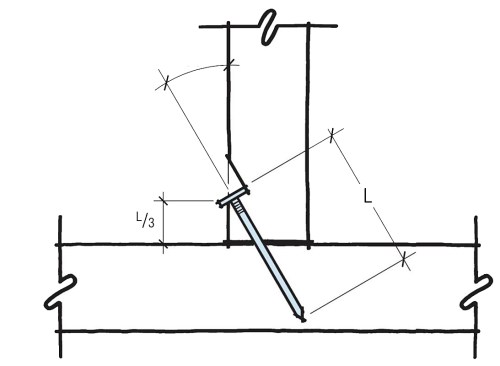
For toenails loaded in withdrawal, multiply the values in the Withdrawal Strength Design Values table, above, by .67. For toenails loaded laterally, multiply the values in the Lateral Strength table, above, by .83. Toenails should be driven at an angle of about 30 degrees from the face of the stud or other member being attached (below).
Tim Healey
Place toenails away from the end of the board a distance that’s equal to one-third the length of the nail. Angle the nail so it comes through at the center of the board’s thickness. This angle is less than 45 degrees.
Pneumatic Nails
Pneumatic nails are typically sold by a specified shank diameter in inches (.120, .131, and .148 are common for framing nails). These are typically skinnier than common nails of equal length and, therefore, have lower lateral strength and withdrawal values (below). Consult manufacturers for lateral strength of specific nail types.
Stainless Steel Nails
While expensive, stainless-steel nails are the most rust-resistant under nearly all conditions. They are highly recommended below grade or in homes that will be exposed to salt air. They’re also recommended for cedar or redwood trim, and for siding that will be left to weather without stain or paint. Stainless-steel nails are typically available as Type 304 and 316. The 316 type are more durable.
Aluminum Nails
Aluminum nails are sometimes used to fasten exterior siding. They’re very resistant to rust and corrosion, but may corrode when used with some flashing metals.
Nailing Rules of Thumb
Typical nailing schedules appear in the table below.
Two is better than one. In general, never rely on a single nail. Use at least two.
Nail spacing. Don’t space nails closer than one-quarter their length to the edge of the board.
Nail penetration. To hold at full strength, nails should penetrate the wood a depth that’s at least 11 times their diameter — 11/2 in. for 8d nails and 13/4 in. for 16d nails.