
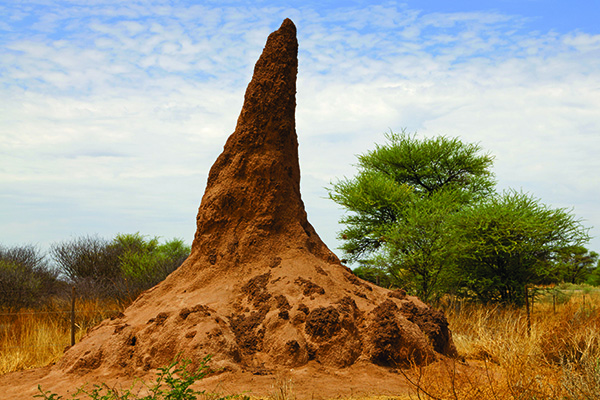
Termites don’t have many fans. Globally, they cause billions of dollars of property damage per year (in the U.S. alone, homeowners spend $5 billion annually to control termites and repair termite damage). Although only 28 out of 2,600 identified termite species worldwide are considered invasive pests, their destructive reputation precedes them.

Underbug (Scientific American/Farrar, Straus & Giroux)
In Underbug, author Lisa Margonelli describes her eight-year trek around the world embedded with multidisciplinary termite-obsessed scientists—many of whom are as interesting and quirky as the insects they study.
Enter a cadre of termite-obsessed scientists who believe we have termites all wrong and that they just may be key to our future survival. In Lisa Margonelli’s Underbug: An Obsessive Tale of Termites and Technology (Scientific American/Farrar, Straus & Giroux, 2018), she describes her eight-year trek around the world embedded with these multidisciplinary scientists—many of whom are as interesting and quirky as the insects they study. From microbial biologists studying the termite’s gut for clues about how to process wood into ethanol to help alleviate the world’s dependence on fossil fuels to roboticists trying to crack the code that allows termites to build mounds the equivalent of skyscrapers in height without a complex brain guiding them, she travels from the American Southwest to Namibia to Australia and back again.
Macrotermes michaelseni. One such obsessed scientist is American physiologist J. Scott Turner, a foremost expert on mound-building termites, Macrotermes michaelseni, found widely distributed throughout sub-Saharan Africa. These termites cultivate a fungus that decomposes dead plant material within the colony (the fungus serves as a food source). For the past 30 years, Turner has searched for clues into why these tiny creatures build such spectacular structures.
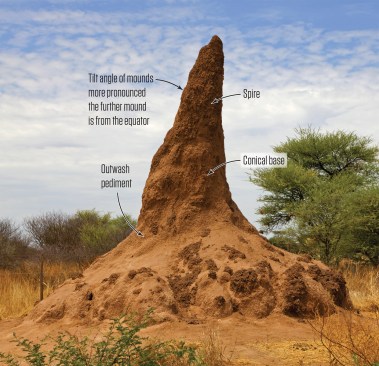
Adobe Stock/Termitenhügel, AnnaReinert
Termite mounds in sub-Saharan Africa typically consist of a spire, a conical base, and a broad outwash pediment consisting of eroded soil. They use the sun to thermoregulate. This Macrotermes mound in Namibia tilts north toward the sun in an effort to heat all sides equally.
Thermosiphon vs. tidal ventilation. Conventional wisdom held that termites built mounds to promote bulk airflow via a thermosiphon model (in which colonial metabolism heats and humidifies the nest air, reducing its density and causing it to flow upward in a convective loop, cooling the mound in the process). Turner’s research told him otherwise; that airflow was more a result of tidal ventilation, or “breathing.”
Turner surmised that the mounds function more as lungs (not merely as chimneys allowing hot air to escape, as with the thermosiphon model). After pumping propane gas down termite mounds, he found it behaved unpredictably—sloshing around sometimes, rising others, seemingly dependent on whether the wind was steady or gusty. According to Margonelli, this led Turner to believe that “the air moves back and forth through the porous dirt skin of the mound by two systems: in big puffs driven by buoyant gases rising from the hot fungus nest (like the sharp intake of breath from the diaphragm), and in small puffs (the way air wheezily diffuses between alveoli in your lungs).” Further, “Turner suspected that the termites themselves circulated air as they moved, like mobile alveoli. The mound was not just a simple structure where air happened to move, but a continuously morphing complex contraption consisting of dirt and termites together manipulating airflow.”
Engineers and architects hope to take this knowledge and apply it to the design of sustainable, self-regulating buildings, conserving energy while supplying ventilation.
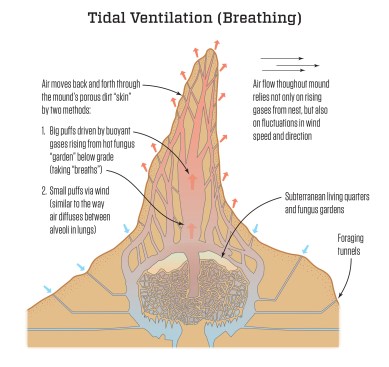
The aboveground portion of the mound serves as a breathing and moisture-management apparatus, helping to promote airflow to subterranean living quarters.