
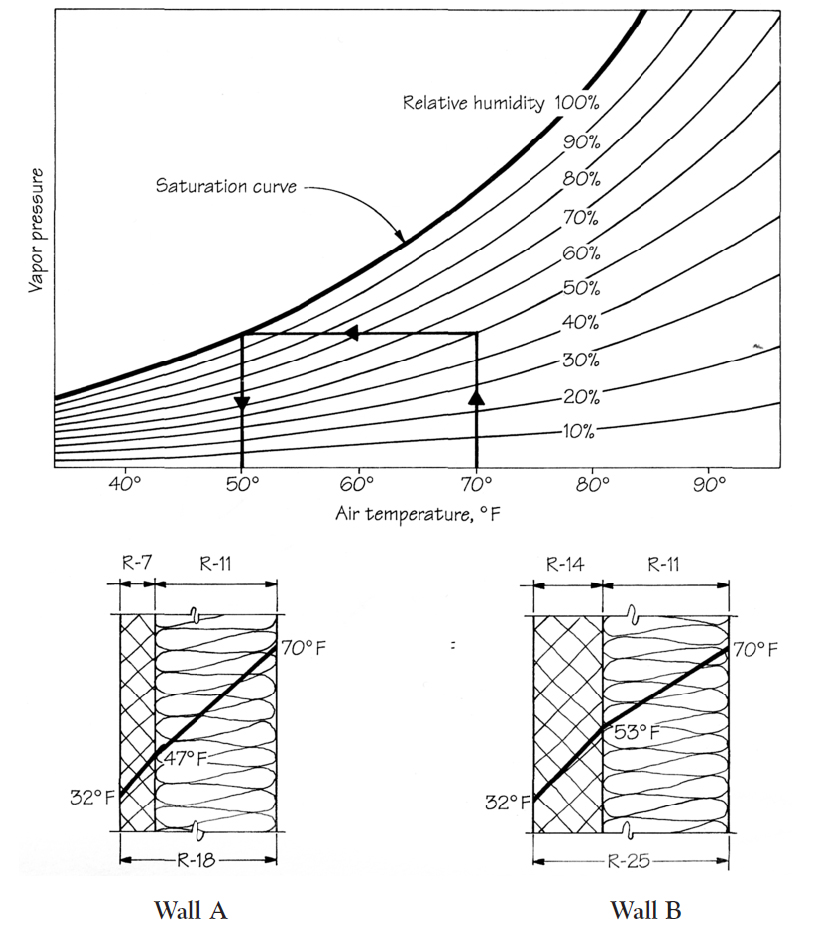
To figure out how much insulating foam sheathing you should install on the exterior of a building, you need to know the dew point of the interior air during winter.
First look at the chart to figure out what the dew point is for a given air temperature and relative humidity. Say you have an indoor relative humidity of 50% at 70°F. On the horizontal scale, locate the temperature and move up to the curve that represents 50% relative humidity, as shown. Then move left to the saturation curve, and down to find the dew point temperature — 50°F in this case.
Moisture must condense on a solid surface (it won’t condense in midair and is unlikely to condense in fiberglass), and the inside surface of the sheathing is where the condensation is most likely to occur. The objective is to put enough foam on the wall so its inside surface remains above the dew point (in this case, above 50°F) for the average winter temperature at the site.
You can find the temperature at any point inside the wall if you know the R-values of the wall insulations you are using. The temperature change through the wall is in direct proportion to that Rvalue. For example, for an average outdoor winter temperature of 32°F, the temperature inside the 1- inch foam sheathing in Wall A will be 7/18 (R-7 over R-18) of the way from 32°F to 70°F, or 47°F. This is below the dew point, so condensation is likely to form on the inside of the foam sheathing.
In Wall B, with 2 inches of foam, the temperature at the inside sheathing surface is 14/25 of the way, or 53°F — safely above the dew point. This thicker insulating sheathing would be your safest bet in climates with an average winter temperature of 32°F or less.