First, collect 1 million pennies. The Philadelphia Mint makes 8 …
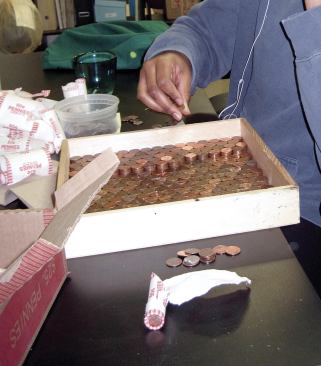
First, collect 1 million pennies. The Philadelphia Mint makes 8 million of them every shift, so you’d think it would be simple to buy a certain amount of brand-new matching coins. But that’s not how it works. You have to get them in mixed $25 boxes from local banks, a few here and a few there. Then someone has to spend a lot of time tearing open the rolls.
Maggie O’Neill
Assemble the pennies into temporary foot-square “tiles” by p…
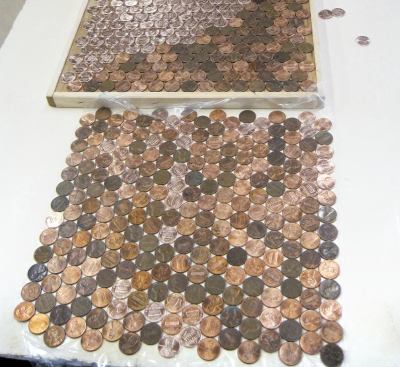
Assemble the pennies into temporary foot-square “tiles” by placing a handful of coins on a lipped plywood form and shaking it gently until they’re all lying flat and the surface is completely covered. Complete each tile by sticking a square of adhesive plastic carpet protector — a material familiar to most remodelers — to the exposed surface. Carefully turn the form over onto a stack of previously prepared tiles, separating the layers with sheets of waxed paper.
Maggie O’Neill
Spread a thin layer of Latapoxy adhesive on a section of the pre…
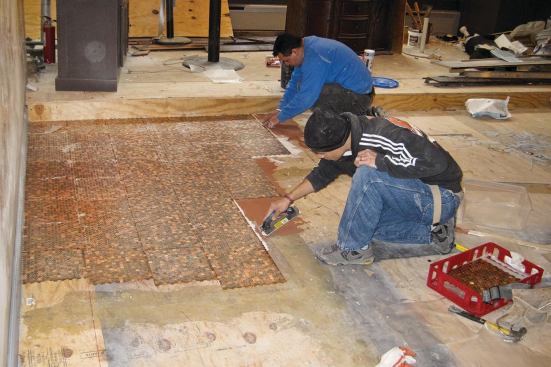
Spread a thin layer of Latapoxy adhesive on a section of the prepared plywood subfloor. It should be thick enough to make the pennies stick securely to the floor, but not so thick it smears their exposed faces. Working fast, turn a “tile” of pennies onto the epoxy and press it into place. Once the resin has cured, peel off the plastic film. Repeat several thousand times.
Maggie O’Neill
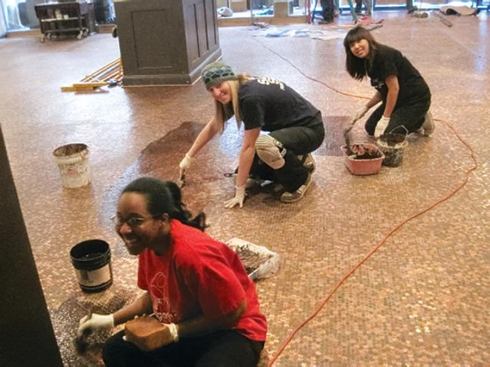
Grout the pennies with clear Rock-Kote epoxy. Wear kneepads.
It’s not the kind of job that comes along often, but just in case you ever need to assemble a durable commercial floor from real pennies, here’s a brief tutorial from Silver Spring, Md., artist and designer Maggie O’Neill. She completed such a project for a popular restaurant in downtown Washington, D.C., two years ago.
So far, O’Neill says, the completed floor has stood up well to heavy foot traffic, except for an area near the bar that was damaged by a water leak. And she’s finally stopped worrying about being arrested for violating the federal law against defacing or mutilating U.S. coins. (Although that prohibition requires fraudulent intent and applies only to coins “in actual use or circulation,” it leaves some room for interpretation.) “I guess I’m okay,” O’Neill says. “The Treasury Department must know about it by now, and I haven’t heard a word from them.” — Jon Vara