
When the Washington, D.C., area has a colder than normal winter, the calls start coming in. “Something’s wrong with our wood floor,” we hear from clients. “There are big gaps between the boards.” Fortunately, this is one of the most explainable issues we run into. Cold air is dry air, so homes that aren’t humidified tend to have low indoor humidity levels in the winter months, and wood boards shrink. With less moisture, boards get narrower; more moisture, they get wider. In areas like ours with seasonal moisture changes—cold, dry winters and warm, humid summers—wood changes size twice a year. Each board gets smaller over the winter and larger in summer.
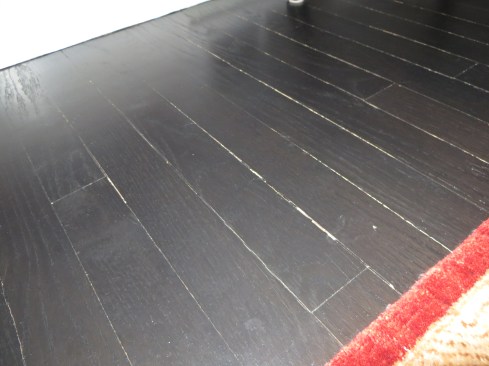
In an especially cold January (2025), shrinkage gaps between oak floorboards were a frequent callback. The dark stain emphasized the gaps.
Seasonal Moisture Changes
In regions with distinct seasons, the moisture content of wood changes gradually throughout the year as relative humidity changes. In some regions, humidity is more stable year-round. For example, the mountain west is relatively dry throughout the year. Along the Gulf Coast, it stays reasonably humid year-round. In northern states where summers are humid but brief, wood doesn’t absorb much moisture.
But in much of the U.S., especially the middle of the eastern half (climate zones 3 to 5), we have humid summers and drier winters. In these conditions, it’s normal to have gaps in wood floors in winter. In our area, the humid season is the summer, so we can inspect the floor in late September or October to verify its condition.
Types of Gaps
At the end of the cold, dry months, it’s normal to see substantial gaps between boards. The size of the gaps will vary depending on the species of wood, the change in humidity levels, the width of the boards, and even the direction the board was cut from the original log. The amount of shrinking is predictable, and we can calculate the expected gaps in floors (see “Calculating Wood Floor Shrinkage”).
Wood Floor Shrinkage Calculator
For a free copy of Doug Horgan’s wood floor shrinkage calculator, send a request via email to
jlc-editorial@zondahome.com.
Usually, gaps are evenly spaced across the floor, showing that each board has shrunk at the same rate. Sometimes, however, several boards in a row have no gaps, and then there’s one big gap. This can be due to a finishing issue called “edge bonding” or “panelization,” where the floor finish glues the boards together, and all the shrinking of five or eight boards appears in one huge gap, resulting in several large gaps that divide the floor into “panels.”
This is a finishing error. Most finish suppliers offer a first-coat product, such as a waterborne sanding sealer, that prevents edge bonding by creating a consistent base layer. That in turn prevents the finish from penetrating unevenly. We’ve had mixed results with leaving edge-bonded floorboards as is, hoping they separate over time. They do eventually, but it may take a season or more.
Controlling Moisture at Installation
If very dry flooring is installed with no gaps in the middle of winter, the wood will expand in summer, possibly so much that the boards buckle or even push interior walls around.
At the end of the humid season, wood floors should be tight. The National Wood Flooring Association recommends inspecting for gaps only at that time. If there are gaps then, it means someone messed up, likely by not controlling the moisture content of the flooring at installation.
While it’s a common myth that you can prevent problems by letting the flooring acclimate to indoor conditions before installing it, that won’t help if humidity levels on a jobsite are excessively high or low. In new construction and large renovations, curing concrete, wet framing lumber, and rainy or snowy weather that has been tracked in can increase indoor humidity levels significantly.
Bringing the flooring onto such a jobsite and allowing it to acclimate is counterproductive. The wood will take on moisture and swell, and gaps may appear in the floor even after the humid season. Running dehumidifiers during the job can help.
According to Howard Brickman, a Massachusetts wood-flooring contractor and long-time JLC contributor, installers should measure the moisture content (MC) of the subfloor and the flooring with a meter before installation. The subfloor should not exceed 11% MC in the northeastern U.S., 14% in the humid Southeast, and 9% in the arid regions of the West. In western coastal regions, the acceptable subfloor moisture content varies from about 11% to 14% MC, depending on the local microclimate.
Then check the moisture of the flooring: It should be about 3.5 percentage points lower than that of the subfloor. That works out to 7.5% in the Northeast, 10.5% in the humid Southeast, and 5.5% in arid regions of the West. If the MC reading of the flooring is higher or lower than these regional levels, it should be unboxed and laid out directly on the subfloor until its moisture content, as measured with a meter, reaches the regional level. The relative humidity in the space should be maintained at a low level to dry the wood or a high level to add moisture.
What to Do About Gaps
Unless the floor has buckled or extreme panelization has occurred, we rarely call for replacing flooring. This can be a nightmare project that tears up a client’s house for several weeks (don’t forget trim repairs and repainting). Even refinishing a floor can be an ordeal in an occupied home, and most hardwood floors can be done only a few times before there’s no wood left to sand out.
In most cases, we advise leaving a floor as is, possibly seeing if the installers can undo any edge bonding. At least, wait until summer. The floor could be fine or, at least, mostly OK and need only a couple of small repairs.
The wood floor industry calls gaps “normal” or “abnormal” depending on whether they close up by the end of the humid season. “Normal” gaps are those that substantially close. Any gaps that are still open are “abnormal.” Narrow “abnormal” gaps (<1⁄32 inch) are fixed with filler. In the unlikely event there are a lot of “abnormal gaps” in sequential boards or a larger gap, a repair may be needed.
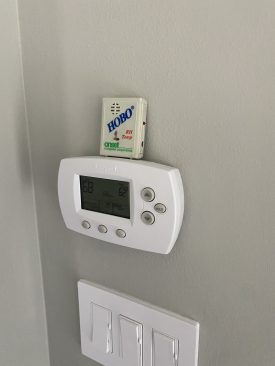
To track indoor humidity, the author uses Hobo monitors if the house doesn’t have a smart thermostat that can provide a readout of relative humidity over time.
The culprit causing most “normal” gaps is indoor humidity, and we first look to the HVAC system. In many cases, a humidifier should be installed (see “Humidifying Homes,” Mar/2022). We also monitor the indoor humidity conditions over a period of time while evaluating the change in the gaps.
I typically use a set of Hobo monitors. Ours are old and need to be periodically plugged into a laptop to get a readout of the indoor conditions. Newer monitors can connect to a cloud or phone app so they can be tracked remotely. Or in some cases, the home may have a smart thermostat that includes humidity readings that can be monitored remotely.
A case in point is a home in which the stained oak floors opened up last January, which was the coldest winter we’d experienced in Washington, D.C., since 2014. The house had a humidifier installed on the HVAC system, but it had not been turned on at the start of the season. Because the floors were stained a dark color, the gaps were especially evident. Gaps are more apparent on very dark or very light floors because the crack is such a different color.
The gaps in the third-floor bedroom were particularly noticeable. Most were about ³⁄₆₄ inch wide, with a couple closer to ⅟₁₆ inch. The wider ones tended to have some normal gap filler or finish in the space, indicating the boards were slightly gapped at time of finishing, so the shrinking since then seemed to be consistent at 1⁄32 to ³⁄₆₄ inch (see photos, below).
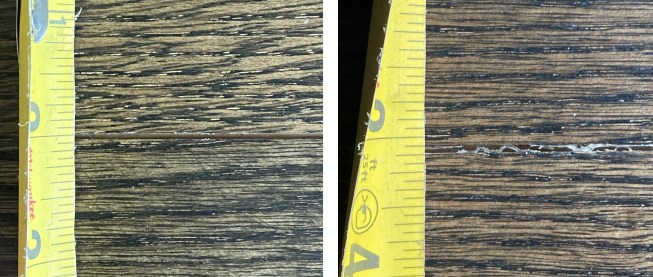
This gap (left) is about 1/32 inch with no finish or filler, so the boards were probably tight when installed. This gap (right) is 1/32 inch open, with about 1/64 inch of finish in the gap, indicating a 1/64-inch gap when finished.
The relative humidity (RH) measurements we took varied from around 20% to 30% before the humidifier was fixed. RH climbed to 40% to 50% once the humidifier was running again.
In this case, as in most homes, we recommend maintaining indoor settings below 40% RH to avoid condensation issues in winter and monitoring windows for condensation (40% may be too high). Most clients report that 30% to 35% feels comfortable. At that humidity level, wood shrinkage is minimal.