
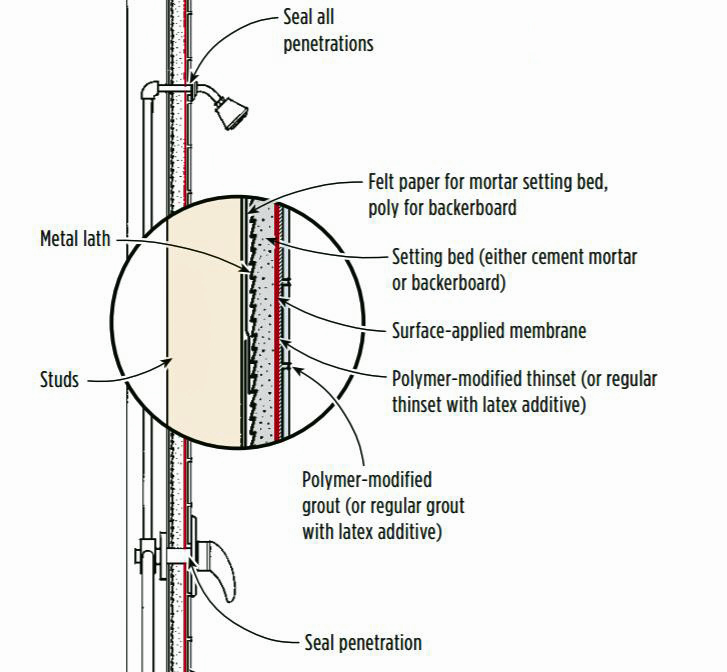
On wall areas subject to wetting, such as a tub surround, never use moisture-resistant drywall—a.k.a. “M.R. board” or “green board” as a tile substrate. Use a cement backerboard or traditional mortar over a minimum 4-mil poly or 15-lb. felt. Reinforce backerboard joints and corners with thinset mortar and mesh tape. Tile corners, perimeters, and penetrations should be protected with a flexible-sealant expansion joint.
Best practice on tiled walls (as on floors) calls for installation of a sheet or trowel-applied waterproofing membrane over backerboard or a mortar setting bed. An alternative is to use a waterproof backerboard, such as Kerdi-Board (for more, see “Prepping Shower Walls for Tile,” 07/15).
Tile selection is also important for tub surrounds and showers. Absorbent, textured, and grainy ceramic and stone tiles can hold considerable amounts of water, as well as dirt, oil, germs, and bacteria — all of which are part of the shower environment and promote mold growth. For hygienic reasons steer clients toward impervious or vitreous tiles, or stone tiles with similar properties.
For more on setting ceramic tile, visit the JLC Field Guide.