When the International Residential Code (IRC) was updated in 2009, it was the first time a major model code had ever required fire sprinklers for one-family and two-family buildings. Press coverage of the new rules at the time, including in JLC (see “Residential Fire Sprinklers,” Aug/09), followed something of a pattern: “You’re going to have to do this thing, so you better learn what’s involved.”
When push came to shove, however, the future didn’t turn out quite that way. State by state, responding to political pressure from home builders, policymakers chose not to implement the fire-sprinkler provisions in the residential building code. As of today, only one state (California) enforces the part of the IRC that requires sprinklers in every single-family or duplex house (although some cities and towns in other states do enforce that part of the code).
Even if you don’t live in any of those places, though, that doesn’t mean you’ll never need to know about sprinklers. Almost everywhere, as soon as you get into larger projects, you’re in the game. Most states and municipalities require sprinklers in townhouse or apartment buildings with three or more dwelling units.
Authorities may also require sprinklers in special situations—for example, where access to a home site is restricted, setbacks from adjacent buildings are tight, or other conditions exist that would make it hard for a fire department to respond to a fire in a residential occupancy.
Fire officials prefer to describe the trade-offs involved in those special situations not as a cost but as an opportunity. And that makes sense. In many situations, installing fire sprinklers in a project allows builders or developers to do things they couldn’t otherwise do. Gerry Leach, a public safety inspector at the Maine State Fire Marshal’s Office who handles fire-sprinkler plan review for the entire state, says: “Fire sprinklers buy the contractor a lot of benefits. If you tell your local fire officials or building department that you’re going to sprinkle all the houses in a development, maybe you can have a longer dead-end road. Maybe you can avoid the need for a fire pond or a cistern. Now you have a buildable lot instead.” In addition, sprinklers may reduce the requirements for fire-truck access or turnarounds or reduce the required space between buildings—factors that can help make a project profitable.
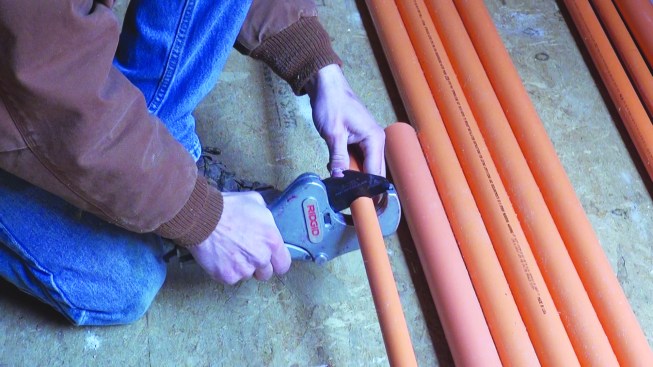
The CPVC piping shown on these pages is only one of a half-dozen or more permitted materials, but it’s widespread because of its versatility, affordability, and ease of use. Above, an installer cuts the tubing with hand shear.
MATERIALS AND METHODS
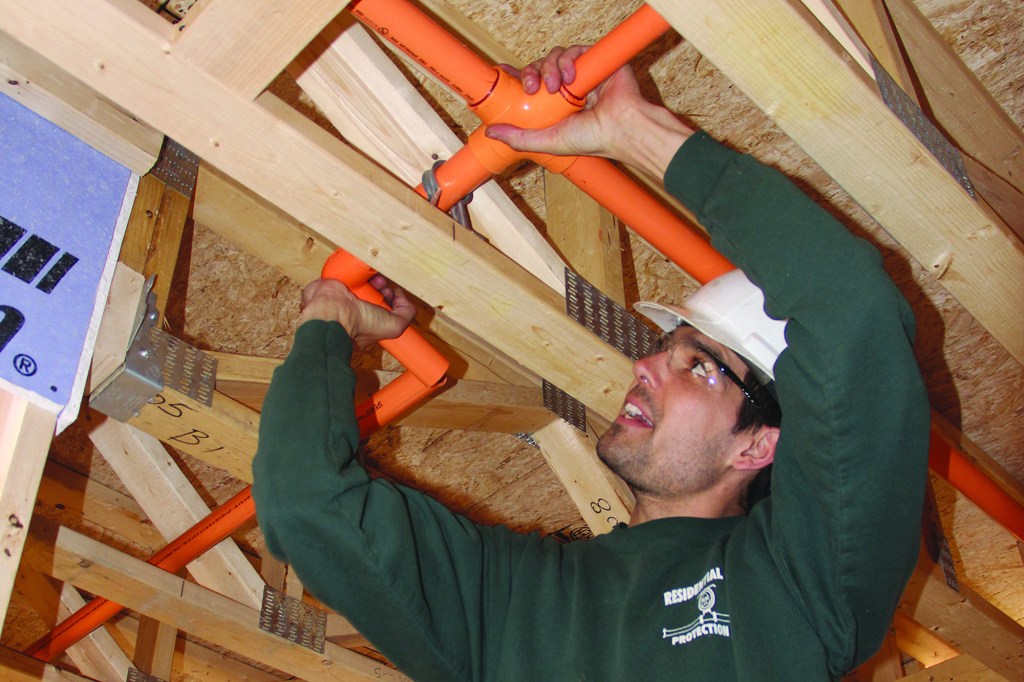
There’s a lot of choice in the world of fire sprinklers. Industry standards require piping and sprinkler heads to meet certain test conditions, but the list of materials that can pass those tests continues to grow. The old standby, steel pipe (commonly called “black iron”), is still popular among sprinkler contractors, but the less-costly CPVC (chlorinated polyvinyl chloride) pipe, recognizable by its bright orange color, is widespread. Another plastic piping option, cross-linked polyethylene (known as PEX), has also made inroads in the market. Copper tubing is permitted too—although it’s expensive, copper is sometimes preferred for exposed conditions where some people find it more visually pleasing than other choices.
Black-iron pipe has the advantage of familiarity for old-school sprinkler contractors, and it has a high bursting strength that suits it for situations where a high-pressure fire-department connection on the exterior of the building is required. It’s also very rigid, which helps where you need a stiff, strong connection to the building. But it’s relatively hard to cut compared with plastic tubing, and it requires the ability to tool threaded connections onto lengths of pipe.
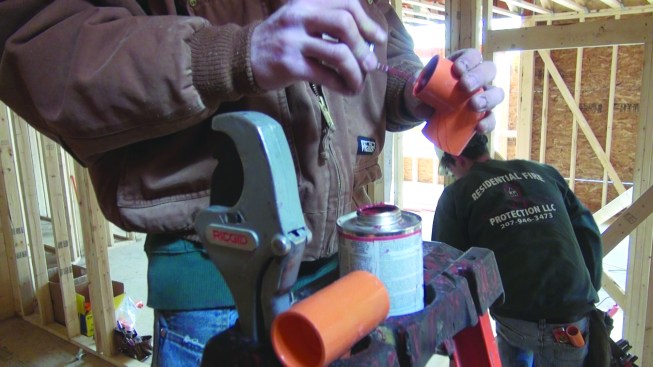
He applies a thick coat of solvent cement to the inside of a fitting.

Then he jams the end of a pipe into a prepared fitting.
CPVC, by contrast, is easier to cut and join. But there’s a significant caveat: The plastic material is sensitive to chemical interactions with other materials—a vulnerability that the industry has learned the hard way, through failures in the field.
Nowadays, suppliers warn about a range of potentially damaging interactions. On the website of Lubrizol, the maker of Blazemaster CPVC pipe and fittings, you can find a long list of incompatible products that includes anti-microbial coatings for steel pipe, 11 different kinds of caulk, 14 different firestopping products, five leak detector fluids, six mold cleaners, two mold inhibitors, a vinyl-coated pipe hanger, four kinds of pipe tape, 20 different thread sealants, and one brand of waterproofing. Putting any of these products in contact with the sprinkler pipes could lead to degradation and leaks. So, too, could exposing the pipe to the UV radiation in sunlight.
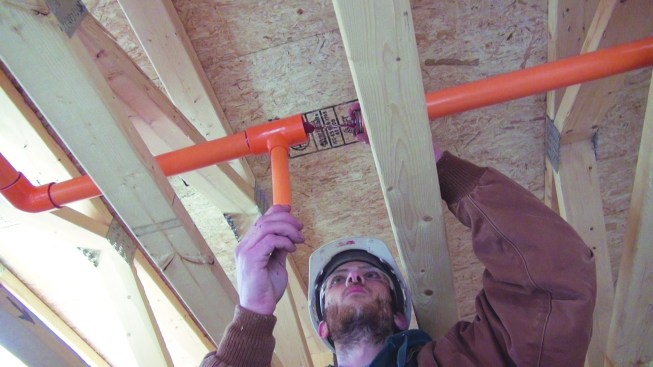
To make a CPVC pipe joint, both of the pieces to be attached need to be smeared with the solvent adhesive. Above, the installer applies a medium-thick coat of adhesive to the inside of the fittings.
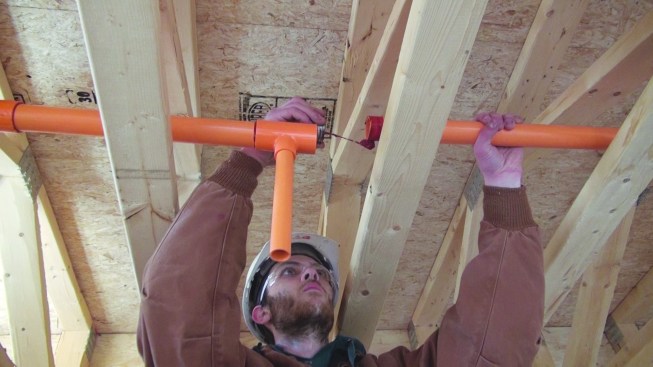
A heavy coat is applied to the pipe end.
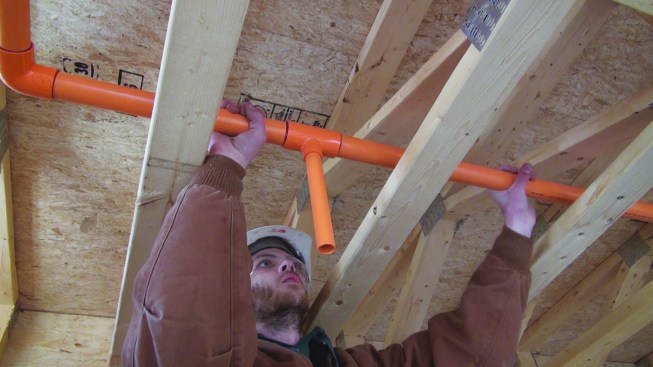
He jams the pipe into the fitting until the pipe bottoms out against the fitting.
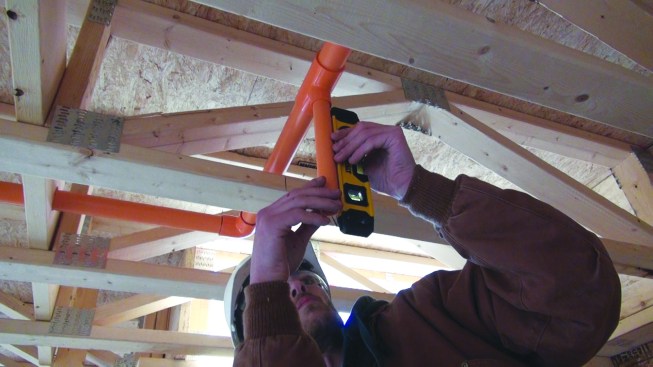
The pipe is checked for plumb.
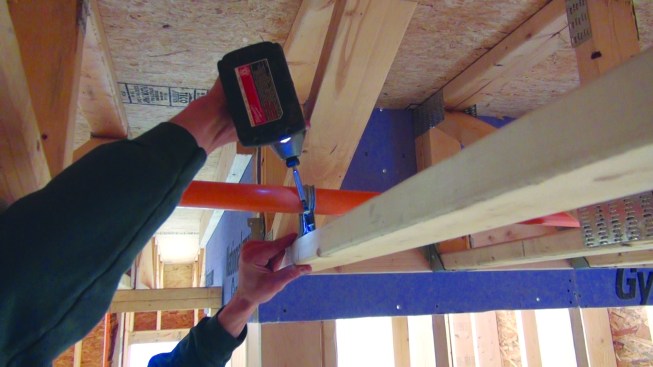
Adjustments to pipes should be made immediately, before the adhesive sets. The installer secures the pipe to the framing with a connector. Pipes need to be restrained against uplift from water pressure in the event that a sprinkler head activates.
When it comes to sprinkler heads, there’s also a lot of choice. Sprinkler heads are designed to actuate one by one when temperature at the head reaches around 200°F, suppressing heat and flame in the area directly under the head with a fine water dispersion. You can get sidewall-mounted as well as ceiling-mounted sprinklers. You can also get recessed sprinkler heads with flush covers that will drop off in the heat of a fire but that allow sprinklers to visually blend with the ceiling.
Whether you use flush covers or exposed sprinkler heads, you need to protect both from paint. Manufacturers supply temporary covers for use during construction.
It’s also important to be aware of obstructions. Sprinkler heads need to be located so that the spray from a head that activates won’t be impeded by soffits, dropped beams, lighting fixtures, and so on. That’s an issue that should be addressed early in the design process.

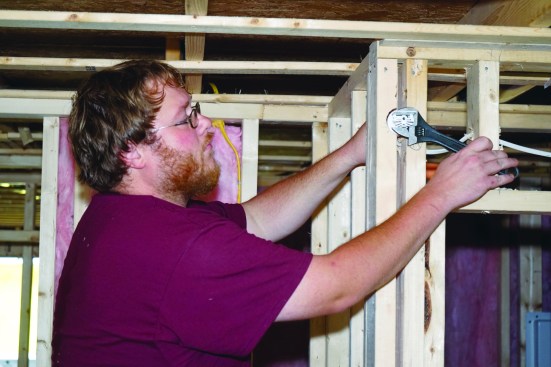
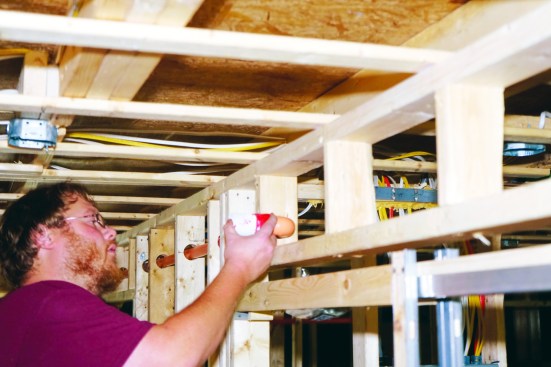
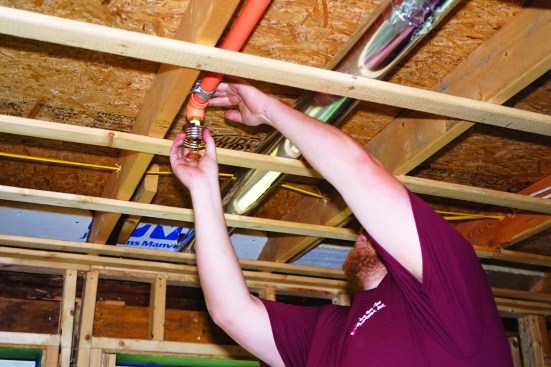
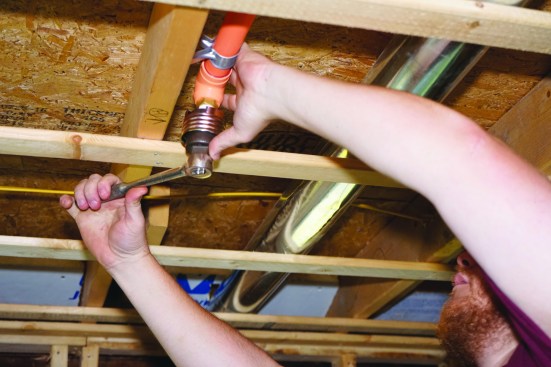
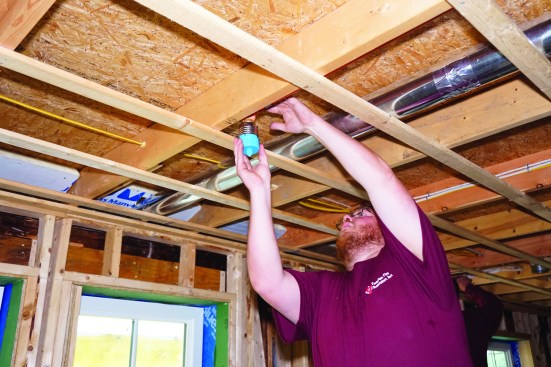
An installer wraps a sprinkler head’s threads with thread tape…
NAVIGATING THE RULES
The trickiest part of working with fire sprinklers is not the technology; it’s the rules. If you do choose to put sprinklers in a building, or if you are required to put them in, you’ve entered a world of code books and standards—and there is plenty in that world that can trip you up. When it comes to sprinklers, the main reference standards are NFPA 13, NFPA 13R, and NFPA 13D, which are published by the National Fire Protection Association. It’s not always obvious which book (or which edition of that book) will apply to your situation, and that alone can make a big difference.
NFPA 13 is the main sprinkler standard. It’s the National Fire Protection Association’s oldest standard, with origins dating back to 1896, and it has grown in size and complexity over the years. NFPA 13 is a fat book, and it’s hard to navigate—so hard, in fact, that the 2019 edition of the standard, which has just been released, basically amounts to a complete reorganization whose purpose was simply to make the standard readable and usable.
Steve Leyton is a nationally known fire-sprinkler consultant who runs an 11-person sprinkler design firm (protectiondesign.com) and has served on the standards committees for NFPA 13R and NFPA 13D. Jokingly, Leyton remarks, “We work very hard to keep the standards as complicated as possible so that the general public has to hire guys like us.” More seriously, Leyton says about the NFPA 13 rewrite, “I’m fully on board with what they’ve decided to do.” Organizationally, the revised standard starts at the street with water supply—a logical format, Leyton says. “I always tell young designers when they’re starting out, ‘Follow the water.’”
Reformatting NFPA 13 required a 6,000-line spreadsheet, and even the new, improved version is still a behemoth. Fortunately for residential builders, most projects won’t require you to delve into the full Standard 13. One-family and two-family homes (and some townhouses) fall under the much, much shorter NFPA 13D standard; and most other residential occupancies less than four stories in height—including apartment buildings, condominiums, group homes, hotels, and motels—typically fall under NFPA 13R, which is also mercifully short.
Conceptually, NFPA 13 is intended to save buildings. NFPA 13R and 13D are intended only to save lives and prevent injury. “The residential system is designed to get the people out,” says Gerry Leach. In practical terms, the differences between NFPA 13, NFPA 13R, and NFPA 13D can be substantial.
To comply with the full NFPA 13, for example, the sprinkler system has to include sprinkler heads in closets, small bathrooms, balconies, attics, and dead spaces—all locations that don’t need to be protected under NFPA 13R or 13D. Also unlike a full NFPA 13 system, or even an NFPA 13R system, NFPA 13D systems don’t require a separate water supply for the building—you can make a “combined system” that uses the domestic water supply as its water source.

Here, a fire-department side-by-side demonstration in Brunswick, Maine, shows the effectiveness of residential fire sprinklers in suppressing a fire in a pair of simulated rooms. A fire in the right-hand room (with no sprinklers) reached deadly flashover in a little over two minutes.

A sprinkler head in the left-hand room ceiling activated in about one and a half minutes after ignition, effectively suppressing the fire. Damage to contents in the unprotected room was far more severe than in the protected room. More importantly, in an actual fire, the sprinkler would have given building occupants precious moments to escape.
SPECIAL CASES
All that simplification is great if you’re doing a simple, straightforward project. However, there are traps for the unwary if you get involved in a complicated situation—as Heather Thompson, a custom builder (and JLC contributor) who runs Thompson Johnson Woodworking in Portland, Maine, learned the hard way this year.
Thompson is in the middle of an investment project on Peaks Island, in the Portland harbor. The job is a major makeover of an old building that used to be the island’s bowling alley and for years has been a two-family dwelling. Thompson is revamping the old structure, adding two apartments and a business occupancy (her own company offices and some storage space).
The city of Portland requires all new homes and this kind of major remodel to have sprinklers. But the city building department told Thompson that she could sprinkler the residential part of the building according to NFPA 13D. Only later, when she got to the level of plan review by the state Fire Marshal’s office, did she find out that according to NFPA rules, she would need to comply with the full NFPA standard, even for the apartments.
The reason, state official Gerry Leach told JLC, is that the fire separation assemblies between the apartments and the commercial occupancy didn’t meet a two-hour separation standard—which Thompson hadn’t known she would have to meet. By the time she got the bad news, the firewalls were already built as a one-hour fire separation, the apartments were fully framed in, and it was too late to make a change.
Interestingly, under NFPA 101, the NFPA’s “Life Safety Code,” the total footprint of Thompson’s project might have been small enough that the remodel would not have triggered any sprinkler requirement at all, according to Gerry Leach. The sprinkler was needed only because of the city of Portland rule that required it. But Leach says, “Even if the state doesn’t require sprinklers, once the city requires the builder to have sprinklers, the state reviews the design according to the NFPA rules—and in this case, if a sprinkler was installed, it needed to comply with the full NFPA 13.”
As a result, Thompson had to find money in the budget for significant upgrades, including sprinkler heads in all the closets in the rental apartments, through-the-wall freeze-protected dry sprinkler heads for the outdoor balconies, and a separate freeze-protected dry sprinkler system for an unheated attic space.
This sort of problem with sprinklers late in the job is common, says expert Steve Leyton—but preventable. “It goes to the whole reason why I went into business,” says Leyton. “You know, you have to coordinate the work. When you start adding up all the things like ductwork, beams, or ceiling fixtures that can get in the way of a fire sprinkler, especially on a commercial job, there is a certain amount of coordination work. It requires some focus. When builders defer the sprinklers, they also defer a lot of the decision-making that should go into the design not just of the sprinklers, but of the building itself.”