Repairing Fire Damage
Assessing the damage and making repairs is challenging enough, but you've also got to get rid of that smell
12 MIN READ
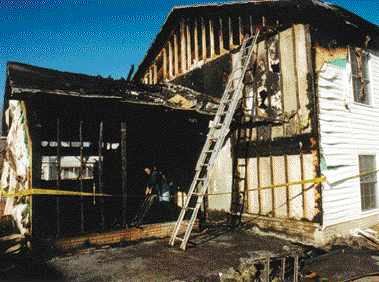

Because we try to preserve as much of the existing structure as possible, we often work backward, replacing joists without removing the subfloor, swapping burned rafters without tearing off the roof sheathing, and sometimes even replacing an entire exterior wall frame without demolishing the exterior brick veneer. Because this can be painstaking, I prefer to do all the structural work with my own employees. Demolition, cleaning, and framing occur simultaneously in fire restoration, not in the separate stages subcontractors are used to.
Smoke penetrates walls and ceilings, so that every surface, even those exposed through demolition, must eventually be cleaned, deodorized, and sealed with special tools and chemicals. Even a small tuft of smoke-saturated insulation left behind can present a major problem when the customer calls to say, “Our house still smells like smoke.” To avoid that, we use a small battery of contraptions and a sizable array of chemicals to deodorize and clean every crack and cranny in a house.
Ozone generator. One of the first tools deployed on the job is our Sonozaire 115A ozone generator ($815, Howe-Baker Engineers, 800/323-2115, www.sonozaire.com) along with a large fan. The ozone generator plugs into a standard outlet and electronically produces a stream of ozone-enriched air that oxidizes odor-causing molecules and converts them into odorless CO2. The fan helps spread this ozone-enriched air throughout the house. Since high ozone levels can harm people, we use it only in empty buildings and generally overnight, when no one’s working.
Dry fogger. Ozone works best on organic (wood, paper, and protein) odors, but because house fires consume many different materials, just one deodorizing system won’t work. After the house has been sealed up and all the smoked debris and wood framing have been replaced, I deploy a thermal fogger called the Electro-Gen 2000 ($200, Unsmoke Systems, 800/332-6037, www.unsmoke.com).
A thermal — or “dry” — fogger resembles a low-volume lacquer sprayer that combines a heating element with a small pump. Once the element heats up, the fogger produces a fine, dry, odor-neutralizing mist that can trace the pathways of smoke and reach areas unreachable by other tools. We pour a cherry-scented, solvent-based deodorant, Thermal Fog CD27GLA (Bridgepoint Systems, 800/794-7425, www.bridgeport.com), into the reservoir, though water-based deodorants are also effective. I like to start in the same spot as the fire began and then follow the fire’s path through the house, fogging every room.
Wet fogger. To sanitize between concealed stud bays and ceiling joists, I puncture the drywall and insert a spray hose attached to my PureMist ULV wet fogger ($285, available from Bridgepoint Systems). This tool resembles an airless paint sprayer and atomizes powerful, water-based deodorants and sealers. I like to use Unsmoke’s 9-D-9 Deodorizer and Bridgepoint Systems’ Smoke Odor Counteractant CD24GL, because they inhibit the evaporation of odor-causing gases.
After saturation-fogging behind drywall and into concealed areas, I seal off any remaining odor-causing particles with a water-based sealer, Bridgepoint Systems’ Soot Sealer CD25GL. I blend this sealer with additional additives — for example, Deodorizing Additive CD28QT and Smoke Odor Counteractant CD24GL, both from Bridgepoint Systems — for a greater margin of security against untreated odor. I use a similar procedure for sealing ductwork, although I usually hire out the duct cleaning because it requires specialized brushes and vacuums that I don’t own.
Unfortunately, there’s no single super-cleaner that removes every kind of smoke damage from every surface. But there are a number of high-tech cleaning products that can save thousands of dollars in replacement costs. In fact, cleaning has evolved into a complex craft with specialized products ranging from delicate enzymes that eat proteins to powerful soot-dissolving acids. For instance, we use dry chemical sponges to extract soot from wallpaper and other delicate materials that cannot take water. To clean textured ceilings, we use a chemical-bleach mist.
Elbow grease works best on most exposed surfaces. I scrub with a variety of industrial cleaners, depending on the nature of the fire. For all-around cleanup, I like Bridgepoint’s Hard Power CC31GL, a versatile blend of detergents and solvents. Some areas are more difficult to wash, like exposed framing, so I combine Hard Power with one or more various manufacturer-recommended additives, using a pump-sprayer to saturate smoke-damaged areas.
Before any framing gets buried under insulation and drywall, I lock down the last traces of odor with a water-based soot sealer. This final application of soot sealer can be put on with a wet fogger, though I prefer to use an airless paint sprayer because its high-volume output makes fast work of large areas.
The airless sprayer works well for sealing wall surfaces, too. But don’t make the mistake of using a shellac-based sealer like Kilz (Masterchem Industries, 800/325-3552, www.kilz.com) to seal in smoke odors. These sealers are really effective only against stains, so it’s best to lock down smoke odors with a clear, odor-inhibiting soot sealer, and then apply a tinted shellac-based stain block as a primer.
Because cleaning can be complex, many general contractors occupy themselves with just the structural portion of the job and leave the cleaning to the experts. I subbed out the cleaning for several years before attending training and certification courses offered by the Institute of Inspection, Cleaning, and Restoration Certification (www.iicrc.org). You can also become more familiar with the techniques, products, and tools available for restoring fire-damaged surfaces by visiting a professional cleaning-supply company.
Before moving on to reconstruction, I like to sprinkle super-absorbent odor crystals or lay larger, spongelike odor blocks between stud bays, chases, and anywhere else smells can hide and fester. This provides another layer of “whiff” protection. If all these apparently redundant procedures seem like overkill, well, that’s the whole point.
By the time the electricians, plumbers, and mechanics arrive, our jobs resemble a normal remodeling project. And instead of acrid smoke, the job sites smell like candy.
Fernando PagesRuiz is a building contractor in Lincoln, Neb.
No recommended contents to display.