
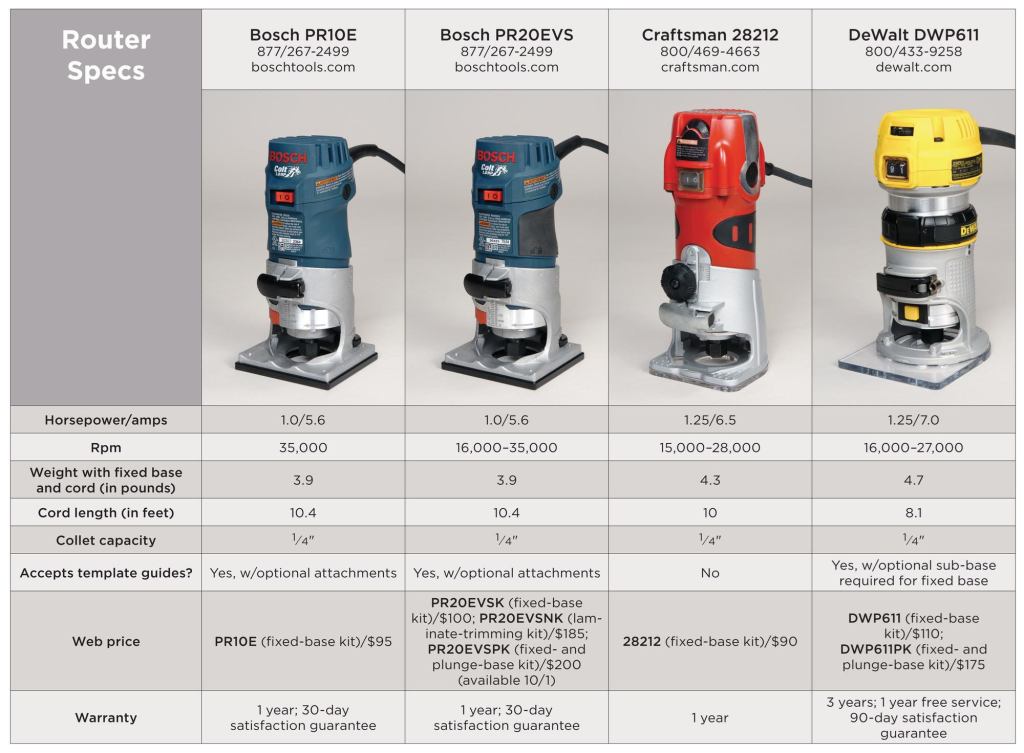
Bosch PR20EVS


Tim Uhler
The author likes compact routers for light-duty, one-handed ope…
This router is almost identical to the PR10E, but adds variable speed and an overmold grip. It comes three ways: in a fixed-base kit with a straight guide, two wrenches, and a plastic case; in a kit that adds Bosch’s new plunge base (available October 1); and in a laminate-trimming kit. When I first inspected this tool, the clamp on the fixed base was too loose to prevent the motor from rotating to the unlocked position. But after a quick adjustment with an 8-millimeter wrench, it was ready for action.
I swapped all of the available bases on the PR20EVS with mixed results. The tilt base works well; it installs and adjusts just like the fixed one, tilts the motor from 45 degrees forward to 30 degrees backward, and has detents for key angles.
The offset base also requires the twist-and-lock routine, but there’s no fine adjustment required. The motor was a tight squeeze into this base, and the clamping lever was difficult to operate because it rubbed the top of the spindle-lock housing — but otherwise the base worked fine. It has a plastic jacket (also sold separately) that you can transfer to the fixed or tilt base; the jacket insulates your gripping hand from high heat created by continuous or heavy usage.
The new plunge base is a beauty: comfortable grips, a 2-1/8-inch-diameter center hole to accommodate big bits, a seven-step rotating turret, a secure depth rod with a zero-reference depth scale, and a nice plunge-locking lever that releases when you press down and self-locks when you let go. Optional attachments allow the base to connect to a vacuum and accept template guides. The base will also sell separately for about $90 to $100.
Craftsman 28212
This Craftsman Professional palm router has surprising power and features for $90. Delivering 1-1/4 peak horsepower, the variable-speed tool comes in a kit that includes a fixed base, an edge guide, a wrench, a carry bag, and an oblong two-handle sub-base that screws to the fixed base. The unique sub-base adds stability and makes it easier to pivot the router on edge to plunge a bit. I also like the D-shaped fixed base, the soft dust cover over the rocker switch, the dual LED work lights, the extra-gentle soft start, the 10-foot cord, and the live-tool indicator light (though it’s hard to see in bright light).
On the downside, the micro depth-adjustment wheel could be better, the rpm fluctuated a bit when I routed at reduced speeds, the tool doesn’t hook to a vacuum or accept template guides, and there’s no satisfaction guarantee. There’s a spindle lock, but if you’d rather use two opposing wrenches, you can’t.
DeWalt DWP611
The basic DWP611 kit includes a fixed base and a collet wrench. The DWP611PK kit adds a plunge base and a carry bag. But DeWalt offers lots of attachments a la carte, including an edge guide, a centering cone for the fixed base, a round sub-base that accepts template guides, a template-guide set, and dust-collection adapters for the fixed and plunge bases.
This variable-speed router was the strongest performer in my subjective trials and is exceptionally easy to set up and use. It has a spindle lock with 12 detents rather than the usual two so you can use the “manual ratchet” method with one wrench to install or remove bits. (You can’t use two wrenches instead, however.) To adjust the cutting depth precisely with the fixed base, you can set the router upright on the workpiece with the bit raised, open the clamping lever, and turn the depth-adjustment ring counterclockwise until the bit just touches down. Then you turn the yellow micro scale under the ring to align the “O” with the pointer on the ring, turn the ring until it points to the desired depth of cut on the scale, and relock the lever. It works great.
To remove the motor from the base, you just open the lever, press two tabs on the ring to separate it from the base, and slide the base off. Spin the ring off the motor, snap it back onto the fixed base so you don’t lose it, and you’re ready to clamp the motor into the plunge base.
That base is also impressive, with comfortable handles, smooth controls, an easy-to-read zero-reference depth scale, and the ability to accept template guides. The router also has a dual LED work light and clear sub-bases that give excellent visibility even in dim light, a D-shaped sub-base on the fixed base that makes it more stable for edge-forming, and a dust cover over the switch. For added convenience, you can orient the motor in the fixed base in two opposite directions and install the sub-base in four positions.
One tiny nitpick: The DeWalt takes about two to three seconds longer than the other routers (except for the closely related Porter-Cable) to come to a complete stop after you turn it off.