
An exterior guardrail presents an opportunity to explore a house’s design themes in detail. All too often, designers and builders opt for an ill-considered stock railing that technically performs the guardrail function but neglects the spirit of the building it serves. A well-designed guardrail should reflect a home’s architectural context.
The following examples provide a range of exterior-railing options for a variety of house types.
Contemporary Cable Rail
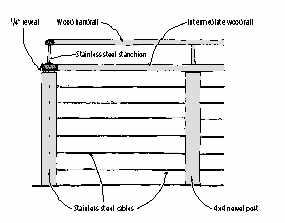
This contemporary system uses 1/8-inch stainless steel cables that run through holes drilled into intermediate newel posts (as spans allow). They terminate at surface-mounted fittings with turnbuckles. The continuous top rail — designed to transition into a handrail at the deck stairs — contributes to the assembly’s streamlined appearance, which recalls familiar boat railings.
When priorities dictate an unobstructed view, a contemporary design, and a feeling of openness, this largely transparent guardrail is a good choice.
Traditional Turned Balusters
Turned wood balusters are typical of traditional 18th- and 19th-century porches, balconies, and widow’s walks. Originally, these railings tended to be stout, measuring about 2 feet tall. Today, however, residential building codes generally require 3-foot-high guardrails, which can result in the elongated turned balusters shown here. Unless the homeowner is doing a period-specific renovation or reproduction, I don’t usually recommend this type of guardrail.
Transitional Linear Guardrails
Creating a unique design in the center of a guardrail can subtly enliven a long and otherwise monotonous run of vertical wood 2×2 balusters. The pattern can incorporate the same components used in the rest of the structure.
The railing shown at top right has crisp, clean lines; the heavy top and bottom rails create strong horizontal boundaries for the pattern in between. Its formal feel derives from its symmetry and static geometry. It’s a “transitional” design because it bridges the gap between traditional and more contemporary guardrails.
Composed of 2x4s and 2x2s, the second example of a transitional linear rail, shown at bottom right, is more graphic in nature. The 2x4s establish primary diagonal Xs and the 2x2s fill in, completing the pattern.
A busy railing like this is a nice foil to a simple house form. The top and bottom rails are not as heavy as in the previous example, which helps to lighten the overall look. A continuous top rail — rather than one interrupted by newel posts — would make it less traditional.
Carved Plank Rail
Of all the guardrail examples, this playful rendition is the most enclosing. The cut-outs alleviate the opacity; the more there are, the lacier the effect, as seen to the left of the break lines in this drawing.
The placement of the top and bottom rails suggests a fence more than it does a guardrail, adding to the structure’s informal feel. It also means that each side of the railing looks different.
Such a whimsical design might complement a small cottage or modest camp.
Eclectic Carved Plank Rail
While still informal, this is a more sophisticated pairing of cut-out planking and linear balusters. Here, the pattern alternates between opacity and transparency. A continuous top rail helps keep the arrangement simple and more contemporary.
Unlike the previous example, this railing looks the same from both sides. It suits a variety of home designs, from older cottages to new custom homes that highlight wood craftsmanship.
Katie Hutchisonis an architect and the owner of Earthlight Design in Salem, Mass.