
Sometimes when you sit down with clients, the thing they called you for has little to do with what the project becomes. That was the case for Sara Jazayeri, principal of Studio 360, an architectural and interior-design firm based in Riverdale, N.Y. When she sat down with clients near Stamford, Conn., what started as a simple interior-design consultation turned into a full makeover of an upscale, modern-style home.
It all started with the couch. When Jazayeri first sat down with these clients, they had won an hour of her design services, which she had donated as part of a fund-raising auction. The couple wanted to use their time to get advice about their couch. They felt it needed to be replaced but couldn’t agree on a color and style. ” I assured them that I could help them pick out a new couch,” Jazayeri said, “but I said the problem with the living room we were sitting in was not the couch. It was the fireplace.” This seemed to surprise the couple, who said they loved the fireplace, and wanted to know more of what Jazayeri meant. She explained that the fireplace brick—only thin, surface-applied veneer—extended only about 3/4-inch off the wall and reached only partway up the wall. “I felt strongly that it could function as a main design element, but it was executed so poorly that it did not take full advantage of the other design elements in the room.” Those elements included very high ceilings, a dramatic array of beams and columns, and full-height, floor-to-ceiling windows.
Sara Jazayeri
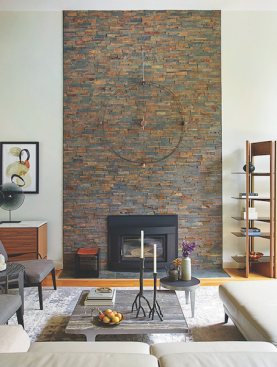
Shabby brick on the fireplace and hearth was replaced by porcelain tile that extended all the way to the ceiling.
The more they talked, the more interested the clients became in what might be done to transform the look and feel of their home. The next time Jazayeri met with them, she brought, of course, some ideas for their couch but also shared ideas for what might be done with the fireplace and the columns.
Little by little, the scope of the project became bigger and bigger. From the living room, she eventually took on the front entry (which included stairs that went down to the lower level), an entire gut of the lower level, the master bedroom, and finally, the exterior. The only rooms she hasn’t touched so far are the kitchen and the master bath, both of which had been renovated when the family moved in. But the clients have since called Jazayeri, saying the master bath doesn’t fit with the rest of the house and would she begin on that room, too.
Even Millionaires Have Budgets
These clients were successful professionals working in New York City, and they certainly had the means to do almost anything they wanted. But, as Jazayeri explained, she has yet to work with a client who told her to “do whatever you want, regardless of cost.”
“Even millionaires have budgets,” Jazayeri said. “As I worked with these clients, it became clear that they weren’t up for doing a complete rehab all at once.” The essential bones of the house were sound, and the clients appreciated the dramatic lines and ample light of their modern-style home. Redoing all the finishes at one time would have put them off balance, even if only temporarily. They needed time, Jazayeri felt, to make decisions and consider options. What she was able to provide, and what they welcomed, was a practical update, a fresh new palette, and prioritized replacement of features that had been executed poorly and did not weather or wear particularly well over time. We went room by room, Jazayeri said, at a pace that allowed them to pay without financing or draining reserves, and that they could emotionally absorb without stress.
Prioritized Solutions
The solution for the fireplace was to bring it all the way to the ceiling line and build it out from the wall to give a more convincing mass. Jazayeri’s team changed out the face brick for a natural-look porcelain tile and redid the hearth with a large-format porcelain tile that provided high contrast against the wood floor for a strong visual foundation.
The existing columns and beams had been stained, but the wood had absorbed the clear strain differently, and light had faded some more than others, so they presented a visual jumble. Simply using a uniform, solid-color stain brought an immediate sense of unity and cohesion to this important design element.
The columns in many cases were also spindly looking. The bearing columns were sufficient structurally but visually too narrow. A few of the columns were dummy columns that didn’t support anything but had been added to create visual balance, and a few of these were simply not straight. By wrapping the columns, Jazayeri’s team succeeded in visually straightening out the lines and providing thicker columns that added a much-needed sense of solid support.
Sara Jazayeri
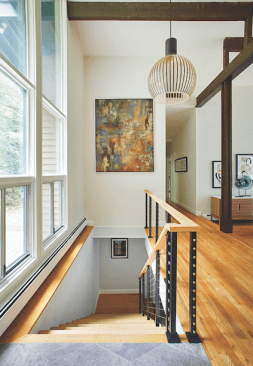
At the entry, a heavy oak banister was replaced with cable railing, which echoed the railing used on all exterior decks as well.
Entry. The front entrance opened onto what is essentially a large top landing to the stairs leading to the lower floor. By replacing the wood floor in this area with tile, Jazayeri provided a sense of walking into a foyer, without needing to add walls or change the footprint. Of course, tile also provided a more durable flooring than wood to better weather wet boots and dripping coats.
The traditional oak railing and balusters on the stairs also badly needed refinishing and tightening up. The balustrade was also heavy and blocked much-needed light from the front windows to the downstairs. Jazayeri took out the oak railing entirely and replaced it with cable rail. She used the same cable railing for the front entry deck and for the other outside decks, providing visual coherence through the front windows between inside and outside, as well as a unity between the three exterior decks. Cable railing also let more light into the lower floor and provided low-maintenance functionality on the exterior decks.
Sara Jazayeri
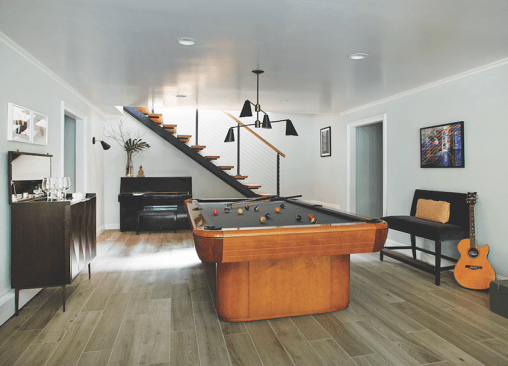
A complete gut of the lower-floor family room and bedrooms brought in more light and clean surfaces.
Downstairs. The lower floor included two bedrooms; one was used by a teenaged son, and the other served as his music room. This floor included a large family room that led to the outdoor pool area, and a small bathroom that served guests changing for the pool. When she first looked at this room, it smelled of mildewing towels, a problem that has since been eliminated by the addition of a towel warmer.
Sara Jazayeri
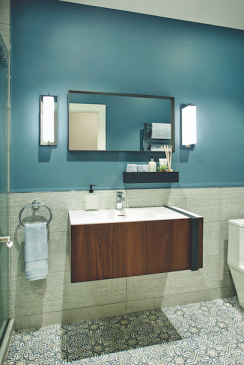
A Moroccan-inspired patterned floor tile, floating vanity, and serene blue paint provided a perfect ensemble for the pool-area bathroom.
This entire floor required a complete gut. The main room downstairs had been dark, and what was critically needed was more room and light surfaces. Replacing the stair railing helped with the light. So did repainting the large brick fireplace—a beautiful blue-gray outside and jet black inside.
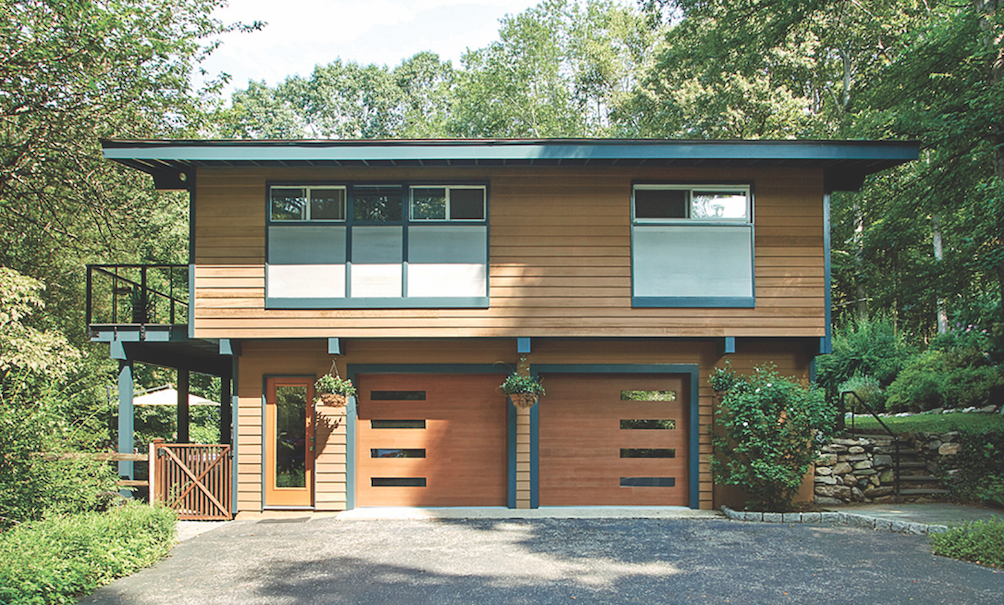
Exterior. The siding, Jazayeri explained, looked tired, and there were issues with rodents nesting in the siding in numerous places. Among the most vulnerable parts of the exterior were plywood panels under the windows that had deteriorated. Jazayeri replaced these with lightweight facade panels from Porcelanosa that are extremely durable. Her team also repaired damaged areas of the trim and repainted it, changing it from an oppressive black to a blue green that complemented the existing horizontal siding, which was, for the most part, still in good shaped and didn’t require refinishing. “The whole point was to keep what worked and change the rest.”
Building on Trust
Jazayeri got to know her clients over time, establishing the trust that is crucial to any good working relationship. But it also afforded her time to get to know and better accommodate their tastes, memories, and interests into the home. “What matters to people is not always what has the highest financial value,” Jazayeri explains. “Good design not only changes a house; it also changes how clients live in the house. That’s what makes our work significant.”