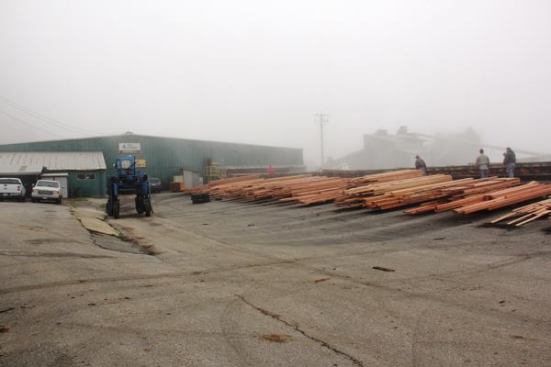
The main mill building is where logs are turned into boards. The…
The main mill building is where logs are turned into boards. There is also a planing mill, offices, and buildings that house the machinery for debarking logs and grinding bark and waste material into mulch. This photo was taken on a foggy March morning; the fog rolled in off the Pacific Ocean which is maybe 200 yards away.
David Frane_ToTT
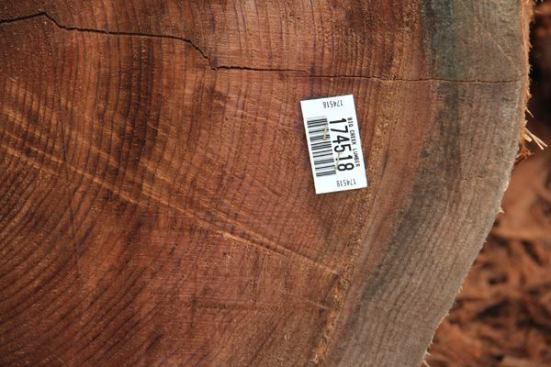
Those small white tags you saw on the logs in the previous photo…
Those small white tags you saw on the logs in the previous photo are bar code labels that contain information about where the logs came from, who the logs came from, and other information of use to the mill.
David Frane_ToTT
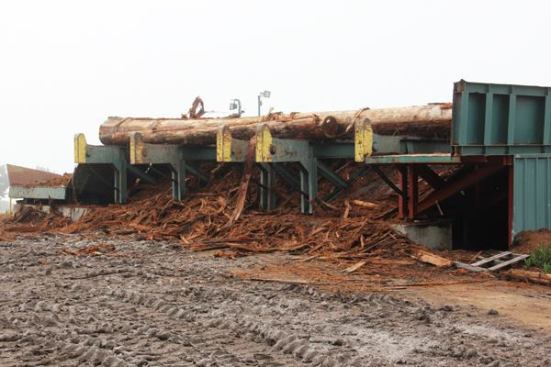
Whenever possible, logs are debarked prior to being sawn because…
Whenever possible, logs are debarked prior to being sawn because when trees are felled and dragged they become caked with dirt and grit, which greatly shortens the life of the blades used to turn them into lumber. These logs (which have already lost some of their bark) are waiting to be run through the debarker.
David Frane_ToTT
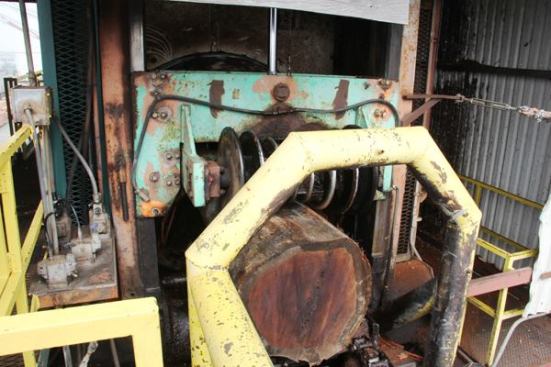
Here a log enters the debarker. It has been through once and is …
Here a log enters the debarker. It has been through once and is being run through a second time. The debarking machine is a giant ring with rotating cutter blades inside. The ring adjusts to fit different diameter logs, though some of the logs that come to the mill are too big to fit through the machine.
David Frane_ToTT
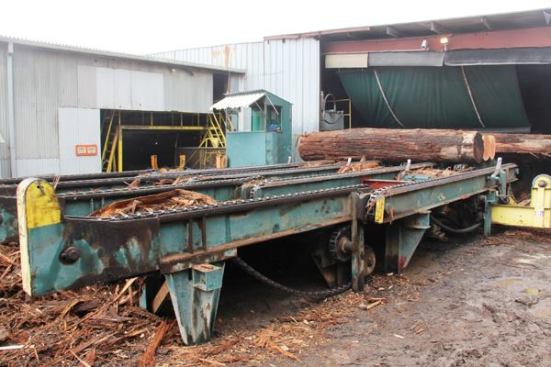
Logs enter the mill via a platform called the live deck—live b…
Logs enter the mill via a platform called the live deck—live because of a chain-drive mechanism that allows it to move and sort logs (
video here). The operator stands at a control panel inside the shed and by moving the chains one direction or the other is able to position logs so they can fed into one of two openings in the wall of the mill. Each opening leads to a different saw; one set up for quick cutting of low-value logs and the other set up for careful milling of high-value logs.
David Frane_ToTT
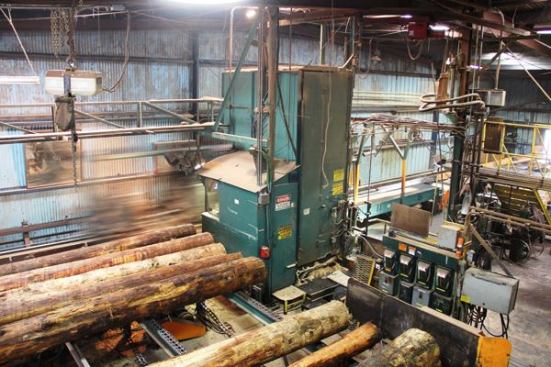
This is the pony rig (
video here), the smaller of the two band …
This is the pony rig (
video here), the smaller of the two band saws in the mill (the other is called the head rig—
video here) Sitting at controls inside the cab the sawyer (
video here) feeds logs onto the rig, rolls them into the desired position, and then cuts them in the manner of his choosing. It’s an important job and requires experience and judgment to get the highest yield—not just in board feet, but in value—out of each log.
David Frane_ToTT
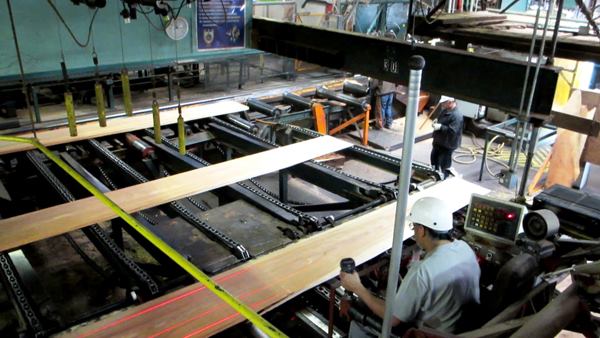
The log comes out of the band saw rig as a series of wide boards…
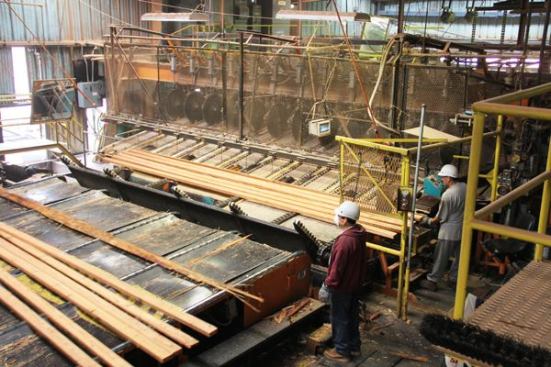
The log comes out of the band saw rig as a series of wide boards and is sent to the edger for ripping. It’s the edgerman’s job to position the boards (
video here) and set the blades inside the saw to rip nominal width pieces. Like the sawyer, he must optimize value by producing long lengths in desirable widths with the least amount of sapwood, knots, and other defects. The edgerman can position the blades on the fly and uses laser beams to see where they will hit the board.
David Frane_ToTT
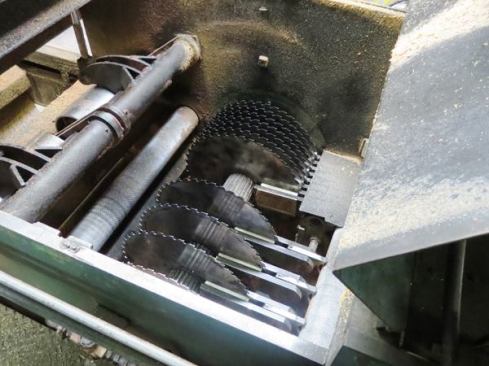
This is the inside of an edger; the blades can be positioned any…
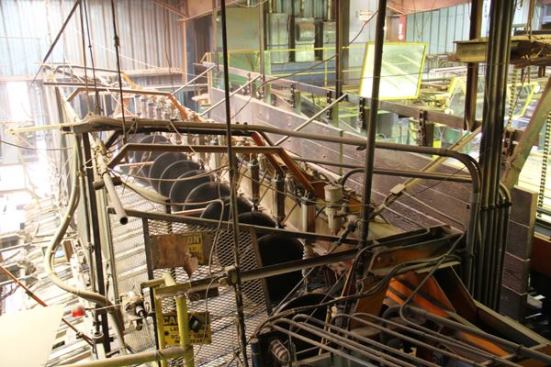
This is the inside of an edger; the blades can be positioned anywhere along the splined drive shaft and can be adjusted on the fly through the use of hydraulic cylinders. The closely spaced blades on the right side of the shaft are fixed, and are set up to rip 2-by out of a thicker piece. The blades on the left are the ones the operator is adjusting in the previous photo and video.
David Frane_ToTT
Five 2x4s plus some thinner pieces (mill run boards) are coming …
Five 2x4s plus some thinner pieces (mill run boards) are coming out of the gang rip saw (
video here). The piece that went in was approximately 3 1/2 inches thick by 9 inches wide.
David Frane_ToTT
When pieces come out of the edger they land on a transfer table …
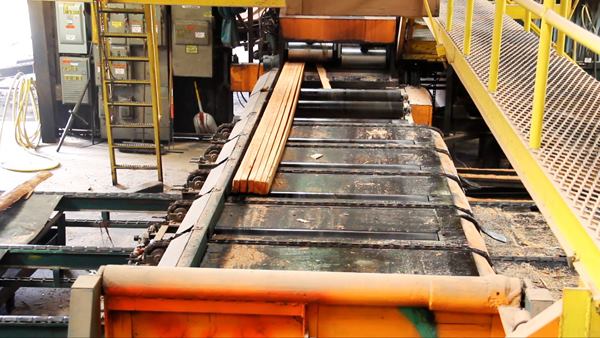
When pieces come out of the edger they land on a transfer table that conveys them to the trim saw that will cut them to length (
video here).
David Frane_ToTT
The saw contains a series of blades spaced 24 inches apart. The …
The saw contains a series of blades spaced 24 inches apart. The trimmerman decides which blades are up and which are down in the cutting position—and so, how long each piece will be. Like the sawyer and edgerman before him, he optimizes value by cutting around the worst defects and producing desirable length pieces.
David Frane_ToTT
Grading is the final step before the lumber leaves this particul…
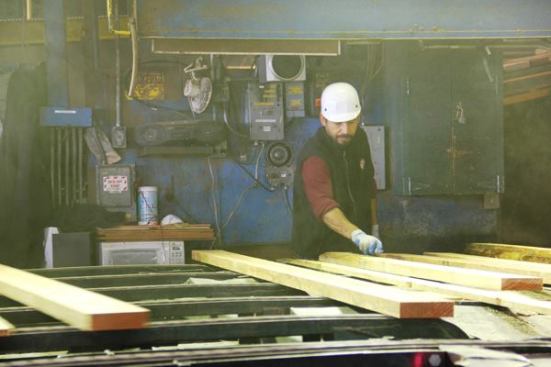
Grading is the final step before the lumber leaves this particular building. The grader takes a quick look at each board and puts a grade mark on it in chalk (
video here). This is another highly skilled job. My tour guide pointed at a board that to this carpenter’s eyes looked perfectly normal and said “See this cross-grain crack? That’s why it’s a lower grade”. I looked again and could barely see it. He said the grader can easily see that kind of defect—it’s a gimme.
David Frane_ToTT
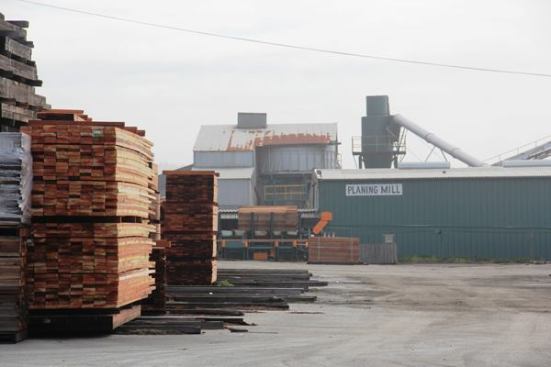
This is the planing mill. I didn’t go in because it was not be…
This is the planing mill. I didn’t go in because it was not being run that day. My bad—I should have gone in and looked at the machines. Well, maybe that’s the excuse for another visit.
David Frane_ToTT
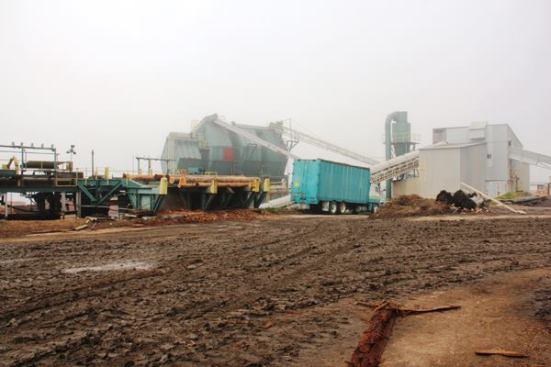
The silver building on the right contains grinding machinery, wh…
The silver building on the right contains grinding machinery, which grinds all of the bark, sawdust, and offcuts from the mill and makes them into a mulch mix. The mulch is conveyed to overhead bulk bins—the green structure to the left of the truck—and from there dropped into the open top of a semi-trailer.
David Frane_ToTT
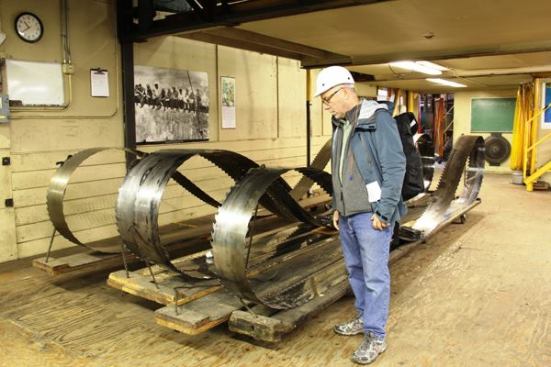
Here I am in the sharpening room—checking out the largest band…
Here I am in the sharpening room—checking out the largest band saw blades I have ever seen. These are dull and waiting to sharpened. If necessary, they will be re-tipped. Re-tipping means re-grinding the gullets and using a machine to weld on new Stellite tips. Stellite is an alloy similar to carbide; it's tougher but not quite as hard.
David Frane_ToTT
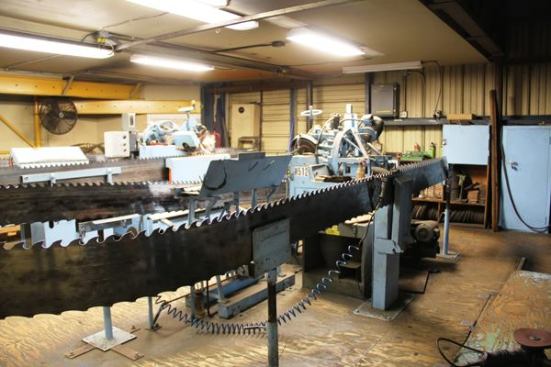
The next step is to sharpen the blade by grinding all edges of t…
The next step is to sharpen the blade by grinding all edges of the newly installed tips. These are the grinding machines. Blades start out 13 1/2 inches wide and get narrower with each sharpening. By the time Big Creek is done with these blades they’ll be about 9 inches wide. Blades typically last around two years.
David Frane_ToTT
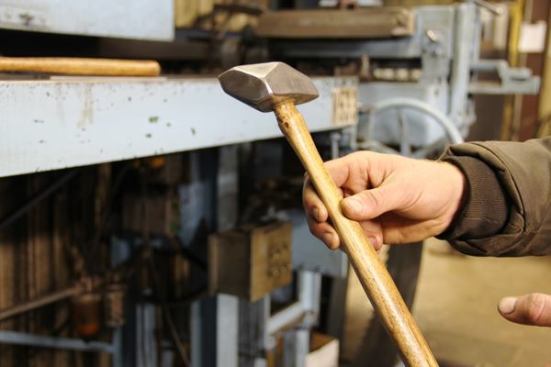
I noticed this strange looking hammer at one of the stations in …
I noticed this strange looking hammer at one of the stations in the sharpening room. I don’t know if it was made this way or someone ground it to this shape. Evidently, the saw sharpener uses this hammer while re-tensioning blades—which flattens and stretches the metal to make them run true.
David Frane_ToTT
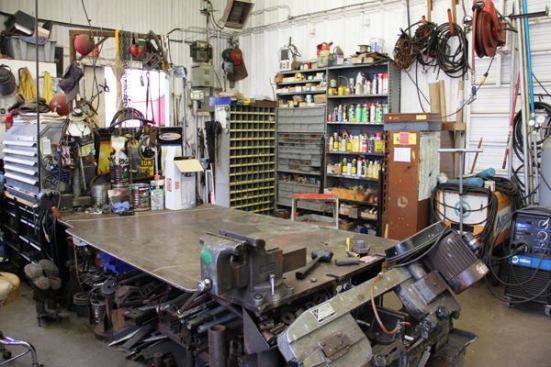
Maintenance and repairs are done in-house. This is part of a muc…
Maintenance and repairs are done in-house. This is part of a much larger maintenance shop filled with mechanic’s tools, parts and supplies, and equipment for cutting and welding.
David Frane_ToTT
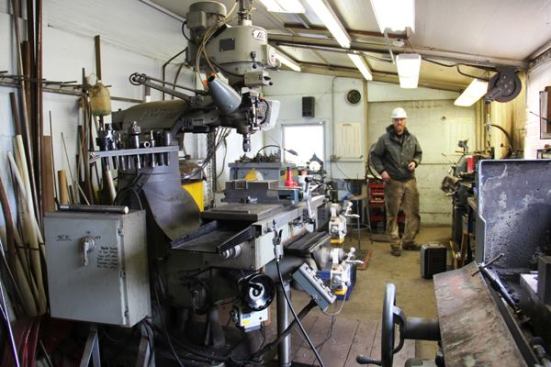
There is also a machine shop—for machining parts that would be…
There is also a machine shop—for machining parts that would be hard to buy.
David Frane_ToTT
Bonus photo: This is the view from the parking lot. The hill in …
Bonus photo: This is the view from the parking lot. The hill in the distance is part of Big Basin Redwoods State Park. The low area in front of it is where Waddell Creek flows into the Pacific. Big Creek Lumber’s original mill was several miles up that creek; it moved to its current location in 1964.
I was talking to a contractor and somehow the conversation turned to the lumber yards in the town where he lives, Santa Cruz, California. He told me that one of them, Big Creek Lumber, has its own sawmill. The mill processes redwood and is located in Davenport, a small town about 20 miles up the coast from Santa Cruz. I said I’d always wanted to see the inside of a sawmill so he put me in touch with someone he knew at the company and we set up a visit. The following week I made the two-hour drive to Davenport and was met by my tour guide, Alex Walker, the operations manager of Big Creek Lumber’s mill. Before we got started Walker gave me the following overview of the company.
Big Creek Lumber was founded in 1946 by members of the McCrary family. Their original mill was located several miles up nearby Waddell Creek Canyon. In 1964 they moved the operation to its current location next to Highway 1 and overlooking the Pacific Ocean. It’s a privately owned business and is now being run by the third generation of the family. Between 50 and 60 people work in the mill, which produces 70-100 thousand board-feet of lumber per day. Some of the lumber is distributed through the company’s five retail lumber yards; the rest is sold to other lumber yards around the state. Some of the logs processed at the mill come from company’s own forestland, but most are supplied by private landowners. Big Creek Lumber was an early practitioner of selective harvesting : Instead of clear-cutting or taking out all the best trees, they take individual trees from throughout the forest and leave the largest most significant trees alone. The company’s forestry department manages the process; done properly it leads to a forest with trees of varying age from which timber can be continuously harvested (maybe every 15 years) for an indefinite period of time.
You can see the inner working of the mill by clicking on the slideshow on the left side of this page. Be sure to check out the captions, some of which contain links to video shot in the mill.