
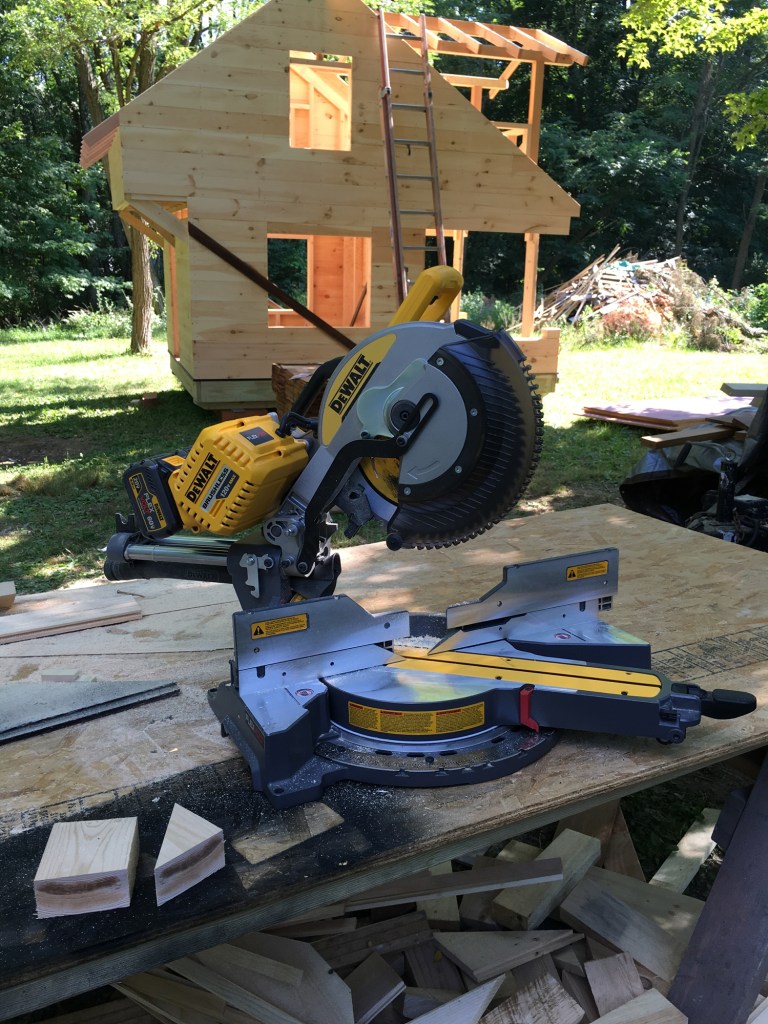
When the very first DeWalt 12-inch double-bevel sliding compound miter saw came on the market, one of the guys on my crew bought one immediately. The price tag on the DWS780 was tough to swallow at first, but its versatility has paid for itself throughout the years. Since then, we’ve purchased a newer edition, which had some nice upgrades, and we still have the original. Several months ago, Tools of the Trade asked us to test DeWalt’s latest iteration, the DHS790—a cordless version that’s identical in specs to the DWS780, except it runs on a brushless motor powered either by two FlexVolt 60V Max batteries or by a power adapter. This part is a game changer—a cordless saw that purportedly functions exactly as the corded DWS780 does and has the capability of being cordless or corded.
Real-World Testing
The first challenge my guys put this saw to was building a playhouse for a local charity event in partnership with a local architect. Most of the frame work for the playhouse was either full-dimension rough-sawn lumber or Douglas fir 4x4s. DeWalt says that on a set of fully-charged batteries, the saw can make 250 cuts in 2x4s. We didn’t keep careful count, and we were cutting slightly heavier material than a standard 2×4, but we were pleasantly surprised by the saw’s runtime. One of my guys even commented halfway through the day, “This thing is like the Energizer bunny: It keeps going and going …” The batteries did eventually drain fully, but we made an awful lot of sawdust beforehand. With regard to battery life, we learned that if the two batteries you put in are depleted to different levels, the saw will only run to the battery with the least amount of charge left.
The saw has essentially the same features as the DWS780: 11 detents for setting a miter angle, several options for setting positive stops for bevels, a vertical cut capacity of 6 3/4 inches on base and 7 1/2 inches on nested crown, and a 4 7/8-inch overall max depth of cut so you can get through most of a 6×6 in one pass. Like the corded version, this saw also has the capacity to cut up to 16-inch-wide material; it requires removing the fences and adding a sacrificial 1 1/2-inch platform to the saw’s table. The miter detent override lever is a nice feature—we used it often when running trim.
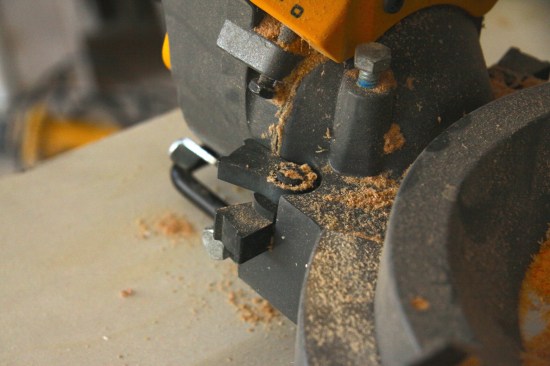
Adjustable positive stops for crown. Two pawls provide positive stops at 22.5 degrees and 33.9 degrees; they can be reversed for 45/45 crown. A chrome lever toward the back provides positive stop at 45 degrees and flips out of the way to achieve a sharper bevel.
The bevel adjustments are also nice and include the ability to go just beyond 45 degrees to about 50 degrees, which is great on outside corners when we’re running trim. The adjustment includes two “pawls” that swivel out on each side—one for 22.5 degrees and the other for 33.9 degrees. We cut crown both on the flat and nested—and found the saw accurate in both positions. Typically, we’re cutting preprimed pine and poplar. We had no deflection issues with the poplar and didn’t cut anything harder than that with the cordless saw. The corded DWS780 has done well for us with hardwoods, so I assume this saw will as well. It was cutting square to the fence right out of the box, though we had to adjust the bevel stops slightly. The fence does get in the way of the large motor when tilting to the left, so that’s something to be aware of on bevel cuts.
The saw’s dust-collection performed well in both corded and cordless modes. The saw comes equipped with DeWalt’s FlexVolt 60T blade, which DeWalt says is designed with a special coating, thickness, and anti-vibration characteristics specifically for this FlexVolt saw, to garner more runtime than a traditional blade. We can’t comment on whether that’s true or not, because we didn’t try the saw with a traditional blade. But we were happy with the blade’s performance and cut quality and the saw’s overall runtime.
One small gripe we had was the range of the depth-stop. We had to make a lot of shallow cheek cuts in 6x6s. This required that we lengthen the depth-stop screw close to its limit. When the depth stop arm was flipped out, however, the screw missed it. Our work-around required us to clamp a block to the area just above the depth-stop. Making shallow cuts in a 6×6 isn’t a common task, and there are other methods for doing this, so it’s not a deal-breaker for us.
My only other criticism relates to the saw’s light, which projects a shadow line of the saw blade onto the work surface. This isn’t a new feature for DeWalt’s miter saws. On the corded model we own, there’s a switch for keeping the light on all the time. There’s a switch on the cordless version too, but it keeps the light on only for about 30 seconds. The light comes on when the trigger is pulled as well, but you have to lower the blade down to the work surface to get an accurate read. Because the saw has a good amount of kick, if you’re not careful, you can accidentally catch the material before you’re ready to cut.
We wish there was a switch on the front of the saw’s handle that made the light go on as soon as you pressed your palm up against it. That way, you could have the light on without having to press a button or engage the motor—and you wouldn’t be depleting the battery by keeping it on all the time.
Bottom Line
The saw is available in three configurations. The DHS790AT2, which we tested, comes with two batteries, a dual-port charger, a corded power supply, dust bag, blade wrench, and 12-inch blade and sells for $800. That’s a big investment, but if you’re already invested in 20V Max tools, and you need a saw this size, it’s definitely worth considering. Or you can go cordless-only with the DHS790T2, which comes with everything except the corded power supply and sells for $750.
The DHS790AB kit comes with the corded power supply, but not the batteries or charger, and sells for $650. By comparison, the corded DWS780 sells for $600. Even if you don’t want to pony up $800 for the full kit, it makes sense to splurge the extra $50 so you have the ability to go cordless down the road if you’re leaning in that direction. (Two batteries will run you $200, and a dual-port charger another $100 if you don’t already have one.)