
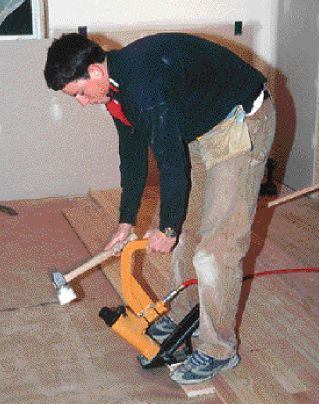
Pneumatic Flooring Nailers, continued
Senco SHF50
This tool is ruggedly built and has good power, but overall it seemed awkward compared with the other nailers. The handle points in the opposite direction from the other tools’ handles, which took some getting used to. The handle was also too short and required more bending.
Senco SHF50
The tool is the heaviest of the lot and seemed poorly balanced. It has a nice large shoe, however, making it easy to align on the flooring. Instead of a safety trigger, the Senco nailer has a contact safety that hangs from the bottom of the tool. Though not to our liking, it worked fine, but we wondered about durability. The hose connection points the hose up and to the side of the nailer — less convenient than nailers that direct the hose straight back. Noise was average.
The Senco’s safety trigger hangs from the bottom of the shoe.
Summing Up
For comparison, we also used my Bostitch stapler for some of the flooring. I noticed a tendency of the staples to split the tongue — something that was never a problem with the blunt cleats used in the nailers.
For now, I will be sticking with my Bostitch stapler, however. But if I were to buy a flooring nailer, I would buy the Bostitch. Of the five guns we had to choose from, it was definitely our favorite and the gun we tended to pick up the most. This is primarily because of the way the tool feels in the hand, its weight and balance, and the ease with which it aligns on the flooring. As a second choice, for a little more money, I would pick the Portamatic Hammerhead 2. Though it’s a little heavier, the tool works great. The case is another plus, and the adaptor plate for face nailing makes it the most versatile of the guns. Before you buy, though, make sure you can get the proprietary fasteners, or plan to order them from the manufacturer.
Craig Reynolds is a custom home builder and remodeler in Charlotte, Vt.