
Other Features
Makita’s saw has an LED headlight that shines on the blade at the cut line. We smirked until we were doing interior framing in a dark basement, then we decided it was pretty handy.
The Firestorm and Ryobi saws have lasers, but I didn’t find a use for them. I was willing to try, but their lines were too short to make it across plywood.
Porter-Cable’s saws have sawdust diverters atop their guards that can rotate out to connect to a vacuum. Ryobi also has a small vac attachment, but it must be screwed to the saw’s upper guard before each use.
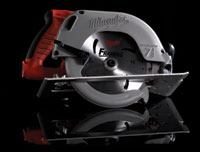
Both Milwaukee saws and the Worx model feature rotating handles that let you position its angle relative to the base. The Milwaukees only move the rear handle, but the Worx moves front and rear handles together. The idea is to keep the handle in a pushing position regardless of the cutting depth, but having used a similar Milwaukee saw for several years, I can tell you I never adjust the handle. I just leave it as far back as it will go with the saw set for full depth as I prefer not to have an additional step every time I adjust the blade depth.
Blade-Left Saws. Using a saw with the blade on the side facing you gives you good visibility, but also fills your boots and toolbelt with sawdust and often drops along with the cut piece.
The two we tested were nice, but not our choice as righties. The $140 Milwaukee 6391-21 is very similar to the blade-right Milwaukee model but without the brake, detachable cord, and on-board hex wrench. Instead, it has a standard wrench that is stowed separately. The front handle is also lacking the ergonomic tilt of the 6394 so it can be used by righties and lefties.
The $140 Porter-Cable 423 MAG is a mirror-image of the Porter-Cable blade-right model. The only difference is this model’s tool bag.
The Winner
There were a lot of good saws in this test, and any of the better pro-grade saws could serve a carpenter well. Remember, you can get used to anything, but the most efficient setup will always be better. So my favorite is the Milwaukee 6394-21 for its rugged construction, easy operation, and great versatility. I particularly value the ability to make quick, bevel adjustments without moving my hands off the tool. This saw makes all types of cuts smoothly, blade changing is easy, and the adjustments work smoothly and lock solidly.
The second place saws are the DeWalt DW369CSK and the Makita 5007MGA. The DeWalt, with its tough composite base, is well designed, lighter, and more compact than most. The Makita is a superbly comfortable saw, and its rubber-covered adjustment levers set a new standard. We were surprised by how much we appreciated the saw’s light, too. These top three saws really define what I would recommend as a full-time saw for serious framers.
The next tier of pro picks includes the DeWalt DW364K, the Hilti WSC167, Hitachi’s new C7BMR, and the Ridgid R3203 Fuego. This little 6-1/2-inch saw was a huge hit, and I suspect that other manufacturers will jump on the compact saw concept pretty soon.
I would have included the Porter-Cable 324MAG near the top of this list if I liked the tool-free blade-changing feature; everything else about this top-quality saw is a pleasure to use. The high-performance Bosch CS20 also would have rated higher if not for the lack of a standard power cord.
Trailing the rest are the Ridgid and Worx saws, followed by the Craftsman, Firestorm, and Ryobi.
–John Spier is a builder and construction writer on Block Island, R.I.
Ridgid R3203 Fuego
>We liked this saw a lot, although the 6-1/2-inch blade is smaller than we are used to. It proved to be among our favorites because it’s so light and easy to use. At 8 pounds and with a 12 amp motor, it’s more compact than any of the 7-1/4-inch saws, but its composite base is big enough, and at 6,100 rpm, it cuts just as fast. Its depth capacity is limited to 2-1/8 inches at 90°, but it cuts 1-5/8 inches deep at 45°, enough to clear 2-by lumber. A button overrides the 45° stop for beveling to 51°. The depth adjustment has detents at common material thicknesses, and both adjustment levers have a nice ratcheting re-positioning function. Blade changing is easy with the on-board hex wrench. Comes with a 12-foot cord and tool bag for $139.
Ridgid
800-474-34443
www.ridgid.com
Thanks
–Thanks to Irwin for providing the Marathon blades used in this test. 800-464-7946 www.irwin.com