

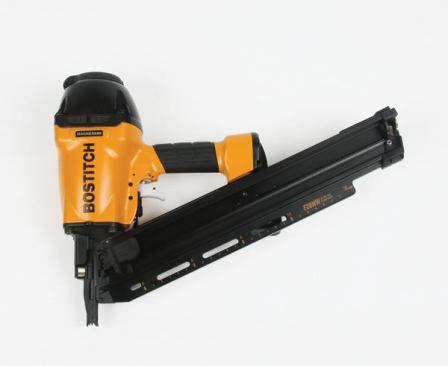
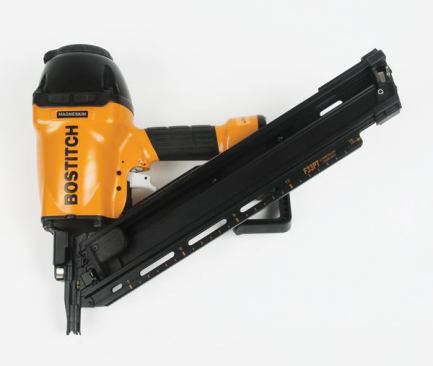
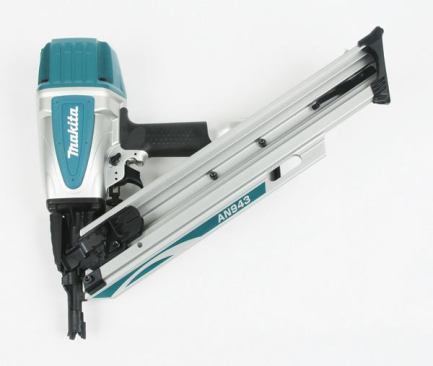

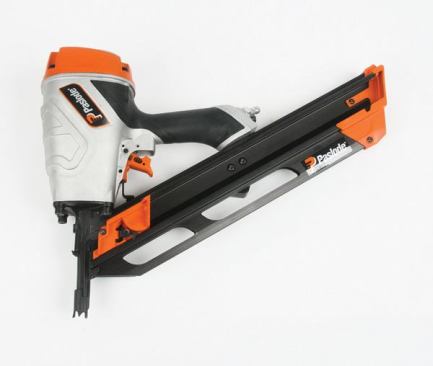


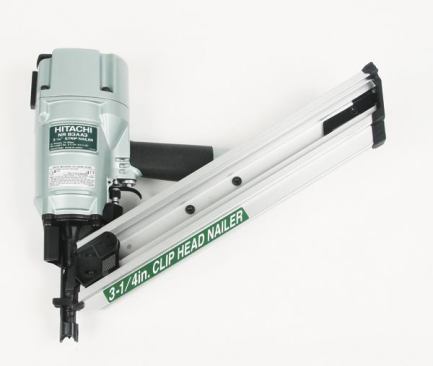
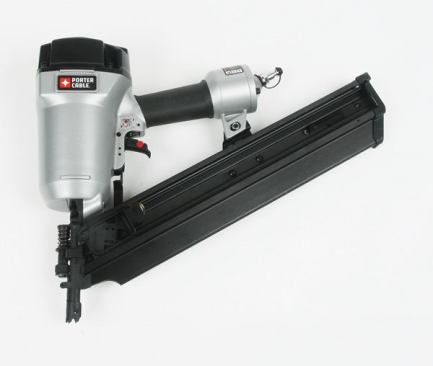
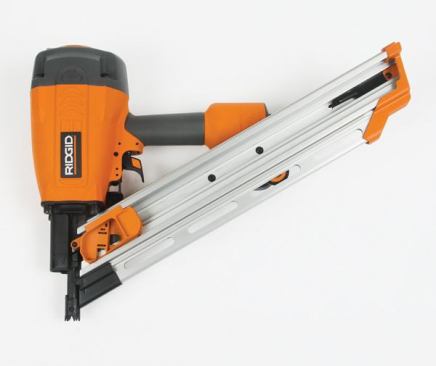
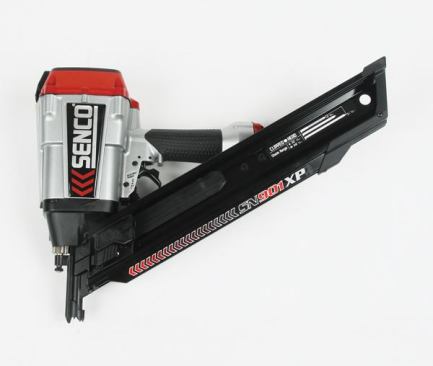
The SN350-34C is one of our favorites, a powerful gun with a sli…
Toenailing
How well a gun toenails depends on how effectively the teeth on the tip engage the wood and whether you can place nails accurately. We got a sense of this from using the tools and from performing a test in which we marked the ends of some 2x4s and tried to hit those marks while toenailing. All of the tips grab pretty well; the ones where the teeth flare out grab the best. I particularly like toenailing with the Bosch, because the fine teeth really grab and the slimmer-than-normal piston housing provides a good line of sight to the tip (though it takes some practice to place the fastener where you want it). The Paslode is very good at toenailing, but the DeWalt and Senco are less so, because they don’t grab as well. The Ridgid gun has poor visibility and tends to leave nails proud when toenailing.
Size and Weight
Other things being equal, small and light is better than big and heavy.
A small gun is more maneuverable in tight quarters and a light gun is easier to handle, especially overhead. The guns we tested average about 8 pounds apiece, but there is a significant spread between the high and low, with the Makita weighing in at 9.3 pounds and the Max at 7.2 pounds.
Lighter guns do tend to have more recoil than heavy ones. It was not a major issue with any of the tools we tested, though we did notice more of it with the Ridgid and Senco.
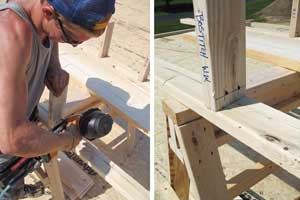
To test the nosepieces, the crew marked short studs and then used the nailers to toenail them (left) to a plate. The best guns gripped well and placed the nails close to the original marks.
Size is as important as weight, though it’s harder to define because there are so many dimensions to consider. When I say a gun is compact,
I am referring primarily to its top-to-bottom height, because that dimension determines the ease with which it can be used sideways in narrow framing bays. The Max and Senco are significantly shorter than average. Their short stature makes them look wider in front, but it didn’t affect our line of sight.
Features
Certain features can enhance the usability of the framing gun – for example, a board hook, dry-fire lockout, or a depth-of-drive mechanism that is particularly easy to adjust.
Board hook. About half of the guns in this test come with board hooks, a feature that allows the user to hang the tool from a sawhorse or nearby framing member. The better board hooks are fully adjustable (they pivot to different positions) and large enough to fit over thick material like 2-1/4-inch I-joists. I like the Paslode and DeWalt hooks the best because they pivot freely and will fit over thicker framing material. The hooks on the Grip-Rite, Makita, and Ridgid models only fit 2-by material. Makita’s hook fits a little too tightly on the board and adjusts to only two positions.
Magazine. Framing guns load from the top or the rear. I have a slight preference for rear-loading models because they seem to have fewer problems with the paper-collated fasteners we normally use. With a rear-loading gun, you put in the nails and pull the follower back until it just catches the back of the clip. With a top-loading gun, you pull the follower all the way back (until it catches), drop in the nails, and then release the follower, causing it to slam into the fasteners from behind. The force of the follower striking the nails is sometimes enough to damage the collation (especially if it’s wet) and cause the gun to jam. I like the Bosch magazine because it has a quick-release lever that allows you to remove it without tools when you need to get at jammed nails.
Tool Specifications
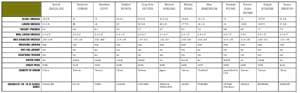
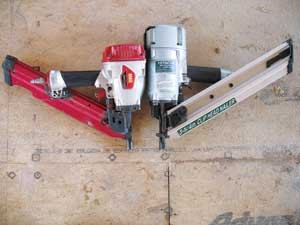
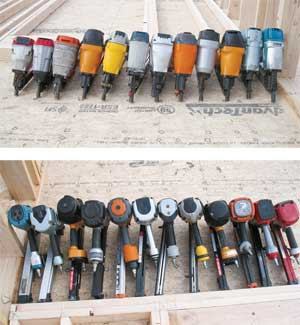
Makers like Max and Senco have shortened some of their guns to make them easier to maneuver in narrow framing cavities; you can see the difference in size in the top photo (the Max gun is on the left). The author lined up all the tools to get a sense of their relative bulk. Viewed from the front (below) from left to right are the Max, Senco, Paslode, Bostitch F33PT, DeWalt, Bosch, Grip-Rite, Ridgid, Porter-Cable, Bostitch F28WW, Hitachi, and Makita. Viewed from the back (very bottom), the order is reversed.
Firing modes. With most of these tools it’s possible to switch between the bump-fire and single-shot modes by flipping a switch on the trigger. With the Bostitch, DeWalt, and Grip-Rite guns, changing modes requires the installation of a different trigger (which usually comes with the gun). Either method of getting to bump-fire is fine by me; there is no advantage to being able to go back to the single-fire mode.
Of greater importance to me is whether or not the gun has a dry-fire lockout mechanism. A dry-fire lockout prevents the gun from firing when empty and usually kicks in when there are three or four nails left in the magazine. Longtime carpenters recognize the sound and feel of a gun firing empty, so this mechanism may not make much difference to them. But it’s helpful for less-experienced crewmembers who might not notice that they are firing blanks and continue to nail things up only to have them fall down or end up improperly fastened.
Depth-of-drive mechanism. Tool-less depth-adjustment mechanisms have come to be standard on framing guns. Most rely on a thumbwheel (under the trigger or on the nose) to extend and retract the contact element. The mechanisms on the DeWalt and both Bostitch models are activated by a push-button on the nose. I particularly like this design because it’s quick and easy to use. On the Bostitch F33PT, the push-button can also be used to detach the standard tip and replace it with one suitable for attaching metal framing hardware.
The Hitachi gun does not have adjustable depth-of-drive, but it was one of the better guns in terms of its ability to drive nails flush.