There are two ways to access the interior, through a door on the…
There are two ways to access the interior, through a door on the right front side of the trailer and via the ramp door on back. Hokel removed the ramp cable from the right side of the trailer. This made it easier to enter and exit the trailer (can walk off the side of the ramp) without making it that much harder to open and close the ramp.
Bruce Hokel
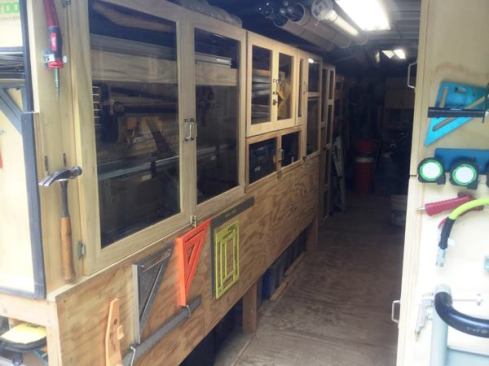
Along the left rear side of the trailer is console that is divid…
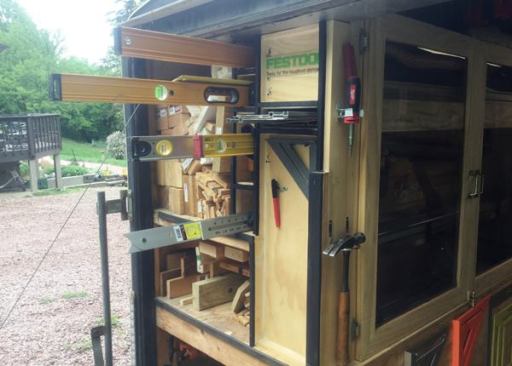
Along the left rear side of the trailer is console that is divided into cubbies. The large upper cubby at the side of the trailer can hold lumber up to 8 feet long. The cubby below that is only 5 feet long and is used to store scrap. The smaller inboard cubbies house 4-, 6-, and 8-foot levels, along with an adjustable 3/4/5 square. Note the horizontally oriented cubby just below the Festool sign. Built to house track saw rails, it is a hollow box that passes through a cabinet. From the inside of the cabinet it looks like an overly thick shelf.
Bruce Hokel
The space below the lumber cubbies contains a metal brake and sh…
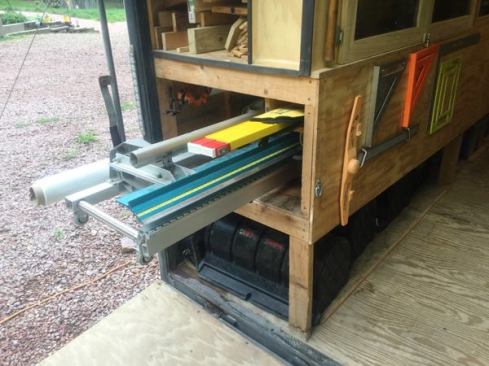
The space below the lumber cubbies contains a metal brake and shelves for a 10-foot Stabila Plate Level and other long items such as pipe clamps and drywall bead. The brake is set up like a stretcher: pull it out and the legs will swing down a pair at a time. Lock them in place and you are ready to roll the break to wherever it is you’ll be using it. To put it away, simply reverse the operation.
Bruce Hokel
The console stops short of the floor, and the space below is use…
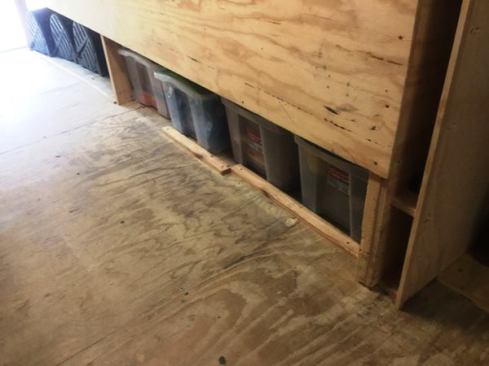
The console stops short of the floor, and the space below is used to store are plastic bins containing extension cords, PVC electrical boxes, and collated nails. Those black things near the ramp are Coil Tamers, hinged plastic containers that hold and dispense the coil stock for the brake. They keep the stock tightly coiled and prevent it from being damaged—and they won’t fall apart like the cardboard boxes.
Bruce Hokel
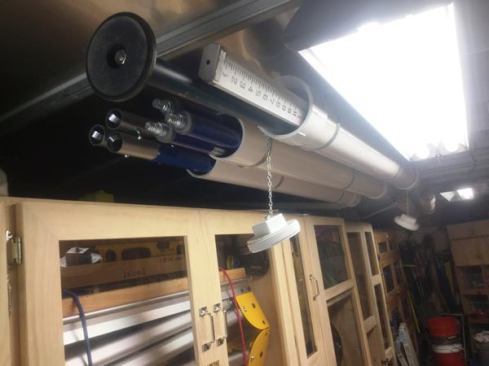
Pipes on the ceiling are used to store a surveyor’s rod and se…
Pipes on the ceiling are used to store a surveyor’s rod and sections of handle for use with concrete floats.
Bruce Hokel
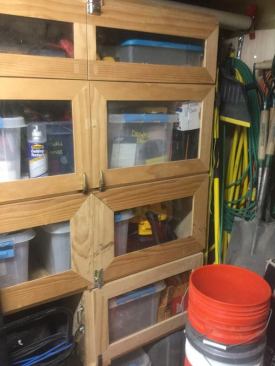
To make easier to find tools, Hokel put clear acrylic panels in …
To make easier to find tools, Hokel put clear acrylic panels in the doors. Doors are held closed with RV style latches, ball catches, or slide bolts—to keep them popping open when the trailer is in transit.
Bruce Hokel
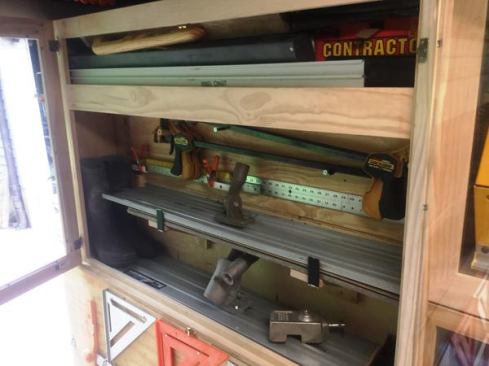
The first cabinet in contains magnesium bull floats, 36-inch cla…
The first cabinet in contains magnesium bull floats, 36-inch clamps, and an assortment of other long items.
Bruce Hokel
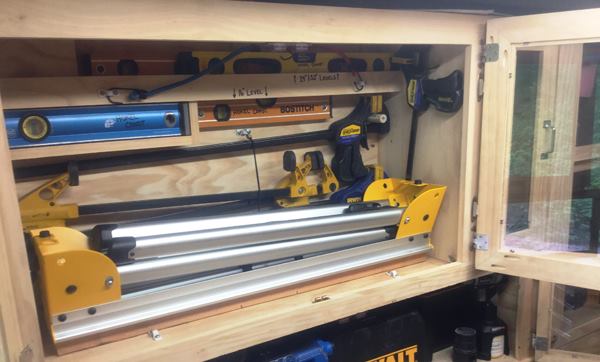
The next cabinet in has two saw horses, some smaller levels and …
The next cabinet in has two saw horses, some smaller levels and 4-foot clamps. From the inside of the door you can see that the joints are mitered and held together with pocket screws. The acrylic panels are held in place with the kind of glazing points used to hold glass in old-fashioned—glazed windows. Note the white clips at the bottom front and back upper wall, which are used to tie/secure tools in place.
Bruce Hokel
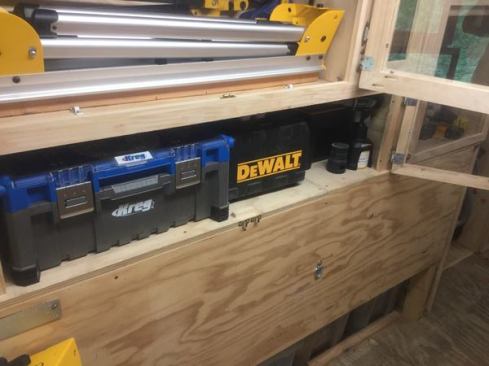
The Kreg Toolboxx and other tools live in the cabinet below the …
The Kreg Toolboxx and other tools live in the cabinet below the sawhorses. Note the ball catch fittings (to hold the doors closed) just below the shelf.
Bruce Hokel
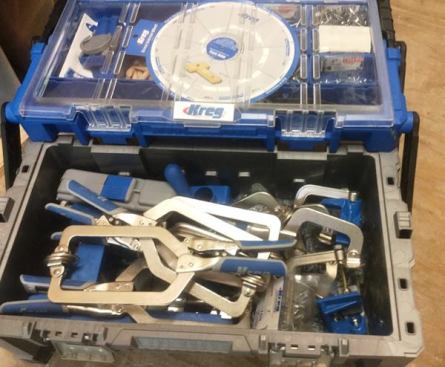
The Kreg Toolboxx costs $65-75 and comes with an assortment of 1…
The Kreg Toolboxx costs $65-75 and comes with an assortment of 1,000 plus pocket screws that store in compartments on top. The upper section opens in the manner of the Keter tool boxes to expose a storage area below. The tools and clamps shown here were purchased separately from the box.
Bruce Hokel
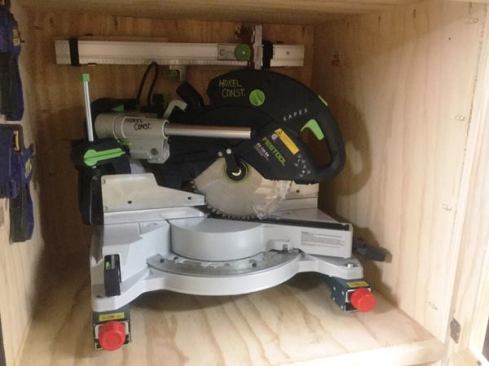
This Kapex is one of two miter saws stored in the trailer; the o…
This Kapex is one of two miter saws stored in the trailer; the other’s a DeWalt. Both tools are fastened to brackets that allow them to be quickly attached and detached from a Bosch Gravity Rise Stand. A taller compartment directly below holds a Bosch table saw on a second Gravity Rise Stand.
Bruce Hokel
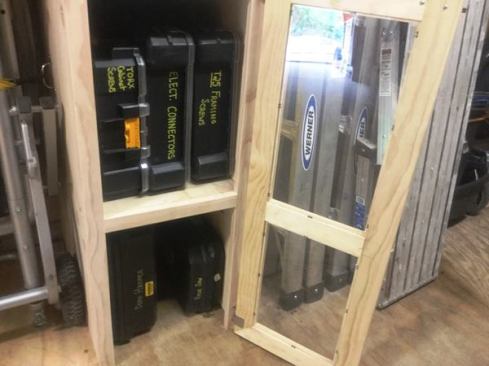
A demo hammer and recip saw store in boxes below; the upper shel…
A demo hammer and recip saw store in boxes below; the upper shelf houses DeWalt Deep Pro organizers containing removable bins of electrical connectors and screws. The organizers are modular and can be clipped one to another and carried by a single handle. The wheel on the left is from a Bosch Gravity Rise Stand and table saw.
Bruce Hokel
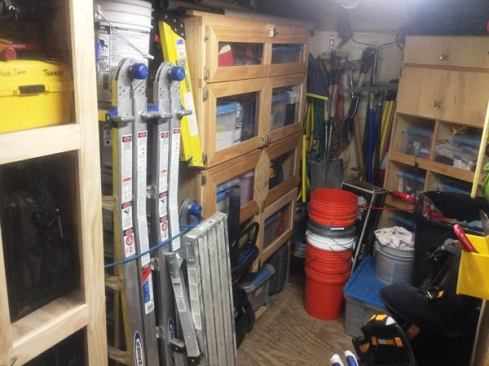
The space between the console and attached cabinets is occupied …
The space between the console and attached cabinets is occupied by several ladders—held in place by bungees so they won’t fall out in transit
Bruce Hokel
Miscellaneous items are stored in a separate cabinet near the fr…
Miscellaneous items are stored in a separate cabinet near the front of the trailer. As with the other doors, these have mitered frames held together with pocket screws. The acrylic panels are secured by glazing points.
Bruce Hokel
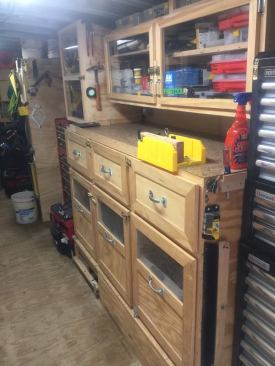
This was shot from several feet in from the ramp and shows a cab…
This was shot from several feet in from the ramp and shows a cabinet, countertop, and two large mechanics tool chests.
Bruce Hokel
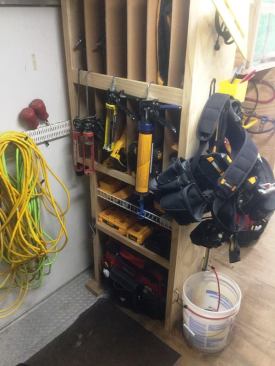
Shot near the front right side of the trailer, the vertical slot…
Shot near the front right side of the trailer, the vertical slots in this unit hold cordless tools (lower) and pneumatic nailers (upper). The cords to the left are hanging from the back of the side door of the trailer. Note the old fashioned window lift hardware and bungee used to keep the drywall bucket from sliding around.
Bruce Hokel
An air compressor is installed below a cabinet on the right side…
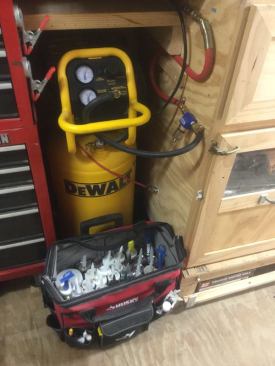
An air compressor is installed below a cabinet on the right side of the trailer. The flexible line contains a water filter, and connects to a copper line that runs to the back of the trailer.
Bruce Hokel
The trailer has RV plugs on either side, which can be connected …
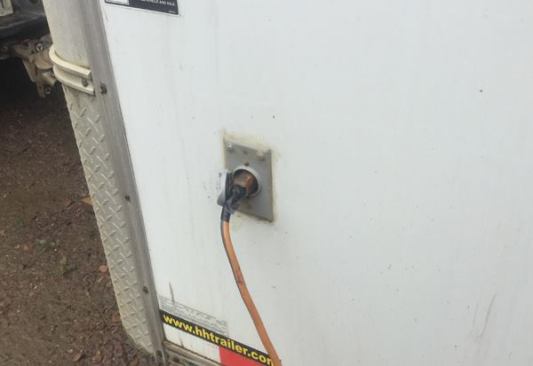
The trailer has RV plugs on either side, which can be connected an AC power source or generator. The interior of the trailer is wired with 12-gauge wire in plastic conduit.
Bruce Hokel
The cabinet above the counter contains a selection of fasteners,…
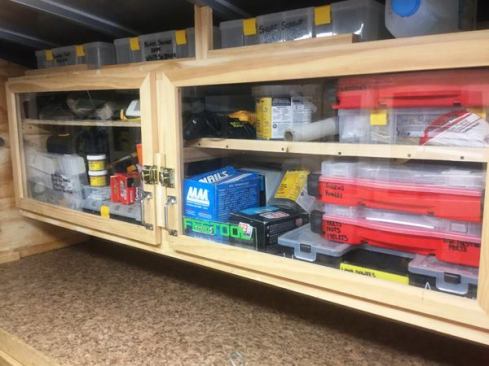
The cabinet above the counter contains a selection of fasteners, hardware, and supplies—many of which are housed in compartmentalized organizers.
Bruce Hokel
The drawers below the counter contain a variety of tools; this o…
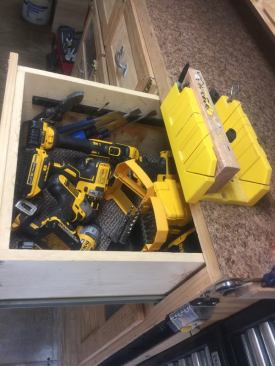
The drawers below the counter contain a variety of tools; this one is devoted to DeWalt 20V MAX tools and accessories.
Bruce Hokel
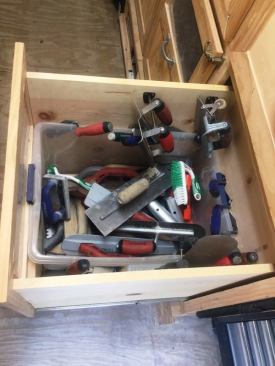
The next drawer down holds some of the floats, trowels, and edge…
The next drawer down holds some of the floats, trowels, and edgers used for concrete and masonry work.
Bruce Hokel
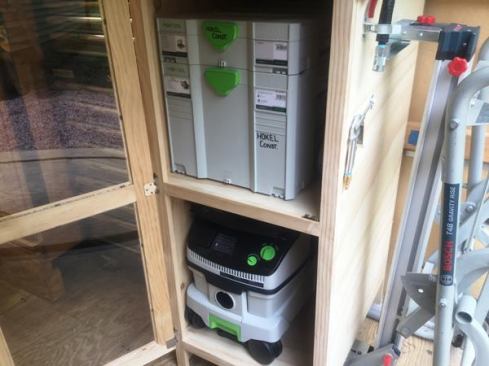
A tall narrow cabinet at the right rear end of the trailer house…
A tall narrow cabinet at the right rear end of the trailer houses a Festool dust extractor, track saw, and a Systainer filled with accessories.
Bruce Hokel
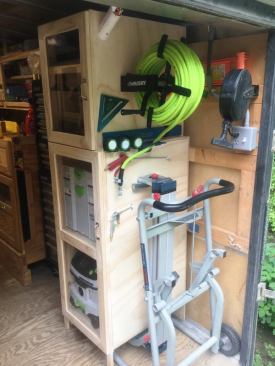
Air is supplied to the hose reel by the copper line that runs fr…
Air is supplied to the hose reel by the copper line that runs from the compressor seen in an earlier slide. The cord reel plugs into one of the receptacles next to the switch for the trailer’s overhead lights. Additional receptacles are spread throughout the trailer. The dolly-like device on the floor is the Bosch Gravity Rise Saw Stand Hokel uses to support miter saws.
After posting a story about a tool trailer modeled on one built by Ron Paulk (Andy’s Amazing Tool Trailer) I received an email from Bruce Hokel about the trailer he outfitted for his construction business.
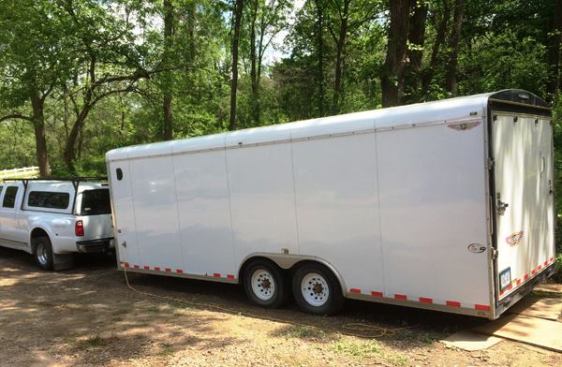
The trailer is Hokel’s “home base” during big builds, a 22-foot V-nose that has been turned it into a tool crib and supply house on wheels. It has 6,000-pound torsion axels with a ramp in back and a 36-inch door on the right front side. The trailer is designed for transport and storage and is not intended to be used as a workspace. The idea is to set up for work in the building or just outside the trailer—though the trailer can also serve as shelter. According to Hokel, he and his crew have weathered many a rain shower perched on upturned buckets just in from the ramp. As soon as the rain stops they can roll out their tools and get back to work. On large projects the trailer might be left on site, though more typically it would be hauled to and from the jobsite every day.
The design of the interior is similar to that of trailers we have covered in the past, but a few things stand out. The doors on many of the storage cabinets have Plexiglass (clear acrylic) panels so it’s easy to see what’s inside. And Hokel created dedicated spaces for hauling a metal brake and a small supply of lumber and scrap. Most of the trailers we’ve covered are 14 feet long; this one is 22 feet long, so it can carry a lot more.
Hokel is a GC in Sioux City, Iowa who specializes in concrete flatwork and masonry. He stopped building entire homes (too much stress) but still builds garages, additions, and other structures. His company also installs doors and windows. He owns skid steers and other equipment, but the trailer is his pride and joy. The company name is not painted on the side and yet the trailer still serves as advertising. People walk by and see what’s inside, and think “anyone who can keep things this well-organized is probably worth hiring.”