Most tradespeople I have met, and all true professional ones, are always looking for ways to get better at their job, whether “better” means tighter joints, more resilient structures, or finer finishes. We search out and share techniques and test what performs best. Coping a perfect joint in crown molding and producing consistent, sound, and straight walls are fantastic goals, but if those tasks take you twice as long as they should or create undo stress on you and those you work with, you will not have a successful career. While the work or product you provide must be good, how you get there must also keep improving. That “how” is the efficiency in performing the task.
When I was putting together ideas for this article, I reached out to contributing editor Mark Clement to compare thoughts and share techniques that have worked for us over the years. One of his first points was that “efficiency” isn’t a result so much as it is a goal or a mindset. Precise layouts, tiles with no lippage, smooth and flat walls: These are results based on acquired skill.
Efficiency is a look at the overall process of the work and what things you could be doing better.
Efficiency is usually measured in terms of time on task, but it is also a feeling. When a process is efficient, it is smoother, and you expend less mental and physical effort to complete the task. Creating this efficiency mindset can start with adopting small improvements that you then build on. The goal is to shed the unnecessary in your workflow so you can focus on the task.
Trash Can
Marc Forget
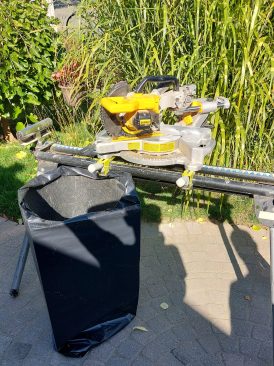
This bin, a yard-bag insert inside a garbage bag, stores flat and takes up little space in the van.
Mark. A person’s relationship with trash and debris can be telling. Ask any building inspector and they’ll tell you that when a jobsite looks like a bomb went off, they’re extra vigilant for hijinks and missing pieces. Having a trash can at the workstation and using it is a first, small step. If I must clear a Stonehenge of scraps off the table or saw, I am not making progress, I am just moving stuff around. That is wasted effort.
Marc. When I set up my work area, I set up the garbage bag right there with it. Start as you mean to carry on. Throw scrap out immediately after cutting, all in the same motion. Clean up throughout the day, not just at the end. Clearing off a place to work is unnecessary mental and physical effort that not only takes time but also distracts me from what I am doing. Thinking about trash is not on task, so not dealing with a mess in my workspace is a start to reducing distractions. For me, a messy jobsite causes stress. I feel out of sorts and have a harder time focusing. Distraction wastes time and wears me down mentally.
If you set up your space so you can throw out trash effortlessly as you generate it, you’ll stay on task and save time cleaning later.
Vehicle and Storage
Marc. After my job evolved from carrying materials to mostly carrying tools, I worked out of a minivan for many years. Before that, I had trucks with different sliding beds and drawers. So, whether you have a truck, van, or some combination with a trailer will depend on what kind of work you do.
Marc Forget
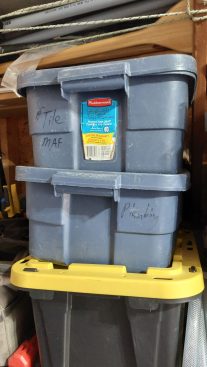
Labels save time and make easy reference for everyone on the job.
The important thing is that you configure your mobile workshop so that you can set up and tear down quickly. Tools and materials must be safe from breakage and easy to access. In my van, I built a set of shelves, hooks, and cubbies that kept all my equipment in designated spots at easy reach. At the end of the day, if a spot was empty, I knew what was missing just by sight.
I also labeled everything. Drywall trowels are in the bin marked “drywall.” Trim nails? In the case marked “Nails.” I didn’t need to think about where something was and spend time looking for it. No wasted thought, just execution. Those limits on the number of decisions I needed to make during a day added up and freed me to get on with the work.
Labeling the bins also made life easy for anyone working with me. They may not have known where to find the 3-inch screws, but if I sent them to the van to grab the case marked “Screws,” they would probably be successful. By spending time to set up these bins, labels, and groupings of tools, I saved myself and my partners time and protected my equipment investments from being misplaced or damaged.
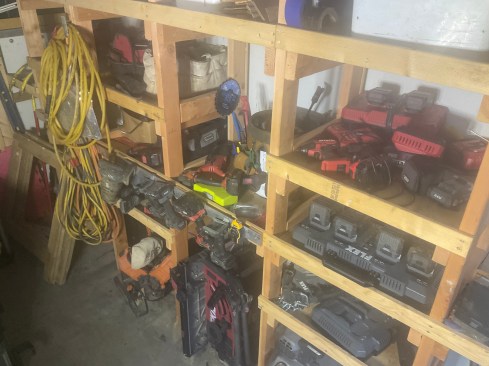
Mark Clement
Tools are easy to access and in designated places for organization.
Mark. This debate on vehicle type is endless. The only right answer is what works for you. The way to get that answer is to explore all the options and not default to an Econoline or pickup because that is what your boss or the other guys in the crew have.
For me, the best fit is a box truck. It’s a store on wheels. Everything I need is in it, dry and organized, and I have room to move around. The time I save from not having to go to the storage unit or dig around in the shop looking for something is significant. If you are rummaging around bent over in a pick-up or looking through a pile in the back of a van, that is time and money lost. I built shelves and a small workstation in my truck so I can turn around to see my equipment or supplies, grab what I need, and get moving.
Battery Management
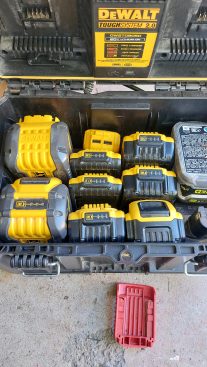
Marc Forget
At the end of day, if Marc does not have time to charge a used battery, he flips it indicator down to show it needs charging first.
Marc. Several years ago, this could have been a section on cord management, but now we live by battery power for our tools. For me, this topic also ties in with the earlier section about keeping tools and materials in their designated places, organized and ready. I reviewed my battery box in the article “DeWalt ToughSystem 2.0 20-Volt Charger” (Nov/Dec 2024). Your tools may be a different brand, but the idea is that you need to manage those batteries. They need to be charged, or you can’t work right away, and they have to be protected from the environment and from loss. By having a designated bag, box, or some sort of case, you can accomplish all of that.
The charger is with or part of the set. If you don’t need to hunt through different cases to find the charged battery or the right size, time is saved. They are in one spot and ready. In my setup, the box is full, so if there is an empty slot, I can see what I am missing. I put my initials on the batteries so they don’t get mixed up with my partners’ batteries. Batteries that I have just used go straight on charge, and I made a habit of checking at lunch to see if I need to rotate any.
Efficiency gain is small habits created and repeated. If you can create that mindset with something small like taking care of your batteries, you can apply that same mindset to other processes.
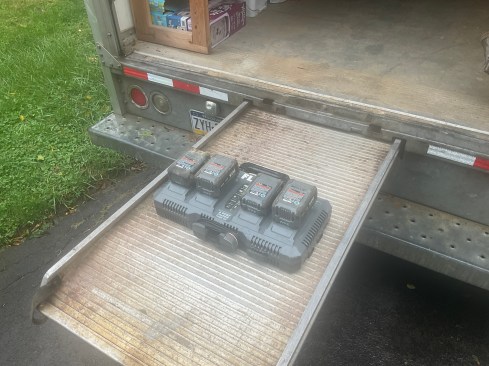
Mark Clement
One charger for multiple batteries reduces set-up and tear-down time. Small changes save time and effort.
Mark. I am frugal. This can cause pinch points and blind spots. Why would I buy a multiport charger when my tool set comes with a charger?
The answer is the hydra of charger bodies and cords and the space they take up. Untangling cords at the start and end of day was frustration I didn’t need. Then there’s the charger cluster on site that always seemed to get in my way. With the amount of deck building I do, I go through batteries fast. Being able to charge multiple batteries at once, in one organized spot, saves stress. One charger with one box of batteries also means one trip to the truck—again, time saved. It may be small stuff efficiency-wise, but it’s part of building a mindset of finding ways to do things better.
The Tool Pouch
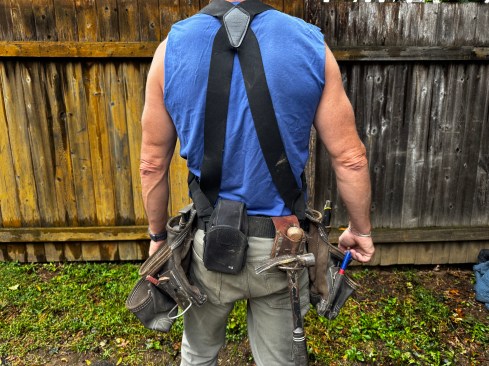
Mark Clement
Many people new to the trade find a tool belt difficult to get used to. Adding suspenders takes the weight off the hip and allow for easier movement.
Mark. I know, I know, it’s uncomfortable. But is it though? Or do you have a lousy pouch or, worse, an expensive one, and it doesn’t fit or flex? Or do you have a hardware store’s worth of stuff in there that you simply don’t need?
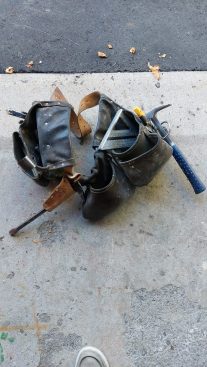
My rig is two McGuire-Nicholas leather side bags and a Dickies nylon belt. On their own, they can get uncomfortable. The solution for me is wearing a set of Perry suspenders. They carry just enough nail-bag sag, they move when I move, and they’re comfortable enough that I often forget about them and drive home wearing them. Find what works for you. I can’t hang a picture without having my frankenbelt on. Everything I need to work is at hand all the time.
Wear the bags. To put it colloquially, if I have to wait for you to get a pencil or find your tape measure because your tool pouch is uncomfortable, go home. If your business is about production—and it is, because they all are—there isn’t time for the guy to be looking for where he put this or that.
Marc Forget
Old and battered like the authors, the pouches are portable tool kits. Essentials for the task are in easy reach at all times, not scattered.
Marc. Belts have been brought up before by others talking about being organized (see “Working Smarter, Not Harder” by John Spier, Mar/Apr 2024) and are a pet peeve. I know the belt can be uncomfortable at times. After more than 20 years of wearing one (the same belt), I understand. So figure out what works for you, your work, and your body type. There will be a combination that will function for you, but it may take a few tries to find it. The point of the rig is to have what you need right where you are.
Like Mark, I can’t think of carpentry without having my belt on. The benefit is that if I need a measurement, a fastener, countersink, whatever, it is at hand. It does not become a game of tool hide and seek.
For example, you need to take and mark out a measurement. The pencil and tape are at the cut station where you were last. You fetch the items and then return to where you were. What were you doing again? Oh yes, a layout! Time was lost to the search, to mental distraction off task, and to refocus.
Get a comfortable rig, don’t burden it with more than you need, and you become a functioning part of the job instead of a tourist wandering around the jobsite looking for things.
The examples that we talked about here are all things that worked for us. For you or your crew, they could and will probably be different. Except the tool belt. That is a hill I will die on. Wear it. If I never have another apprentice to train just to watch them wandering around looking for their tape measure, I will die content. The point of the examples is to make you think about how you work.
The skills involved in framing, masonry, electrical, and so on can be improved by practice and tutorial. The way you get those tasks done can also be improved if you are open to learning and practicing. An efficient work site or solo job will take less time and effort. With that comes more money, more time for you, and an easier career.
That last bit about the career can seem a stretch, but follow my thinking here: If you are taking fewer steps, making fewer and easier lifts, and experiencing less stress, you are giving your body and mind a gift. The pay bump when you finish a job faster is nice, too. Audit what you do each day, discuss it with colleagues, and look for solutions to simplify your process. Any gain, no matter how small, is a win. The trades are problem solvers. This problem is one whose solution is all to your benefit.
Keep the conversation going—sign up to our newsletter for exclusive content and updates. Sign up for free