The days when every builder stapled 6-mil poly to the inside of every exterior wall are long gone. Experience in the 1980s and 1990s made it clear that in many situations, impermeable plastic on the inside face of a wall caused trouble rather than preventing trouble.
So in this century, codes have evolved. And in today’s world, recommendations for what building scientists are now calling the “vapor control layer” have become considerably more refined. Depending on the climate and the other materials involved in the wall or roof assembly, a designer could choose to specify either an impermeable material, a semi-permeable material, or a vapor-open material on the inboard side of the assembly.
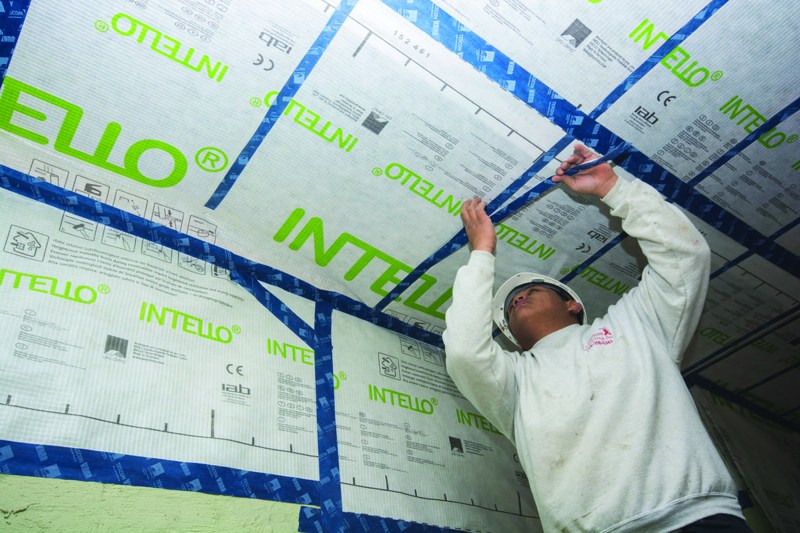
And for tricky situations, builders now have a new class of materials to work with: the so-called “smart” or “intelligent” vapor retarders. Several products in the market today have “variable permeability”—they are relatively vapor-closed when exposed to air that is relatively dry, but become increasingly vapor-open when exposed to more humid air. CertainTeed supplies a smart vapor barrier called MemBrain. ProClima manufactures two smart vapor barriers, trademarked Intello and DB. And Cosella-Dorkin has plans to introduce another product—trademarked Delta-Sd-Flexx—in this class to the U.S. market next year (along with a reinforced version of the material called Delta-Novaflexx).
But you don’t necessarily need to buy one of these advanced membranes to achieve variable vapor permeability. The Kraft-paper facing on old-fashioned fiberglass batts also has variable permeability: Like MemBrain or Intello, the facing opens up in humid conditions and closes down in dry conditions. But the range of permeability shown by Kraft facings is narrower than the range achieved by materials designed with that characteristic in mind. So depending on the conditions, and on the performance requirements, choosing a smarter membrane may be a smarter move.
If you want to use these materials correctly, however, it helps to understand how they work. And while suppliers are enthusiastic about their products, they’re not always clear about how, when, and why the materials change permeability in service. In the field, you may hear salesmen as well as contractors offering a whole grab bag of unscientific theories.
Contrary to what you may hear, this class of vapor barriers is not a one-way gate that lets vapor pass through in only one direction. Vapor diffusion through a smart membrane, like vapor diffusion in still air, moves from more humid to less humid: The water vapor on the humid side of the membrane moves through the material into the air on the dry side. If the humidity conditions reverse—if the vapor drive changes direction—so does the direction of vapor diffusion.
Products on the market today also don’t have “active vapor transport.” That term refers to materials that can move vapor through the material against the direction of vapor drive—what you might call “uphill”—when a voltage is applied to the material. That might be a useful property in a membrane, but that’s not what MemBrain or Intello do.
And smart vapor barriers also don’t necessarily “open up” in summer and “close down” in winter. If summer conditions are humid and winter conditions are dry, that is what will happen; but if humid indoor conditions should happen to occur in winter—say, because the membrane is installed next to a humid bathroom—the material will become vapor-open and let moisture through. That could create problems in the wall.
And despite the nickname, smart vapor barriers don’t “sense” moisture. They’re not really intelligent. They don’t have a brain, or even a nervous system. They just undergo a physical change when the material absorbs moisture from the environment, allowing a greater number of water molecules to migrate through the material at a faster rate.
In the case of wood-fiber-based materials such as Kraft paper or ProClima DB, this material change is related to the way water vapor bonds to cellulose fibers. Once the paper has reached “fiber saturation point,” vapor doesn’t stick to the fibers, but passes more readily through. MemBrain, which is a “polyamide” (nylon) film applied to a reinforcing material, and Intello, which is a specially tailored plastic composed of polyethylene blended with a softer “copolymer,” behave a little differently from paper. But the effect is the same: As more vapor is deposited on the material and absorbed into it, the pathways that water follows to diffuse through the material become more open, allowing a faster rate of diffusion.
How open the material gets under humid conditions, and how closed it becomes under dry conditions, varies from brand to brand. So does the shape of the “vapor curve” that defines the material’s permeability across the whole range from zero to 100% relative humidity. Matching the material to the situation based on that profile is an art, and the choice of material will typically depend on the requirements of the building design, as well as on the project’s budget.
Kraft paper is the “poor man’s smart vapor barrier,” as Vladimir Kochkin, Director of Applied Engineering at the Home Innovation Research Labs, phrased it recently. In many cases, Kraft-faced batts in a wall are a cheap way to take that wall out of the condensation danger zone—as Kochkin and his colleagues have shown in test wall assemblies at the lab’s Maryland facilities.
But in more challenging cases, builders may want to step up to an engineered material with a known vapor-permeability curve. For example, Canadian builder Doug Tarry turned to MemBrain to solve a basement moisture problem where condensation was occurring on a code-required poly vapor barrier on the inside of a finished basement stud wall. Using MemBrain on the upper half of that wall let the stud cavities dry into the basement as needed, but kept interior basement moisture from traveling into the wall.
Building scientist John Straube, who consulted with Tarry on what Tarry is now calling the “Optimum Basement Wall,” said the smart material really solved a building official problem, not a building science problem. Straube said he would have preferred using rigid foam in the wall assembly. Straube also prefers exterior foam insulation to smart vapor barriers as a solution to condensation concerns in above-grade wood stud walls. But the MemBrain did solve Tarry’s problem, just as it could solve above-grade moisture problems if a builder has other reasons not to use foam.
For other situations, builders may prefer to spec Intello because of its wider range of response. Based on industry data, Intello closes down tighter than other products in dry conditions and opens up wider in humid conditions—which may be required in some cases to sufficiently prevent wall wetting and allow wall drying. If you’re in a situation where the difference between Intello and MemBrain is significant, however, you’d be well advised to have an expert analyze your assembly using an advanced simulation software such as WUFI, to give yourself some confidence that the results are going to be what you intend.