
Setting the Rail Cars
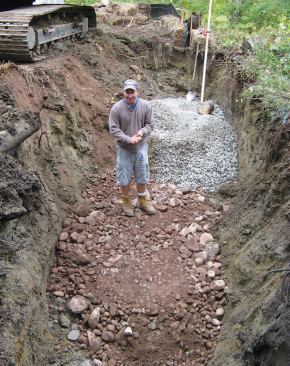
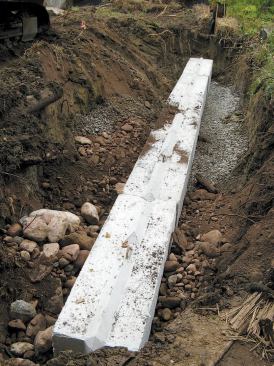
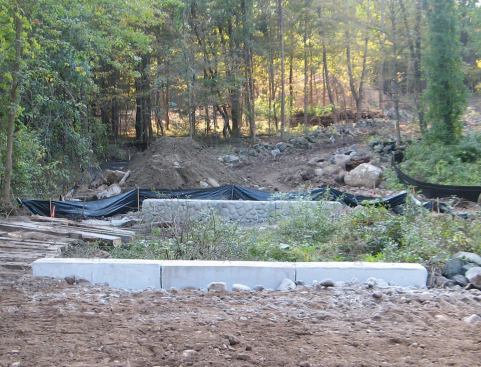
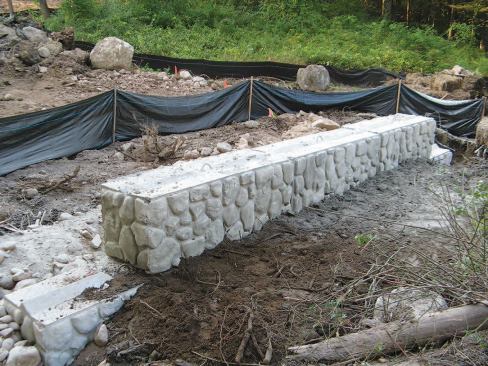
Intelligent reuse of old railcar beds enabled the author to con…
On the day we placed the bridge, an all-terrain crane was set up on the site and the truck carrying the bridge backed into place. We used the cargo tie-down hooks on the bridge to lift the two rail-car sections — each of which weighed approximately 11,000 pounds — and placed them side by side, so that angle brackets welded to the ends of the rail-car sections rested on rubber pads on top of the abutments.
We were pleased to find that the positioning of our abutments was accurate enough that the bridge did not need any shims. After the position of the bridge was verified, we fastened the welded angle brackets to the abutments with expansion anchors, and the two rail-car units were welded together from beneath at the quarter points, using steel angle provided by the bridge company. This part of the job went very quickly: The crane charge was $2,600 for about three hours at the site, but hoisting the bridge into place took only about an hour.
Finishing Up
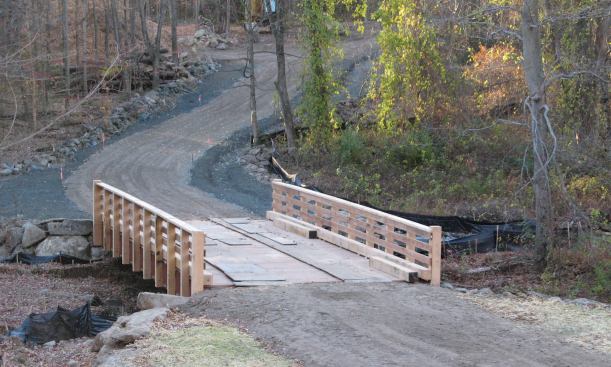
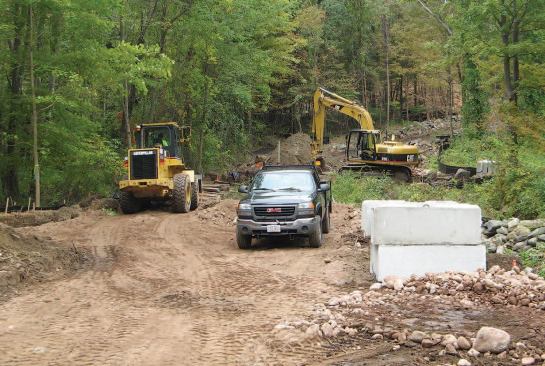
With the bridge itself in place, we built up the approach ramps, using some of the abundant boulders found on the site to line their sides. We didn’t put the final decking on the bridge until we had backfilled the opposite side ramp. While this limited the bridge’s load capacity somewhat, it allowed us to use the structure for construction equipment without damaging the final wood decking.
After the driveway was finished, my carpenters installed the decking and rails. The posts for the rail were locally milled red oak 6x6s and 8x8s, which were predrilled using a template and fastened to the bridge brackets with galvanized bolts. I added an 8×8 curb to help prevent vehicles from striking the rail.
In order to highlight my development project, I arranged for a local paper to cover the installation of the bridge. They thought it was an interesting event and featured it on the cover. The bridge has become a minor landmark in town and has succeeded in creating an upscale image for the building lots.
Paul Huijing owns Paul Huijing, Inc., Construction & Engineering in Wilbraham, Mass.