
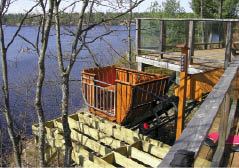
Waterfront property never goes out of style, and everyone likes a spectacular building site perched on high ground. But put the two together, and you need a safe and convenient way to go back and forth between them.
For some homeowners, the solution is what’s variously known as a hillside elevator, tram lift, or hillside lift – essentially a wheeled elevator that rides on rails. (It’s also sometimes referred to as a “funicular,” although technically that label is reserved for a two-track system in which the weight of a descending car is partially counterbalanced by another being drawn upward.) A handful of companies in North America install such systems, including Bracebridge, Ontario–based Inclined Elevation, which claims to have dozens of satisfied clients throughout eastern Canada.
Company owner John Weinstein – a former University of Mississippi professor of particle physics – reports that the most challenging system he has installed was over 200 feet long and inclined at a jaunty 57 degrees from the horizontal. Even steeper inclines are negotiable, he says – though, he adds, “we don’t like to exceed 90 degrees.” According to Weinstein, a basic lift with 100 feet of track installed within easy working distance of the company’s base of operations costs about $60,000, plus $500 or so per year for maintenance and inspection.
That may seem like a lot, but owners of building sites that can benefit from these systems tend to have deep pockets. And the conventional alternative to a hillside elevator – a long, steep run of outdoor steps, perhaps the equivalent of 10 stories high – isn’t exactly cheap either. Weinstein claims that stairs generally cost somewhere between a third and half as much as an elevator, and have a shorter service life. And, of course, stairs have another disadvantage: “If you have them,” Weinstein points out, “you have to walk up and down them.” – Jon Vara