
Fusing and Pulling the Pipe
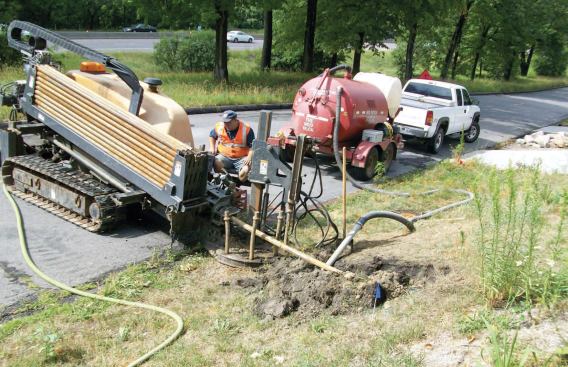

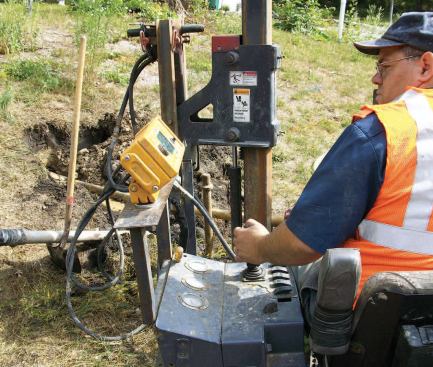
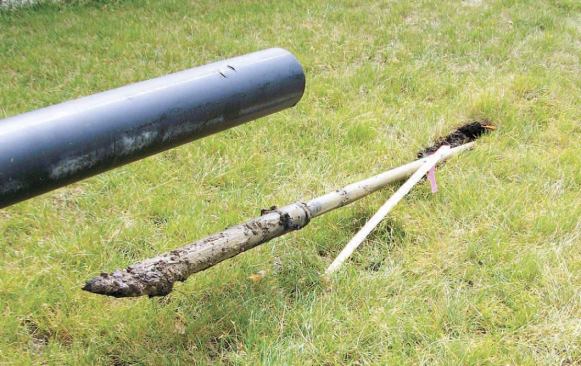
Horizontal boring to install drainage pipe proved a more cost-ef…
Joining the pipe sections with fittings would greatly increase soil resistance, so instead they’re welded together with a pipe-fusing machine that heats the sections and presses them together.
First a section of pipe is loaded into each end of the welder and clamped in place, then a hydraulic ram forces the ends into a cutting blade that reminded me of a two-sided deli slicer. The “facing” blade shaves off a thin layer of material to provide a clean surface and ensure that the ends of the pipe will line up perfectly with one another. Next, the blade is replaced with a heating element, and both sides of the pipe are heated up simultaneously to about 500°F.
Finally, the two sections of pipe are pressed together with 300 pounds of force and held there until the melted plastic cools. Because 100 feet of 8-inch HDPE weighs 800 pounds, I had to use my truck to pull the pipe into position after the last weld was completed.
Back-reaming and pulling. Given the heavy clay soil, the excavators decided to smooth and enlarge the borehole with a back-reaming bit as they pulled the pipe through it. This was a matter of screwing a sleeved pipe puller to the HDPE pipe, then mounting the reaming bit ahead of it with a swivel coupling. With everything in place, the boring machine was put in reverse to draw the pipe back down the borehole. The maneuver went off without a hitch, and we were in business.
Finishing Up and Counting Costs
Installing the catch basins was easy. We cut back the 8-inch HDPE a bit in order to get the right elevation, then used 8-inch corrugated pipe to attach the basins to one another. We tried to pick the naturally lowest areas for the location of the basins, but to ensure maximum water drainage we dug back another few feet around each basin and sloped the ground toward each basin even more.
Where the pipe met the road, we put down landscaping fabric and covered the area with rock. The city engineer also required us to put 2-inch foam under the fabric and rock, because the water main was located 8 feet directly below the area, and he was worried about freezing.
The bottom line. Our final costs for the project were as follows:
- $1,000 in engineering fees
- $2,000 for directional boring
- $800 for 100 feet of 8-inch HDPE pipe
- $200 rental fee for fusing machine
- $500 for basins and landscaping
The final tally of $4,500 turned out to be just about half what we would have spent to do the same job according to the original site plan. I wouldn’t hesitate to use this approach again if a similar situation comes along in the future.
Mark Petersen is co-owner of Access Builders Corp. in Shakopee, Minn.