
Fast Jack Rafter Layout and Cutting

2 MIN READ
A pool-house renovation I recently worked on gave me the opportunity to demonstrate this method on a small scale. My company added a second floor and hip roof to an existing one-story pool house. The 7:12-pitch hip roof is framed with 2x6 common and jack rafters on 16-inch centers and with 2x8 hips and ridge. At the birdsmouth, I supplied the 3 ½-inch seat and for the rafter tail, a 12-inch overhang with a 2 ½-inch-high subfascia (plumb cut), which dictated the level cut at the heel.

A pool-house renovation I recently worked on gave me the opportunity to demonstrate this method on a small scale. My company added a second floor and hip roof to an existing one-story pool house. The 7:12-pitch hip roof is framed with 2x6 common and jack rafters on 16-inch centers and with 2x8 hips and ridge. At the birdsmouth, I supplied the 3 ½-inch seat and for the rafter tail, a 12-inch overhang with a 2 ½-inch-high subfascia (plumb cut), which dictated the level cut at the heel.

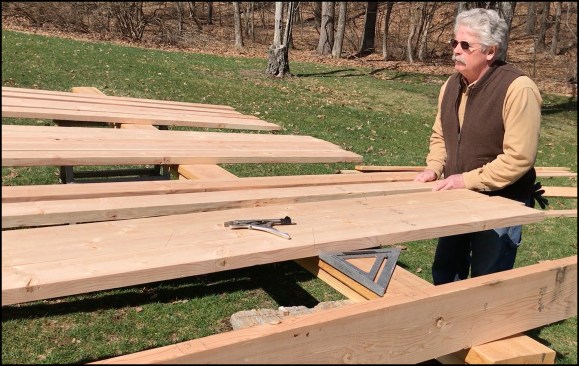
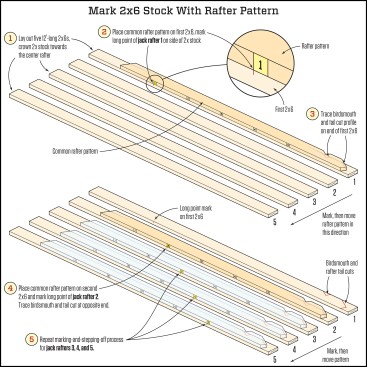
With the help of my son, Kyle, I laid out a group of five 2x6s for the jacks (one group includes enough material to frame one corner of the hip roof). To minimize any bow in the rafters, we faced the crowns of the stock towards the middle 2x6, the center rafter being the straightest one.

With the help of my son, Kyle, I laid out a group of five 2x6s for the jacks (one group includes enough material to frame one corner of the hip roof). To minimize any bow in the rafters, we faced the crowns of the stock towards the middle 2×6, the center rafter being the straightest one.
Click to enlarge

The illustration above shows the stepped-off process of marking the 2-by stock with the common rafter pattern. This process is also shown in the photos below.
The illustration above shows the stepped-off process of marking the 2-by stock with the common rafter pattern. This process is also shown in the photos below.

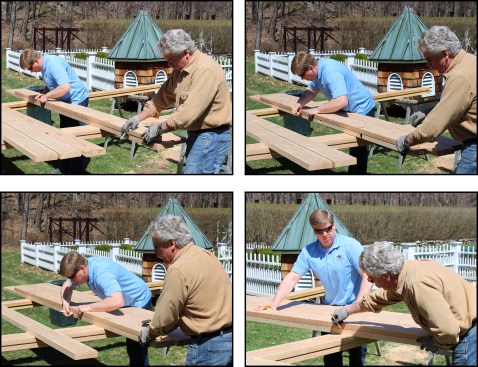
Using the rafter pattern on the first piece of 2x6 stock, Kyle marked the long point for the first jack rafter, while I traced the birdsmouth and tail cut. Moving down the line, we marked the remaining rafters. Kyle marked long point “2” on the second 2x6 (photo, top left); long point “3” on the third (top right), and so on (bottom left). I marked long point “5”, birdsmouth and tail cuts on the fifth 2x6 (bottom right).

Using the rafter pattern on the first piece of 2×6 stock, Kyle marked the long point for the first jack rafter, while I traced the birdsmouth and tail cut. Moving down the line, we marked the remaining rafters. Kyle marked long point “2” on the second 2×6 (photo, top left); long point “3” on the third (top right), and so on (bottom left). I marked long point “5”, birdsmouth and tail cuts on the fifth 2×6 (bottom right).
Click to enlarge

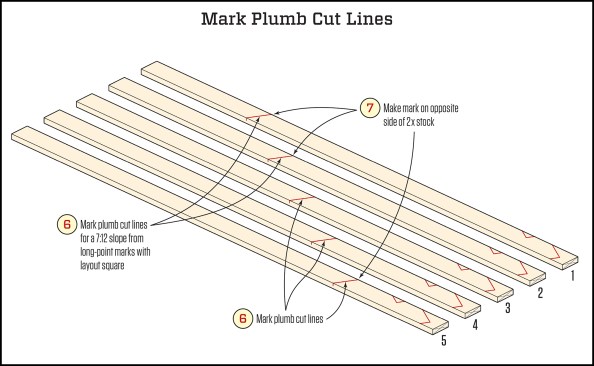
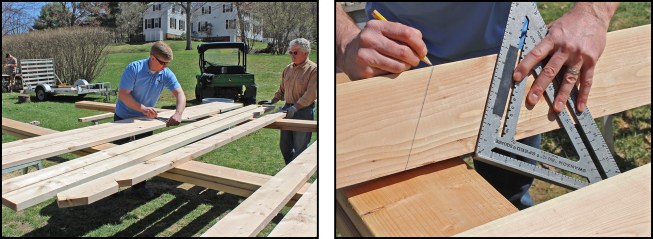
With the long points and rafter tails marked, we marked the plumb cut lines (see illustration, above). Holding a layout square at a 7:12 angle, Kyle drew lines representing the long-point plumb cuts where the jacks will meet the hip (photo, above left). He then carried those lines onto the opposite edge of the rafter stock (photo, above right), where he marked the opposite sides of the rafter so we'd be able to line them up with the short points on the rafter pattern during the next step of the layout process.

With the long points and rafter tails marked, we marked the plumb cut lines (see illustration, above). Holding a layout square at a 7:12 angle, Kyle drew lines representing the long-point plumb cuts where the jacks will meet the hip (photo, above left). He then carried those lines onto the opposite edge of the rafter stock (photo, above right), where he marked the opposite sides of the rafter so we'd be able to line them up with the short points on the rafter pattern during the next step of the layout process.

Register to download and view this article

Get your copy

About the Author

Dale Diamond

Dale Diamond is a partner with his son, Kyle, in New Dimension Construction, in Millbrook, N.Y.

No recommended contents to display.

Upcoming Events