Framing a Barrel-Vault Ceiling – Continued
The major axis was a little trickier, but treating the elliptical “hips” like regular roof hips helped. Just as a hip runs 17 inches — actually 16.97 inches — for every 12 inches of common run, so does the elliptical hip. Using a calculator, we multiplied the common run, 30 1/2 inches, by to get the hip run — 43 1/8 inches. Twice this would give the major axis of the ellipse, but since you use half the major axis to locate the focus points that allow you to scribe the ellipse, 43 1/8 was the number we needed.
Scribing and Cutting the Ellipse
We used picture-hanging wire rather than string to scribe the ellipse. We made sure to stretch it very tightly over the nail at the top of the minor axis when securing it to the nails at the two focus points. The final step was to pull the nail from the minor axis, then slide a pencil against the taut wire to scribe the curve.
Because the arch segments for the vault were 12 inches high, we needed only the top 12 inches of the elliptical arcs. This curve was flat enough to cut with a circular saw. To save time, we doubled up the plywood and cut two arches at the same time, then cut those in half to get the four hip pieces.
Putting the Pieces Together
Before building the vault, we needed to know the length of the barrel section. Again, I treated the opening as a hip roof, dividing the width of the vault in half (48 1/2 inches ÷ 2) and measuring that distance in from each end of the opening.
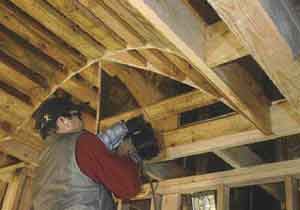
Because it was small enough to be lifted into place easily, we built the barrel — basically flat 2×4 “purlins” sandwiched between a pair of 1/2-inch plywood arches at each end — on a bench. We nailed temporary 2×4 cleats across each end of the barrel, high enough up so they would land on the top of the framing and support the barrel while we positioned it and nailed it off. This barrel was small enough for two guys to handle; we’ve framed some that took six guys to lift.
Once the barrel was up, we installed the king commons and the elliptical hips, checking for alignment with a 4-foot level.
End purlins. Though the purlins in the middle of the vault were cut square, the ones at the ends had to be compound beveled where they hit the hips. To get the miters and bevels, I simply held up a test piece where the lowest purlin would go and scribed the miter. Then I eyeballed the bevel and made the cut. After a couple of tries, I got it to fit and used a Speed Square to measure the two angles.
I knew the very top purlin would have a 45-degree miter with a 0-degree bevel, and I now knew the compound angle for the bottom piece. So, to get the angles for the rest of the purlins, I took the difference between the top and bottom angles and divided by the number of purlins. This gave me the number of degrees by which the bevel and miter angles would change as the purlins moved up the vault.
Tim Uhleris a lead framer and exterior trim carpenter for Pioneer Builders Inc. in Port Orchard, Wash.